The Ultimate Science Trivia Quiz: 100+ Fun Science Trivia Questions & Answers to Challenge Yourself
Science touches everything you do, from the coffee that wakes you up to the stars you glance at before bed. This science trivia quiz pulls together 100+ science trivia questions and answers across space, biology, chemistry, physics, and Earth science.
Whether you want easy science trivia to warm up or hard science trivia to truly test your smarts, this list has you covered. Grab a pen, challenge a friend, or just see how many you can answer without peeking.
Table of Contents
Space & Astronomy Science Trivia Questions and Answers
The universe is massive, strange, and full of surprises. These space trivia questions cover planets, stars, and the physics that holds it all together.The Ultimate Science Trivia Quiz.
Must visite:Ultimate Bible Trivia Questions: 150+ Questions to Challenge Your Faith Knowledge
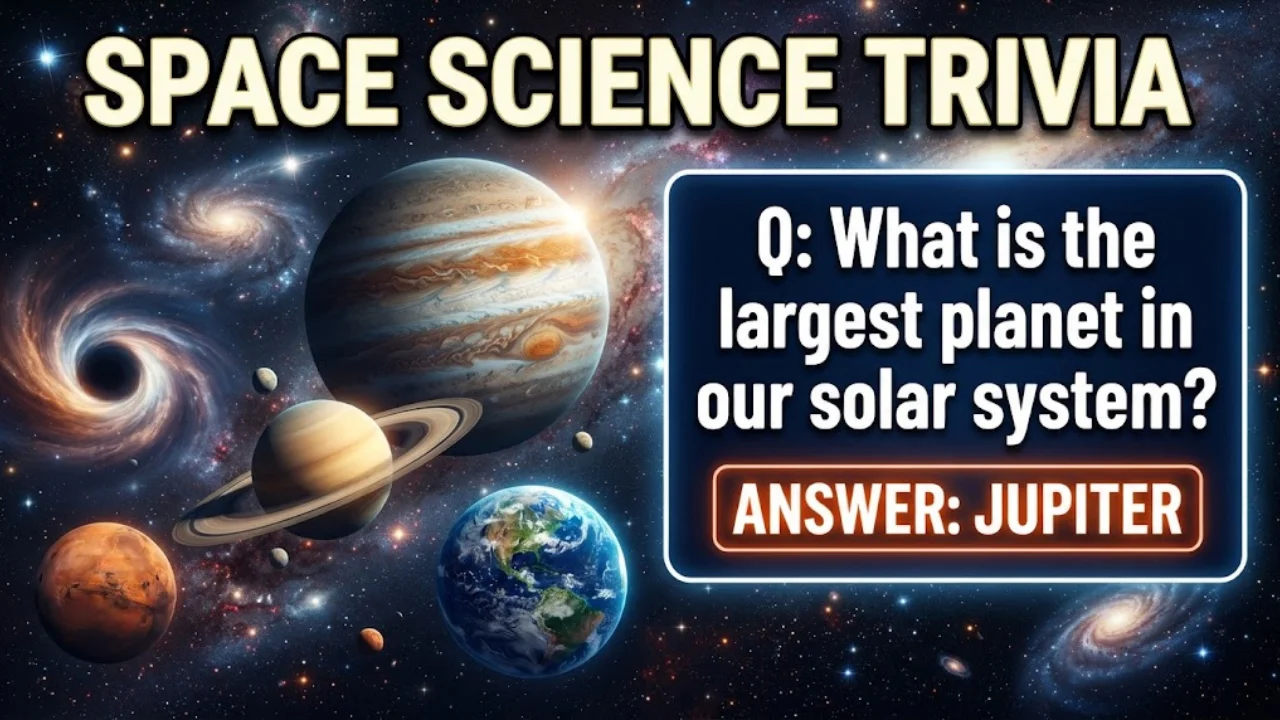
- Question: What is the largest planet in our solar system? Answer: Jupiter. It’s so big that more than 1,300 Earths could fit inside it.
- Question: Which planet is known as the Red Planet? Answer: Mars. Iron oxide, or rust, on its surface gives it that reddish color.
- Question: How long does it take sunlight to reach Earth? Answer: About 8 minutes and 20 seconds, even though light travels at roughly 186,000 miles per second.
- Question: What is the closest star to Earth besides the sun? Answer: Proxima Centauri, located about 4.24 light-years away.
- Question: Which planet has the most prominent ring system? Answer: Saturn. Its rings are made mostly of ice particles and rocky debris.
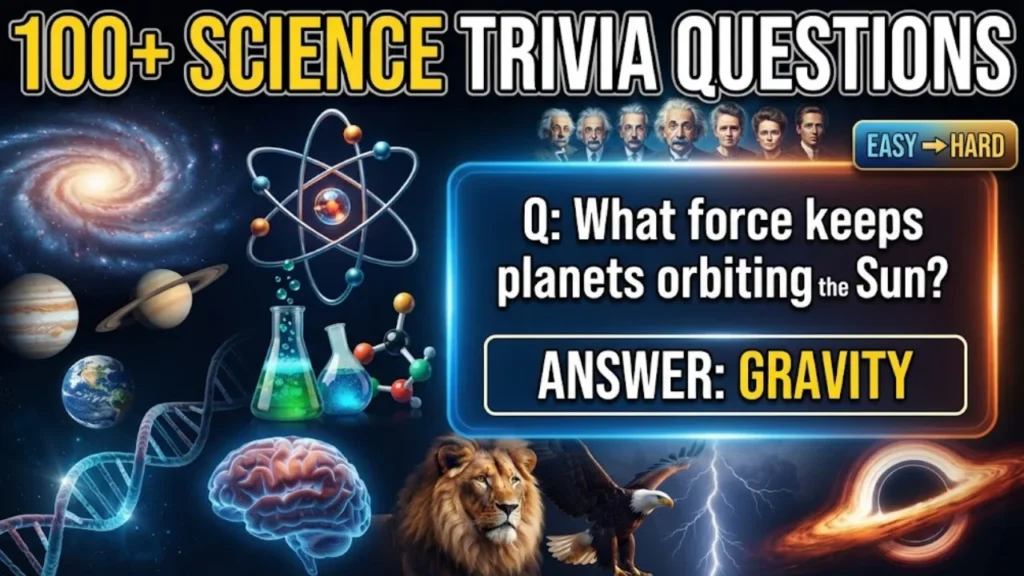
- Question: What force keeps planets orbiting the sun? Answer: Gravity. The sun’s mass creates a pull strong enough to hold the entire solar system in motion.
- Question: What is a black hole? Answer: A region in space where gravity is so intense that not even light can escape.
- Question: How many moons does Mars have? Answer: Two: Phobos and Deimos.
- Question: What galaxy is Earth located in? Answer: The Milky Way, according to NASA.
- Question: Which planet spins on its side? Answer: Uranus. Its axis is tilted almost 98 degrees.
- Question: What is the hottest planet in the solar system? Answer: Venus, even though Mercury sits closer to the sun. A thick, heat-trapping atmosphere keeps Venus scorching hot.
- Question: Who was the first human in space? Answer: Yuri Gagarin, a Soviet cosmonaut, in 1961.
- Question: What is the largest volcano in the solar system? Answer: Olympus Mons, located on Mars. It stands nearly three times taller than Mount Everest.
- Question: What causes a solar eclipse? Answer: The moon passing directly between the Earth and the sun, blocking sunlight.
- Question: What is the name of our galaxy’s nearest large neighbor? Answer: The Andromeda Galaxy.
- Question: How old is our solar system, approximately? Answer: About 4.6 billion years old.
- Question: What type of star is the sun? Answer: A yellow dwarf star, technically classified as a G-type main-sequence star.
- Question: Which planet has the most known moons? Answer: Saturn, with well over 100 confirmed moons.
- Question: What do astronomers call a rock from space that reaches Earth’s surface? Answer: A meteorite.
- Question: What is the asteroid belt, and where is it located? Answer: A ring of rocky debris orbiting between Mars and Jupiter.
- Question: How long would it take to drive to the nearest star at highway speed? Answer: More than 356 billion years, which shows just how vast interstellar distances really are.
- Question: What is the Great Red Spot? Answer: A massive, centuries-old storm on Jupiter that’s actually larger than Earth.
Human Body & Biology Science Trivia Questions and Answers
Your body runs on countless hidden processes. These biology trivia questions dig into bones, cells, and the systems that keep you alive.
- Question: How many bones are in the adult human body? Answer: 206.
- Question: What is the largest organ in the human body? Answer: The skin.
- Question: What is the powerhouse of the cell? Answer: The mitochondria, which produces the energy cells need to function.
- Question: What does DNA stand for? Answer: Deoxyribonucleic acid.
- Question: What shape is a DNA molecule? Answer: A double helix, which looks like a twisted ladder.
- Question: Which blood type is considered the universal donor? Answer: O-negative.
- Question: How many chambers does the human heart have? Answer: Four: two atria and two ventricles.
- Question: What is the longest bone in the human body? Answer: The femur, or thigh bone.
- Question: What part of the brain controls balance and coordination? Answer: The cerebellum.
- Question: What protein carries oxygen through the blood? Answer: Hemoglobin.
- Question: What gland is known as the body’s master gland? Answer: The pituitary gland, since it regulates hormones released by other glands.
- Question: How many pairs of chromosomes do humans typically have? Answer: 23 pairs, for a total of 46 chromosomes.
- Question: What is the smallest bone in the human body? Answer: The stapes, or stirrup bone, found in the inner ear.
- Question: What organ produces insulin? Answer: The pancreas.
- Question: What is the process of cell division called? Answer: Mitosis.
- Question: How many taste buds does the average adult have? Answer: Roughly 2,000 to 10,000, according to the National Library of Medicine.
- Question: What is the heaviest internal organ in the human body? Answer: The liver.
- Question: What protein gives skin and hair their color? Answer: Melanin.
- Question: True or false: octopuses have three hearts. Answer: True. Two pump blood to the gills, and one pumps it to the rest of the body.
- Question: What is the average number of vertebrae in the human spine? Answer: 33, though several fuse together as you grow.
Chemistry & Physics Science Trivia Questions and Answers
From the elements in your kitchen to the laws that govern motion, this section covers chemistry trivia questions and answers alongside core physics concepts.
- Question: What is the chemical symbol for gold? Answer: Au, from the Latin word aurum.
- Question: How many elements are on the periodic table? Answer: 118, as confirmed by the International Union of Pure and Applied Chemistry.
- Question: What is the most abundant gas in Earth’s atmosphere? Answer: Nitrogen, making up about 78% of the air we breathe.
- Question: What metal is liquid at room temperature? Answer: Mercury.
- Question: What is the chemical formula for table salt? Answer: NaCl, or sodium chloride.
- Question: What scale measures how acidic or basic a substance is? Answer: The pH scale, which runs from 0 to 14.
- Question: What is the hardest natural substance on Earth? Answer: Diamond, which scores a perfect 10 on the Mohs hardness scale.
- Question: What are atoms of the same element with different numbers of neutrons called? Answer: Isotopes.
- Question: What is Newton’s third law of motion? Answer: For every action, there is an equal and opposite reaction.
- Question: What unit measures electrical resistance? Answer: The ohm.
- Question: What is the speed of light in a vacuum? Answer: Approximately 186,282 miles per second, or about 299,792 kilometers per second.
- Question: What type of energy does a moving object have? Answer: Kinetic energy.
- Question: What law says energy cannot be created or destroyed, only transformed? Answer: The law of conservation of energy.
- Question: What is inertia? Answer: The tendency of an object to resist any change in its state of motion.
- Question: What gas gives soda its fizz? Answer: Carbon dioxide.
- Question: What is the lightest element on the periodic table? Answer: Hydrogen.
- Question: What is the boiling point of water at sea level in Fahrenheit? Answer: 212 degrees.
- Question: What subatomic particle carries a negative charge? Answer: The electron.
- Question: What is refraction? Answer: The bending of light as it passes from one material into another, like air into water.
- Question: What temperature are Celsius and Fahrenheit equal? Answer: Minus 40 degrees.
Earth Science, Nature & Mind-Blowing Science Trivia Questions
Our planet is stranger than most people realize. This section blends Earth science trivia with wild, fact-checked oddities pulled from nature and technology.
- Question: What is the largest desert in the world? Answer: Antarctica. Deserts are defined by low precipitation, not heat, and Antarctica receives under 200 millimeters of it a year.
- Question: What is the deepest known point on Earth? Answer: The Challenger Deep, inside the Mariana Trench, sitting roughly 36,000 feet below sea level.
- Question: What percentage of Earth’s surface is covered in water? Answer: About 71%, according to the U.S. Geological Survey.
- Question: What causes tides on Earth? Answer: The gravitational pull of the moon, along with a smaller effect from the sun.
- Question: What are the three main types of rock? Answer: Igneous, sedimentary, and metamorphic.
- Question: What is the name of the supercontinent that existed roughly 300 million years ago? Answer: Pangaea.
- Question: What layer of the atmosphere contains the ozone layer? Answer: The stratosphere.
- Question: What is the study of earthquakes called? Answer: Seismology.
- Question: What is the fastest land animal? Answer: The cheetah, capable of reaching speeds around 70 miles per hour.
- Question: Which mammal lays eggs? Answer: The platypus, along with the echidna. Both are known as monotremes.
- Question: What is the largest animal to have ever existed? Answer: The blue whale, which can grow up to 100 feet long.
- Question: What process do plants use to turn sunlight into food? Answer: Photosynthesis.
- Question: How long can a beaver hold its breath underwater? Answer: Up to 15 minutes.
- Question: What is a group of flamingos called? Answer: A flamboyance.
- Question: What animal has the strongest bite force on record? Answer: The saltwater crocodile, with a bite exceeding 3,700 pounds per square inch.
- Question: What is the fear of the number 13 called? Answer: Triskaidekaphobia.
- Question: How much energy does a single lightning bolt carry, roughly? Answer: Enough to toast about 100,000 slices of bread, based on typical lightning-energy estimates.
- Question: What is the only fruit that grows its seeds on the outside? Answer: The strawberry.
- Question: What was the first artificial satellite launched into space? Answer: Sputnik 1, launched by the Soviet Union in 1957.
- Question: What is sublimation? Answer: The process of a solid changing directly into a gas without becoming a liquid first, like dry ice does.
Hard & Advanced Science Trivia Questions and Answers
Ready for hard science trivia? These questions cover advanced concepts and the scientists behind some of history’s biggest breakthroughs.
- Question: Who proposed the theory of evolution by natural selection? Answer: Charles Darwin, in his 1859 book On the Origin of Species.
- Question: What does Einstein’s equation E=mc² actually mean? Answer: It shows that mass and energy are interchangeable, laying the groundwork for nuclear physics.
- Question: What did Marie Curie discover? Answer: The elements polonium and radium. She remains the only person to win Nobel Prizes in two different sciences.
- Question: What did Alexander Fleming accidentally discover in 1928? Answer: Penicillin, after noticing mold killing bacteria in a contaminated petri dish.
- Question: What is Nikola Tesla best known for? Answer: Developing alternating current, or AC, electrical systems used in modern power grids.
- Question: What did Galileo’s telescope help confirm? Answer: That Earth orbits the sun, supporting the heliocentric model of the solar system.
- Question: What did Rosalind Franklin contribute to science? Answer: Her X-ray images of DNA, including the famous Photo 51, helped reveal DNA’s double-helix structure.
- Question: What did Stephen Hawking theorize about black holes? Answer: That they slowly emit radiation, now called Hawking radiation, and can eventually evaporate.
- Question: What is the difference between nuclear fission and fusion? Answer: Fission splits a heavy atom apart to release energy, while fusion joins light atoms together and releases even more energy, which is what powers the sun.
- Question: What is absolute zero? Answer: The lowest possible temperature, at -459.67°F, where atoms have almost no thermal energy left.
- Question: What is dark matter? Answer: An invisible form of matter that doesn’t emit or reflect light but is detected through its gravitational effects. Scientists estimate it makes up about 27% of the universe.
- Question: What is the half-life of carbon-14? Answer: About 5,730 years, which makes it useful for dating ancient organic material.
- Question: What is the Doppler effect? Answer: The change in pitch or frequency of a wave caused by the motion of its source, like a siren sounding different as it passes you.
- Question: Who formulated the universal law of gravitation? Answer: Isaac Newton, in the 17th century.
- Question: What is an event horizon? Answer: The boundary around a black hole beyond which nothing, not even light, can escape.
- Question: What two scientists are credited with describing DNA’s double-helix structure in 1953? Answer: James Watson and Francis Crick.
- Question: What is the strong nuclear force? Answer: The fundamental force that holds protons and neutrons together inside an atom’s nucleus.
- Question: In what year was Pluto reclassified as a dwarf planet? Answer: 2006, by the International Astronomical Union.
- Question: What is quantum entanglement? Answer: A phenomenon where two particles become linked so that the state of one instantly affects the other, regardless of distance.
- Question: What did Antoine-Laurent Lavoisier contribute to chemistry? Answer: He’s widely considered the father of modern chemistry for his work identifying oxygen and hydrogen as elements.
FAQs
What are some fun science trivia questions?
Fun science trivia questions usually involve a surprising twist, like question 63 above, which reveals that Antarctica, not the Sahara, is technically the world’s largest desert. Questions about animal abilities, like a crocodile’s bite force or a beaver’s diving time, also tend to spark good conversation.
What are the best science trivia questions for adults?
Adults usually enjoy hard science trivia questions that dig into physics, famous scientists, and advanced concepts, such as dark matter, quantum entanglement, or the difference between fission and fusion. These questions reward real curiosity and a bit of prior knowledge.
What are some easy science trivia questions for kids?
Easy questions work best for kids, like naming the largest planet, identifying what gas plants release, or counting the chambers in a human heart. These build confidence and introduce basic scientific vocabulary without overwhelming young learners.
What are some challenging science trivia questions?
Challenging questions push past memorized facts into real understanding, like explaining Hawking radiation, describing the strong nuclear force, or naming the scientists behind the discovery of DNA’s structure. These test both memory and comprehension.
Conclusion
Science trivia does more than fill quiet moments. It sharpens memory, sparks curiosity, and gives you something interesting to bring up at dinner. However many of these 100+ questions you got right, you now know a little more about the world than you did five minutes ago. Keep exploring, and keep asking why.

Abroy Sohail is the founder and lead content writer at TriviaQuestionsHub.com. Passionate about trivia, general knowledge, and helping readers learn something new every day, Abroy curates and writes engaging quiz content for readers of all ages.