Constitution and Founding Fathers Trivia: 150+ Amazing & Ultimate Questions
Jefferson and Adams died on the same day, exactly 50 years after the Declaration of Independence. Facts like that make Founding Fathers trivia hard to put down.
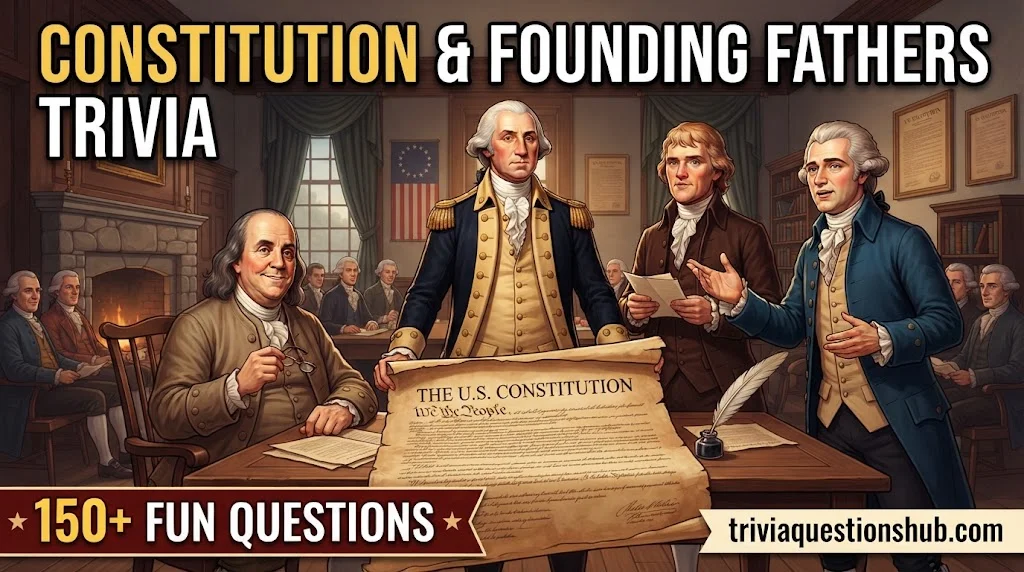
This quiz packs in 150 Constitution and Founding Fathers trivia questions with answers. Each one is short, fact-checked, and ready for class, trivia night, or Constitution Day.
Table of Contents
Founding Fathers Trivia Questions and Answers
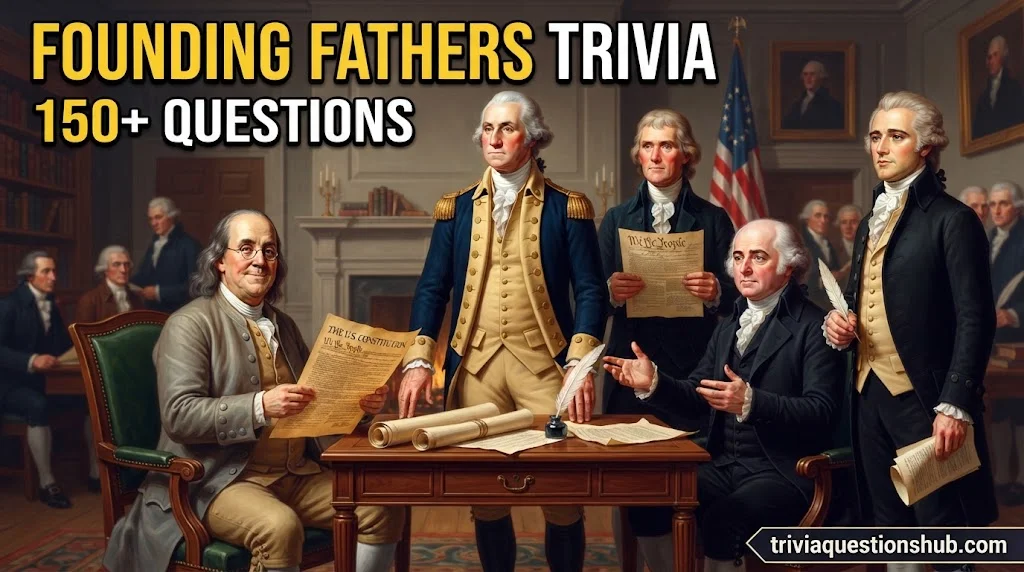
These questions cover the men and women who shaped early America. Sources include Mount Vernon, Monticello, and ConstitutionFacts.
Must visite:Retirement Party Roast Trivia Questions: 150+ Fun Questions for Coworkers & Friends
1. Who are the Founding Fathers?
No official list exists. The term covers leaders who won independence and built the new government, such as Washington, Adams, Jefferson, Franklin, Hamilton, Madison, and Jay.
2. Who coined the term “Founding Fathers”?
Warren G. Harding is credited with the phrase, in a 1916 Republican convention speech. The Founders never heard it.
3. Where did George Washington live?
He lived at Mount Vernon, his Virginia estate on the Potomac River.
4. Who was the first U.S. president?
George Washington, who served from 1789 to 1797.
5. Who is the only president elected unanimously?
Washington. He won every Electoral College vote in 1789 and again in 1792.
6. How tall was George Washington?
About 6 feet 2 inches. That was very tall for the 1700s.
7. Did Washington have wooden teeth?
No. His dentures used ivory, human teeth, animal teeth, and metal.
8. Did Washington really chop down a cherry tree?
No. Parson Weems invented the story after Washington died.
9. What was Washington’s shortest speech?
His second inaugural address, at just 135 words.
10. Did Washington run a whiskey distillery?
Yes. His Mount Vernon distillery made about 11,000 gallons in 1799, and it was legal.
11. When was Washington’s real birthday?
He was born February 11, 1731, by the old Julian calendar. After Britain switched calendars, it became February 22, 1732.
12. Did Washington free enslaved people?
His will freed the 123 enslaved people he owned. Martha Washington signed their freedom order in early 1801.
13. Who was Martha Washington?
She was the first First Lady and one of Virginia’s wealthiest widows when she married George in 1759.
14. Who wrote the Declaration of Independence?
Thomas Jefferson wrote the main draft. He served on the Committee of Five.
15. What instrument did Jefferson play?
The violin. Jefferson studied it seriously for years.
16. What did Jefferson want on his tombstone?
He listed three achievements: author of the Declaration, author of the Virginia Statute for Religious Freedom, and founder of the University of Virginia. He left out the presidency.
17. How did Jefferson help rebuild the Library of Congress?
British troops burned the library in 1814. Jefferson sold Congress 6,487 books from his own collection.
18. What is Jefferson’s link to slavery?
He enslaved more than 600 people over his lifetime. A 2000 Monticello report found he most likely fathered the children of Sally Hemings.
19. Did Jefferson refuse to sign the Constitution?
No. He was in Paris as U.S. minister to France during the 1787 convention.
20. Did John Adams refuse to sign the Constitution?
No. He was in London as minister to Britain, so he missed the convention too.
21. Who was John Adams?
He was the first vice president and the second president. He was born in what is now Quincy, Massachusetts.
22. Whom did Adams defend after the Boston Massacre?
Adams defended the British soldiers in 1770. He believed everyone deserved a fair trial.
23. Who was the first president to live in the White House?
John Adams, in November 1800.
24. Which Founding-era president lived longest?
John Adams, who died at age 90.
25. What happened on July 4, 1826?
Adams and Jefferson both died that day, 50 years after the Declaration. Adams reportedly said, “Thomas Jefferson survives,” not knowing Jefferson had died hours earlier.
26. Which other president died on July 4?
James Monroe, the fifth president, died on July 4, 1831.
27. Who was Benjamin Franklin?
He was a printer, scientist, diplomat, and author of Poor Richard’s Almanack. He retired from printing at age 42.
28. How old was Franklin at the Constitutional Convention?
He was 81, the oldest delegate.
29. What did Franklin invent?
The lightning rod, the Franklin stove, and bifocal glasses.
30. Did Franklin want the turkey as the national bird?
Not officially. In a 1784 letter to his daughter, he called the turkey more respectable than the bald eagle, but he never proposed it for the seal.
31. Which key documents did Franklin sign?
The Declaration of Independence, the Treaty of Paris, and the Constitution.
32. What did Franklin say about the sun on Washington’s chair?
He said he was glad it was a rising sun and not a setting one. Madison recorded the remark in his notes.
33. Who was Alexander Hamilton?
He was born on Nevis in the West Indies and became the first Treasury Secretary.
34. How many Federalist Papers did Hamilton write?
About 51 of the 85 essays.
35. What was Hamilton’s financial plan?
He wanted the federal government to take on state war debts and create a national bank. He believed strong credit would hold the young nation together.
36. How did Hamilton die?
Aaron Burr shot him in a duel at Weehawken, New Jersey, on July 11, 1804. Hamilton died the next day.
37. What was the Reynolds affair?
Hamilton admitted an affair with Maria Reynolds in 1797 to prove he had not misused public money. Aaron Burr later served as Reynolds’s divorce lawyer, the National Constitution Center notes.
38. How tall was James Madison?
About 5 feet 4 inches. His nickname was “Jemmy.”
39. Who was Dolley Madison?
She was the fourth First Lady. In 1814, she saved a portrait of Washington as British troops approached the White House.
40. Who was the last surviving signer of the Constitution?
James Madison, who died June 28, 1836, at age 85.
41. Who wrote the Bill of Rights?
Madison drafted it in 1789, drawing on George Mason’s ideas and state proposals.
42. Who was John Jay?
He was the first Chief Justice of the Supreme Court. He also wrote five Federalist Papers and negotiated Jay’s Treaty.
43. Who was George Mason?
He wrote the Virginia Declaration of Rights in 1776. He later refused to sign the Constitution.
44. Who was Gouverneur Morris?
A Pennsylvania delegate who lost a leg in a carriage accident. He polished the Constitution’s final wording.
45. Who was Roger Sherman?
The only person to sign all four founding documents: the Continental Association, the Declaration, the Articles of Confederation, and the Constitution.
46. Who was James Wilson?
He was born in Scotland and became one of the first six Supreme Court justices. He argued that the people, not the states, held power.
47. Who was Edmund Randolph?
He introduced the Virginia Plan. He later became the first U.S. Attorney General.
48. Who was Elbridge Gerry?
A Massachusetts delegate who refused to sign the Constitution. The word “gerrymandering” comes from his name.
49. Who was Samuel Adams?
John Adams’s cousin, a leader of the Sons of Liberty, and a signer of the Declaration.
50. Who was Abigail Adams?
John’s wife and closest adviser. In 1776, she urged him to “remember the ladies” when writing new laws.
Constitution Trivia Questions and Answers
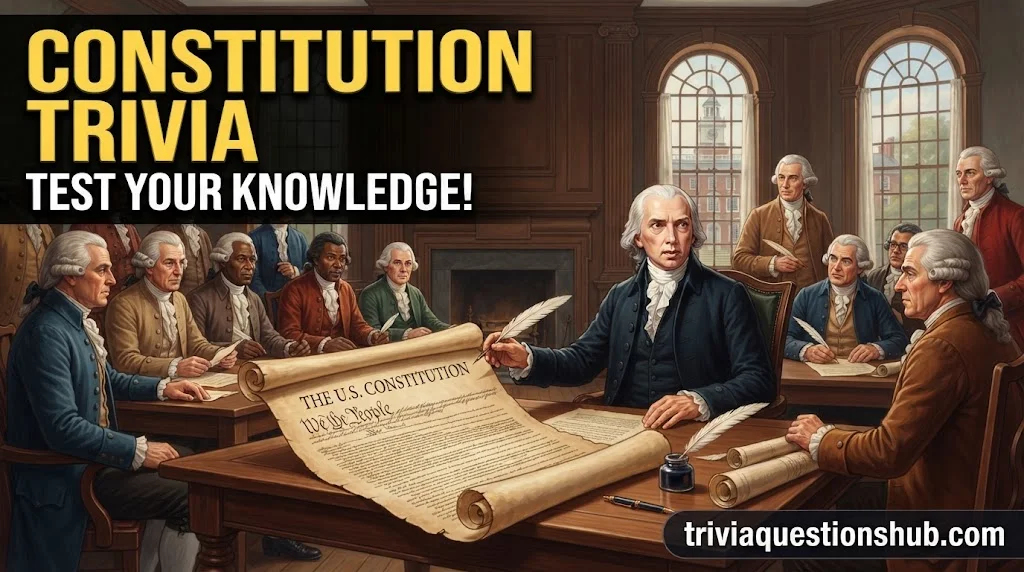
These Constitution trivia questions cover the 1787 convention, the big compromises, and the Bill of Rights. The National Archives holds the original.
51. When was the Constitutional Convention held?
From May 25 to September 17, 1787.
52. Where did the delegates meet?
In the Pennsylvania State House in Philadelphia, now called Independence Hall.
53. Why did leaders replace the Articles of Confederation?
Congress could not tax, there was no chief executive, and changes needed all 13 states to agree.
54. How many delegates attended?
55 attended, and 39 signed.
55. Which state sent no delegates?
Rhode Island.
56. Who presided over the convention?
George Washington.
57. Who was the youngest delegate?
Jonathan Dayton of New Jersey, age 26.
58. Who took the best notes?
James Madison. His notes were published after his death.
59. Were the debates open to the public?
No. Delegates kept them secret and closed the windows in the summer heat.
60. What was the Annapolis Convention?
A 1786 meeting on trade problems. Only five states sent delegates, so Hamilton and Madison pushed for a bigger meeting in Philadelphia.
61. What was the Virginia Plan?
Randolph presented it, and Madison shaped it. It proposed three branches and a two-house Congress based on population.
62. What was the New Jersey Plan?
William Paterson’s plan for one house with an equal vote for every state.
63. What was the Great Compromise?
Roger Sherman’s idea: the House is based on population and the Senate gives each state two seats. It is also called the Connecticut Compromise.
64. What was the Three-Fifths Compromise?
It counted each enslaved person as three-fifths of a free person for representation and taxes. It gave slaveholding states extra political power.
65. Who spoke most at the convention?
Gouverneur Morris, with 173 speeches. Roger Sherman spoke 138 times, says ConstitutionFacts.
66. What was the Committee of Style?
Five delegates who polished the final text: William Samuel Johnson, Hamilton, Morris, Madison, and Rufus King.
67. How does the Preamble begin?
With “We the People.” Morris is credited with its polished wording.
68. How many articles does the Constitution have?
Seven.
69. How long is the original Constitution?
Four pages and roughly 4,500 words. It is one of the shortest national constitutions.
70. What did Franklin reportedly say the delegates had created?
“A republic, if you can keep it,” he told Elizabeth Powel when she asked.
71. Who signed the Constitution first?
George Washington, as president of the convention.
72. Who refused to sign?
George Mason, Edmund Randolph, and Elbridge Gerry.
73. Why did Mason refuse?
He wanted a bill of rights and objected to the slave-trade provisions.
74. When did delegates sign the Constitution?
September 17, 1787.
75. What is Constitution Day?
An observance held each year on September 17.
76. What are the three branches of government?
Legislative, executive, and judicial.
77. What are checks and balances?
Rules that let each branch limit the others. Congress passes laws, the president can veto them, and courts can review them.
78. What is federalism?
Power shared between the national government and the states.
79. How many states had to ratify the Constitution?
Nine of the 13.
80. Which state ratified first?
Delaware, on December 7, 1787.
81. Which state was ninth?
New Hampshire, on June 21, 1788.
82. Which state ratified last?
Rhode Island, on May 29, 1790.
83. Who were the Federalists?
Supporters of the Constitution and a strong national government, led by Hamilton, Madison, and Jay.
84. Who were the Anti-Federalists?
Opponents who feared a powerful central government and demanded a bill of rights.
85. What are the Federalist Papers?
Eighty-five essays that argued for ratification. They appeared in New York newspapers in 1787 and 1788.
86. Who was “Publius”?
The pen name shared by Hamilton, Madison, and Jay.
87. What is the Bill of Rights?
The first ten amendments, ratified December 15, 1791.
88. How many amendments does the Constitution have?
Twenty-seven.
89. Which amendment took the longest to pass?
The 27th, on congressional pay. Proposed in 1789, it was ratified in 1992.
90. What does the First Amendment protect?
Religion, speech, press, assembly, and petition.
91. What does the Second Amendment say?
It protects the right to keep and bear arms.
92. What did the 12th Amendment fix?
It created separate electoral votes for president and vice president after the tied election of 1800. It was ratified in 1804.
93. What did the 13th Amendment do?
It abolished slavery in 1865.
94. What did the 14th Amendment add?
Citizenship and equal protection under the law, in 1868.
95. Which amendment gave women the vote?
The 19th, in 1920.
96. What is Article V?
The amendment process. It takes two-thirds of Congress and three-fourths of the states.
97. What is the Supremacy Clause?
The rule in Article VI that federal law overrides conflicting state law.
98. What was Marbury v. Madison?
An 1803 case that established judicial review, the Supreme Court’s power to strike down unconstitutional laws.
99. Who was John Marshall?
The Chief Justice in that case. He led the Supreme Court for 34 years, from 1801 to 1835.
100. What did the Judiciary Act of 1789 do?
It created the federal court system and set the Supreme Court at six justices.
101. Where is the original Constitution today?
At the National Archives in Washington, D.C.
102. Was the Constitution written on hemp paper?
No. The final copy is on parchment, though some working drafts may have used hemp paper.
103. Was John Hanson the first U.S. president?
No. He led Congress under the Articles of Confederation. Washington was the first president under the Constitution.
104. What is the Necessary and Proper Clause?
Article I, Section 8 lets Congress make laws needed to carry out its listed powers. It is also called the elastic clause.
105. Why did the Founders create the Electoral College?
It was a compromise between Congress choosing the president and a direct popular vote. Today it has 538 electors.
American Revolution and Declaration of Independence Trivia
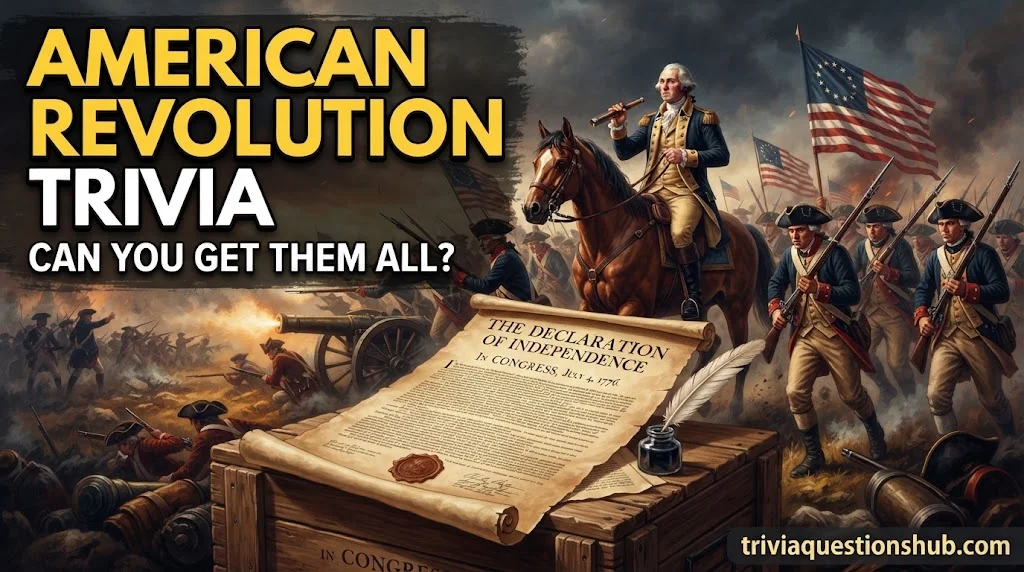
The Declaration and the war set the stage for the Constitution. These questions connect them to the early republic. For more, see ConstitutionFacts on the Declaration.
106. What happened on July 2, 1776?
The Continental Congress voted for independence.
107. When was the Declaration adopted?
On July 4, 1776.
108. When did most delegates sign it?
On August 2, 1776.
109. Who first read the Declaration to the public?
Colonel John Nixon, on July 8, 1776, in what is now Independence Square.
110. Who served on the Committee of Five?
Jefferson, Adams, Franklin, Roger Sherman, and Robert R. Livingston.
111. How many men signed the Declaration?
Fifty-six.
112. Who was the youngest signer?
Edward Rutledge of South Carolina, age 26.
113. Whose signature is the largest?
John Hancock’s. He was president of the Continental Congress.
114. How many colonies declared independence?
Thirteen.
115. What rights does the Declaration name?
“Life, Liberty and the pursuit of Happiness.”
116. Where is the original Declaration?
At the National Archives, next to the Constitution and the Bill of Rights.
117. How much of Jefferson’s draft did Congress cut?
About a quarter, including a passage on the slave trade.
118. Who were the Sons of Liberty?
Colonial protesters, led in part by Samuel Adams, who fought British taxes.
119. What was the Stamp Act?
A 1765 tax on printed paper. It fueled the cry of “no taxation without representation.”
120. When was the Boston Tea Party?
December 16, 1773.
121. What was the “shot heard round the world”?
The first fighting of the war, at Lexington and Concord on April 19, 1775.
122. Who led the Continental Army?
George Washington, appointed in June 1775.
123. What happened at Valley Forge?
The army endured the harsh winter of 1777 to 1778. Baron von Steuben drilled the troops there.
124. When did Washington cross the Delaware River?
On the night of December 25 to 26, 1776, before the victory at Trenton.
125. Why did Saratoga matter?
The 1777 American win helped bring France into the war as an ally.
126. How did the war end on the battlefield?
British General Cornwallis surrendered at Yorktown on October 19, 1781.
127. What was the Treaty of Paris of 1783?
The peace treaty that ended the war. Franklin, Adams, and Jay negotiated it.
128. Who sat in Washington’s first cabinet?
Jefferson (State), Hamilton (Treasury), Henry Knox (War), and Edmund Randolph (Attorney General).
129. Where was Washington inaugurated?
At Federal Hall in New York City, on April 30, 1789.
130. What term-limit precedent did Washington set?
He stepped down after two terms. That tradition lasted until Franklin Roosevelt.
131. What was the Farewell Address?
His 1796 letter warning against political parties and foreign entanglements.
132. What was the Proclamation of Neutrality?
Washington’s 1793 declaration that the U.S. would stay out of the war between France and Britain.
133. What was the Whiskey Rebellion?
A 1794 protest against a whiskey tax in western Pennsylvania. Washington sent nearly 13,000 militia to end it.
134. What was Jay’s Treaty?
A 1794 deal in which Britain agreed to leave its forts in the Northwest Territory. Many Americans found it unpopular.
135. When was the First Bank of the United States created?
In 1791, with a 20-year charter. It was Hamilton’s project.
136. Who were the first two political parties?
The Federalists, led by Hamilton and Adams, and the Democratic-Republicans, led by Jefferson and Madison.
137. When did the capital move to Washington, D.C.?
In 1800, during Adams’s presidency.
138. What was the XYZ Affair?
French agents demanded bribes from American diplomats in 1797 and 1798. The insult stirred public anger.
139. What was the Quasi-War?
An undeclared naval conflict with France from 1798 to 1800. Adams chose peace over full war.
140. What were the Virginia and Kentucky Resolutions?
Jefferson and Madison wrote them to argue that states could challenge unconstitutional federal laws. They were a response to the Alien and Sedition Acts.
141. What happened in the election of 1800?
Jefferson and Aaron Burr tied in the Electoral College. The House took 36 ballots, and Hamilton backed Jefferson.
142. Who was the first president inaugurated in Washington, D.C.?
Thomas Jefferson, on March 4, 1801.
143. What was the Louisiana Purchase?
A 1803 deal in which France sold its territory for $15 million. It roughly doubled the size of the United States.
144. What was the Lewis and Clark expedition?
A 1804 to 1806 journey that Jefferson ordered to map the new territory. Sacagawea guided and helped the party.
145. What was the Embargo Act of 1807?
A law that banned American exports. It hurt U.S. merchants more than it hurt Britain or France.
146. What is impressment?
The British navy’s practice of seizing sailors from American ships.
147. What happened in the War of 1812?
The U.S. fought Britain again, and British troops burned Washington, D.C., in August 1814.
148. What was the Monroe Doctrine?
President Monroe’s 1823 warning to European powers to stay out of the Americas.
149. Where did the first five presidents come from?
Four were Virginians: Washington, Jefferson, Madison, and Monroe. Adams came from Massachusetts.
150. Who was the last surviving signer of the Declaration?
Charles Carroll of Maryland, who died November 14, 1832, at age 95.
FAQs
What are some interesting trivia facts about the Founding Fathers?
Washington never had wooden teeth. Franklin invented bifocals. Adams and Jefferson died on the same day, July 4, 1826. Madison stood about 5 feet 4 inches tall.
Who is the father of our Constitution?
James Madison. He shaped the Virginia Plan, took detailed notes at the convention, and later wrote the Bill of Rights.
Were any of the Founding Fathers LGBTQ?
No Founding Father is confirmed to have been LGBTQ. Some historians point to Hamilton’s warm letters to John Laurens, while others say that was normal friendly language for the time. Baron von Steuben faced same-sex rumors, but he was a military aide, not a Founding Father in the usual sense. The evidence is thin, so scholars still debate it.
Who has the oldest Constitution?
The U.S. Constitution, in effect since 1789, is the oldest written national constitution still in use. The Massachusetts Constitution of 1780 is the oldest still-active state constitution. San Marino’s Statutes of 1600 are sometimes cited as an older governing document.
Conclusion
You now have 150 Founding Fathers and Constitution trivia questions with answers. Use them for classroom quizzes, family game night, or a Constitution Day celebration.
Test a friend on ten questions. The Founding Fathers were people with quirks, rivalries, and big ideas, and that is what makes their story so fun to learn.

Abroy Sohail is the founder and lead content writer at TriviaQuestionsHub.com. Passionate about trivia, general knowledge, and helping readers learn something new every day, Abroy curates and writes engaging quiz content for readers of all ages.