Midwest vs East Coast Slang Trivia: 100+ Fun Questions & Answers
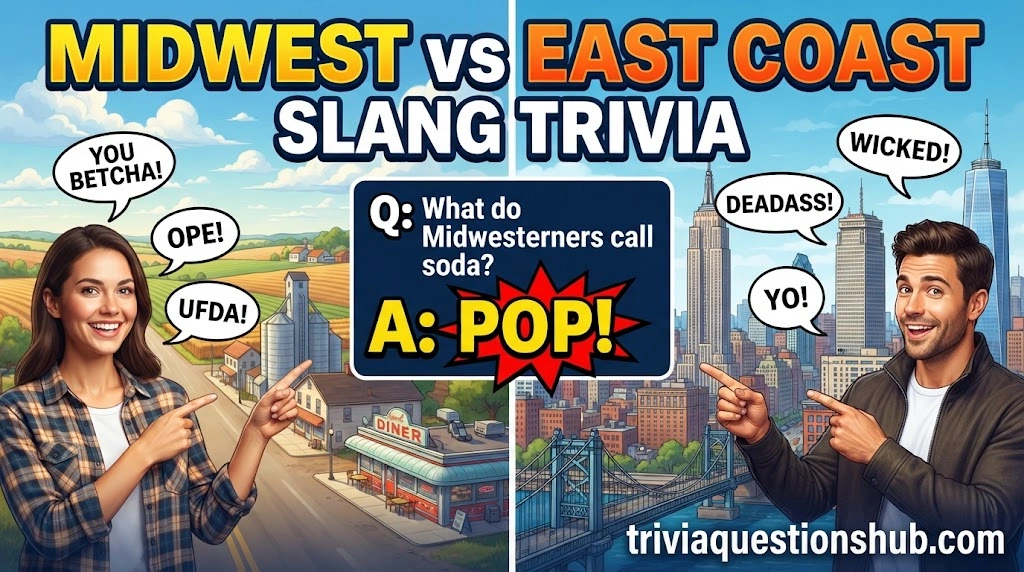
Say “pop” in Boston and people will stare at you. Say “wicked” in Ohio and you’ll get a laugh. This Midwest vs East Coast slang trivia guide puts both dialects head to head with real questions, real answers, and real facts about how Americans talk.
You’ll find Midwest slang trivia, East Coast slang trivia, and the linguistic reasons behind the differences — backed by research from Harvard, the University of Pennsylvania, and the Dictionary of American Regional English.
Table of Contents
What Is Midwest vs East Coast Slang Trivia
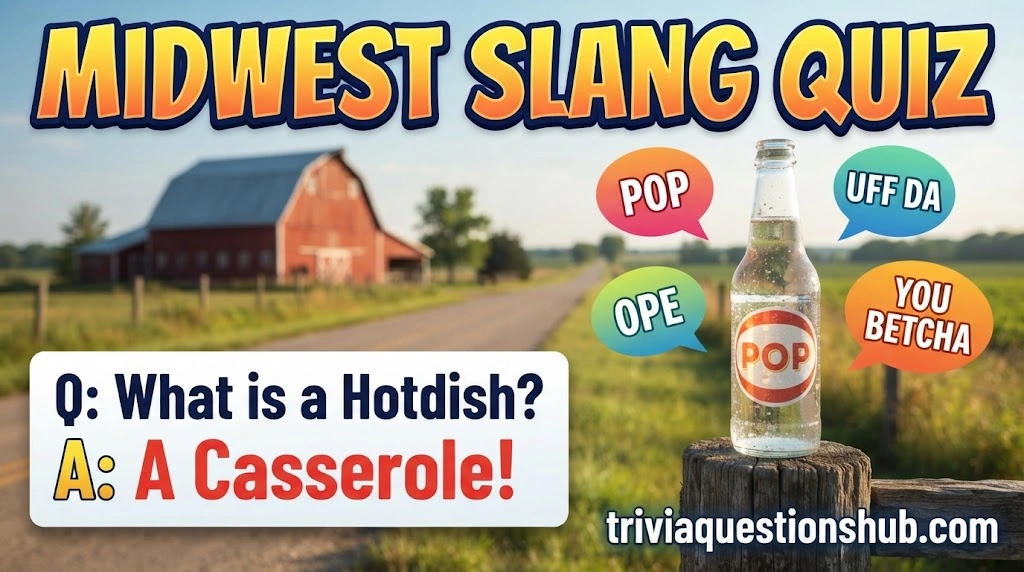
Midwest vs East Coast slang trivia is a quiz that tests how well you know regional American vocabulary. It compares everyday words from Midwestern states like Minnesota, Wisconsin, and Ohio against East Coast cities like Boston, Philadelphia, and New York.
Must visite:The Ultimate Music Trivia Quiz: 100+ Amazing Music Trivia Questions & Answers
These aren’t made-up words. Linguists call the geographic boundary between two dialect terms an isogloss, and American English has hundreds of them. The Harvard Dialect Survey, led by Cambridge linguist Bert Vaux, gathered responses from more than 9,000 people and mapped exactly where these word boundaries fall.
Midwest Slang Trivia Questions & Answers
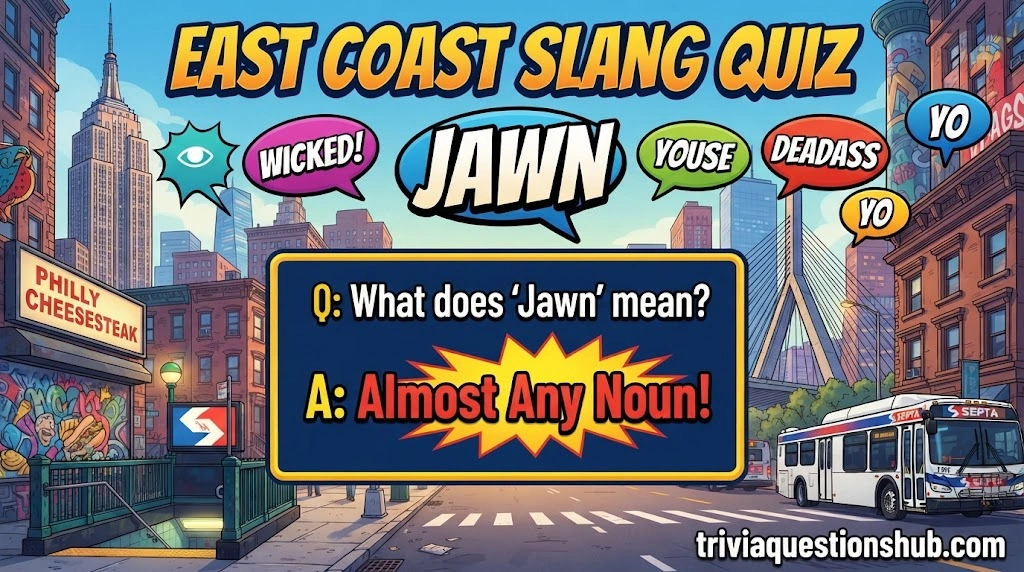
The Midwest dialect grew out of German and Scandinavian settlement patterns, which explains why so many of its words sound imported. Here are 50 Midwest slang trivia questions to test your knowledge.
1. What do Midwesterners call a carbonated soft drink? Answer: Pop.
2. What is the Midwest word for a grocery bag? Answer: Sack.
3. What Minnesota word expresses surprise or mild frustration? Answer: Uff da.
4. What filler word do Midwesterners say before apologizing? Answer: Ope.
5. What do Midwesterners call athletic shoes? Answer: Tennis shoes.
6. What phrase means “to join someone,” as in “Are you coming ___?” Answer: Come with.
7. What do Midwesterners call a small stream? Answer: Crick.
8. What Minnesota-only version of a playground game replaces “goose” with a color? Answer: Duck Duck Grey Duck.
9. What do Wisconsinites call a water fountain? Answer: Bubbler.
10. What word means “expensive” in Midwest slang? Answer: Spendy.
11. What is a “hotdish”? Answer: A casserole.
12. What phrase confirms agreement, common in Minnesota and the Dakotas? Answer: You betcha.
13. What do Chicagoans call athletic shoes, instead of “tennis shoes”? Answer: Gym shoes.
14. What is the Midwest word for a TV remote? Answer: Clicker.
15. What does “the Region” mean in Indiana slang? Answer: Northwest Indiana, near Chicago.
16. What Minnesota dish is a burger stuffed with melted cheese? Answer: Juicy Lucy.
17. What do Minneapolis residents call the grass strip beside the street? Answer: Boulevard.
18. What do Ohioans call that same strip of grass? Answer: Tree lawn.
19. What word replaces “dinner” for the evening meal in the Midwest? Answer: Supper.
20. What does “pert near” mean? Answer: Almost, or pretty near.
21. What sausage is a Wisconsin cookout staple? Answer: Brat.
22. What phrase politely asks someone to repeat themselves? Answer: Come again?
23. What do Minnesotans call a lake house? Answer: Cabin.
24. In Chicago and St. Louis, what does “hoosier” mean outside of Indiana? Answer: An unrefined or unfashionable person.
25. What do Wisconsinites call a vacuum cleaner? Answer: Sweeper.
26. What Scandinavian-style dish is made from dried, gelatinized fish? Answer: Lutefisk.
27. What Midwestern word acts as an intensifier, as in “___ good”? Answer: Real.
28. What nickname do Michiganders give their state’s shape? Answer: The Mitten.
29. What phrase substitutes for “you’re welcome” in the Midwest? Answer: Don’tcha know.
30. What do Midwesterners call a vending machine for soda? Answer: Pop machine.
31. What old-fashioned pronunciation replaces “milk” in rural Midwest speech? Answer: Melk.
32. What phrase means “right away” in Midwest slang? Answer: Right quick.
33. What farming saying tracks corn growth by early summer? Answer: Knee high by the Fourth of July.
34. What do Midwesterners call a shopping cart? Answer: Cart.
35. What does “up north” mean to a Minnesotan or Michigander? Answer: A lake cabin or vacation spot.
36. What does the Midwestern phrase “borrow me a…” really mean? Answer: Lend me a…
37. What game does “Duck Duck Grey Duck” replace? Answer: Duck Duck Goose.
38. What do Midwesterners bring to a potluck, calling it “hotdish”? Answer: A casserole.
39. What Chicago hot dog style skips the ketchup entirely? Answer: Chicago dog.
40. What word describes cold, biting winter weather in the Midwest? Answer: Brisk.
41. What Wisconsin liqueur is famous for tasting terrible, often used as a dare? Answer: Malort.
42. What older Midwestern word means a couch? Answer: Davenport.
43. What phrase means “I don’t know” casually in the Midwest? Answer: Beats me.
44. What do Midwesterners call rubber boots worn in mud or snow? Answer: Galoshes.
45. What phrase expresses mild surprise in the Midwest? Answer: Well, I’ll be.
46. What Midwestern nickname describes the Great Lakes region broadly? Answer: The Heartland.
47. What phrase invites someone along casually? Answer: Wanna come with?
48. What does “the whole shebang” mean? Answer: Everything, all of it.
49. What does a Midwesterner mean by “cripes”? Answer: A mild exclamation, like “geez.”
50. What phrase ends a Midwestern phone call warmly? Answer: Alright then, take care.
East Coast Slang Trivia Questions & Answers
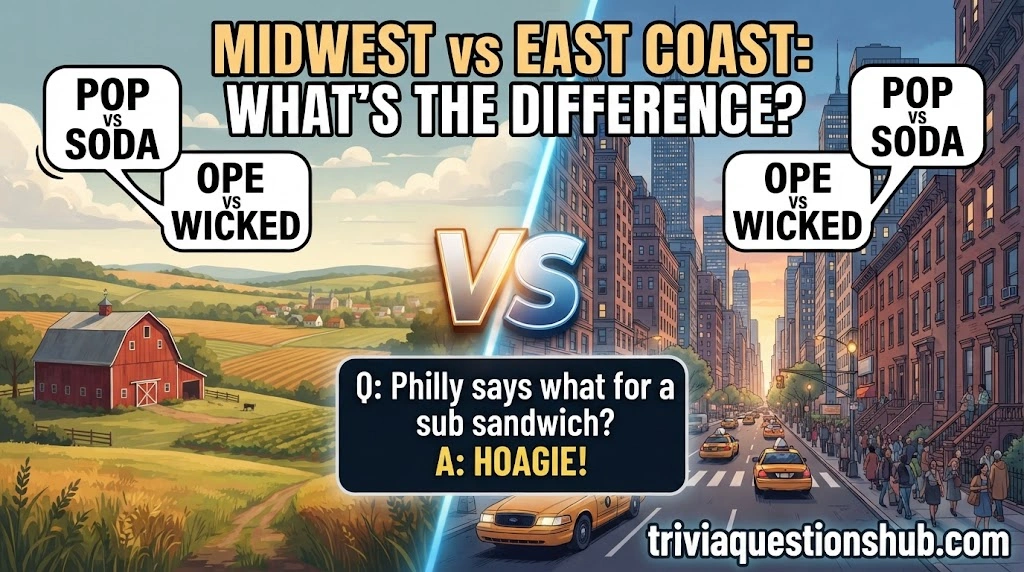
East Coast slang formed differently. Dense cities, old immigrant neighborhoods, and distinct local accents each produced their own vocabulary. Here are 50 East Coast slang trivia questions covering Boston, New York, Philadelphia, and Pittsburgh.
1. What Boston word means “very,” as in “___ good”? Answer: Wicked.
2. What Philadelphia word stands in for almost any noun? Answer: Jawn.
3. What is a “hoagie” in Philadelphia? Answer: A sub sandwich.
4. What does “youse” mean in New York and Philly slang? Answer: You all.
5. What Pittsburgh word means “you all”? Answer: Yinz.
6. What does a New Englander call a sub sandwich? Answer: Grinder.
7. What is a “packie” in Boston slang? Answer: A liquor store.
8. What do Bostonians call a traffic circle? Answer: Rotary.
9. What does a New Yorker mean by “a regular coffee”? Answer: Coffee with cream and sugar.
10. What do New Yorkers call an entire pizza? Answer: A pie.
11. What does “mad” mean in New York and New Jersey slang? Answer: Very, or a lot.
12. What is a “bodega” in New York City? Answer: A small neighborhood corner store.
13. What do Rhode Islanders call a milkshake made with syrup? Answer: Cabinet.
14. What does a Rhode Islander call a front porch? Answer: Piazza.
15. What do Bostonians call a water fountain? Answer: Bubbler.
16. What did New Englanders traditionally call soda? Answer: Tonic.
17. What do New Englanders call a thick milkshake with ice cream? Answer: Frappe.
18. What Pittsburgh word means “nosy”? Answer: Nebby.
19. What do Pittsburghers call a rubber band? Answer: Gumband.
20. What do Philadelphians call a shaved-ice treat? Answer: Water ice.
21. What Philadelphia breakfast dish is made from pork scraps and cornmeal? Answer: Scrapple.
22. What do New Yorkers say when waiting in a queue — “in line” or “on line”? Answer: On line.
23. What do Bostonians call an errand to buy alcohol? Answer: A packie run.
24. What Philadelphia pronunciation turns “water” into a local sound? Answer: Wooder.
25. What do New Jersey locals call a trip to the beach? Answer: Down the shore.
26. What does “brick” mean in East Coast slang, as in “it’s brick outside”? Answer: Very cold.
27. What classic New York drink mixes milk, seltzer, and chocolate syrup? Answer: Egg cream.
28. What do New Yorkers call a sub sandwich? Answer: Hero.
29. What does a New Englander call ice cream sprinkles? Answer: Jimmies.
30. What does “deadass” mean in New York slang? Answer: Seriously, no joke.
31. What informal term describes a strong Boston accent? Answer: Masshole.
32. What do Philadelphians say as a casual greeting? Answer: Yo.
33. What phrase captures the classic Boston “dropped R” accent? Answer: Pahk the cah.
34. What do New Yorkers call sitting outside on front steps? Answer: Stooping.
35. What term describes commuters from outside Manhattan? Answer: Bridge and tunnel crowd.
36. What do New Englanders traditionally call old-fashioned jeans? Answer: Dungarees.
37. What does “wicked pissah” mean in Boston slang? Answer: Something excellent.
38. What Rhode Island fried corn snack shares its name with a folk tale? Answer: Johnnycake.
39. What do New Yorkers call Manhattan casually? Answer: The city.
40. What do Massachusetts residents call a basement? Answer: Cellar.
41. What does “no suh” mean in a thick Boston accent? Answer: No, sir.
42. What is “chowdah,” phonetically spelled? Answer: Chowder.
43. What do Cape Cod locals call their peninsula? Answer: The Cape.
44. What Pittsburgh word means a vacuum cleaner? Answer: Sweeper.
45. What does “the tri-state area” mean to a New Yorker? Answer: New York, New Jersey, and Connecticut.
46. What is a “spa” in old New England slang? Answer: A small convenience store.
47. What does a New Yorker mean by “forgeddaboutit”? Answer: Forget about it, used to dismiss or emphasize a point.
48. What does “deuces” mean when someone says it while leaving? Answer: Goodbye.
49. What do New Jersey locals call a highway exit used as a landmark? Answer: An exit, as in “I’m from Exit 4.”
50. What does “on point” mean in East Coast slang? Answer: Exactly right, or excellent.
Midwest vs East Coast Slang: Key Differences Explained
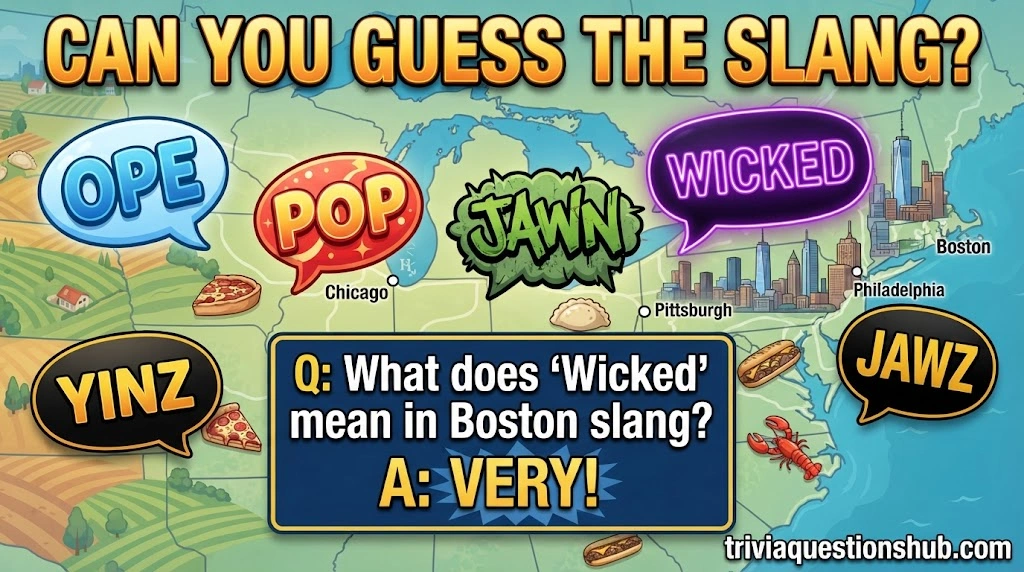
The gap between Midwest slang and East Coast slang isn’t random. It’s the result of who settled where, and how isolated each region stayed over time.
Word origin is the biggest split. Midwest slang borrows heavily from German and Scandinavian immigrants — “uff da,” “lutefisk,” and “ope” all trace back to that heritage. East Coast slang leans on phonetic dialect shaped by dense cities, like “wicked,” “wooder,” and “chowdah.”
Sandwich names prove the point best. Philadelphia says hoagie. New York says hero. New England says grinder. Same sandwich, three completely different regional names, all within a few hundred miles of each other.
Soft drink naming follows a similar pattern. According to the Pop vs. Soda project, which has tracked over 100,000 survey responses, “pop” dominates the Midwest almost entirely, while the East Coast splits between “soda” and older regional terms like “tonic” in New England.
Accent research backs this up too. Linguist William Labov spent decades at the University of Pennsylvania studying the Philadelphia dialect and found that roughly 25 percent of natural misunderstandings between Americans trace back to dialect differences, not vocabulary they didn’t know existed.
Politeness style also splits the two regions. Midwest slang softens speech (“ope,” “don’tcha know,” “you betcha”), while East Coast slang tends to be direct and fast (“deadass,” “forgeddaboutit,” “mad tight”).
Not every word follows the East-vs-Midwest split cleanly, though. Both Wisconsin and Rhode Island use bubbler for a water fountain, and both Pittsburgh and the rural Midwest use sweeper for a vacuum cleaner — proof that dialect boundaries rarely follow a straight line on a map.
FAQs
What is Midwest vs East Coast slang trivia?
It’s a quiz format testing regional American vocabulary, comparing words used in Midwestern states like Minnesota and Ohio against East Coast cities like Boston, New York, and Philadelphia.
What are the most common Midwest slang words?
The most common Midwest slang words include pop (soda), sack (bag), uff da (an exclamation), ope (an apologetic filler word), hotdish (casserole), and you betcha (yes).
What are the most common East Coast slang words?
The most common East Coast slang words include wicked (very), jawn (an all-purpose noun), hoagie (a sub sandwich), youse (plural you), yinz (Pittsburgh’s y’all), and mad (very).
How is Midwest slang different from East Coast slang?
Midwest slang is softer and shaped by German and Scandinavian settlers, while East Coast slang is direct and shaped by dense city neighborhoods. Word choice also splits sharply — the Midwest says “pop” and “sack,” while the East Coast says “hoagie,” “hero,” or “grinder” depending on the city.
What causes regional slang to form in the first place?
Linguists point to settlement history, geographic isolation, and immigrant language influence. The Harvard Dialect Survey found these patterns persist even in the age of national television and social media.
Conclusion
Regional slang trivia isn’t just a fun quiz — it’s a map of American history, migration, and identity, backed by real linguistic research. Whether you scored high on Midwest slang trivia or East Coast slang trivia, one thing’s clear: America still speaks in dialects, no matter how connected the country gets.

Abroy Sohail is the founder and lead content writer at TriviaQuestionsHub.com. Passionate about trivia, general knowledge, and helping readers learn something new every day, Abroy curates and writes engaging quiz content for readers of all ages.