

Olympic Gymnastics Trivia: 150+ Epic Questions About Champions, Events & History
Olympic gymnastics has given the world some of the most unforgettable sports moments ever televised. From Nadia Comaneci’s first perfect 10 to Kerri Strug’s vault on an injured ankle, this sport blends raw power with artistic grace like no other.
This Olympic gymnastics trivia collection covers 150+ questions spanning history, legendary champions, apparatus, and lesser-known facts. Whether you’re hosting trivia night, studying for a quiz, or just love the sport, use this list to test — and boost — your gymnastics knowledge.
Table of Contents
Olympic Gymnastics History Trivia Questions
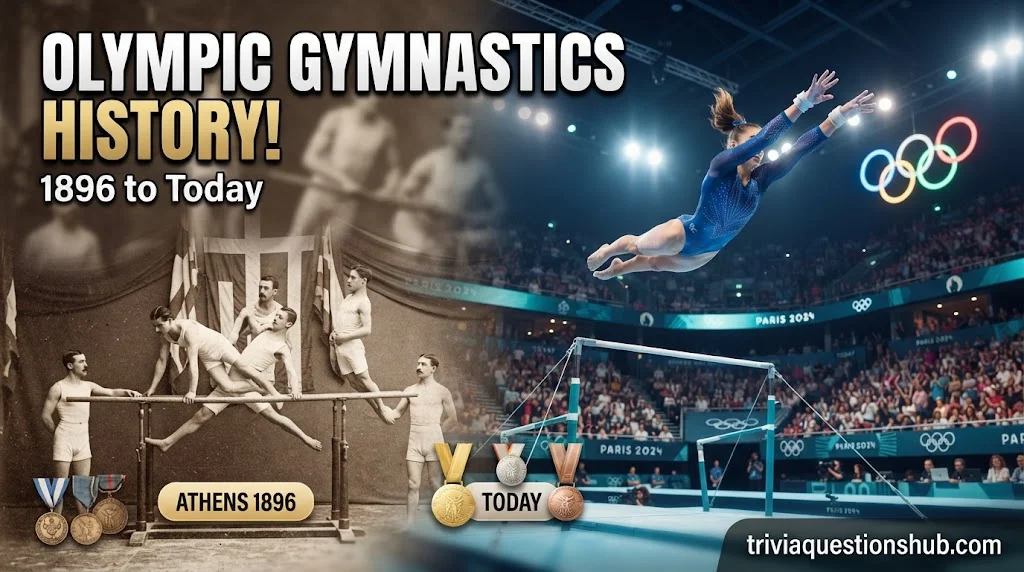
Gymnastics has been part of the Olympic Games since the very first modern Olympics. These questions cover how the sport evolved over more than a century.
Must visite:Odd Laws in US History Trivia: 200+ Bizarre Questions About Weird American Laws
- Q: When did gymnastics first appear at the Olympics? A: 1896, at the first modern Olympic Games in Athens.
- Q: What other sports have been at every Summer Olympics since 1896? A: Athletics, cycling, fencing, and swimming.
- Q: When did women’s artistic gymnastics join the Olympics? A: 1928, at the Amsterdam Games.
- Q: What scoring system did gymnastics originally use? A: A perfect 10-point scale.
- Q: Why was the perfect 10 system replaced? A: Judges adopted an open-ended Code of Points system to better separate elite-level difficulty.
- Q: What are the two main scores judges give today? A: An execution score and a difficulty score.
- Q: What is the Karolyi Ranch? A: The former USA Gymnastics Women’s National Team Training Center in Texas.
- Q: Who owned the Karolyi Ranch? A: Bela and Martha Karolyi.
- Q: Which country dominated Olympic gymnastics during the Cold War era? A: The Soviet Union.
- Q: Which country rose to prominence after Nadia Comaneci’s success? A: Romania.
- Q: When did trampoline become an Olympic sport? A: 2000, at the Sydney Games.
- Q: What are the three disciplines of Olympic gymnastics? A: Artistic, rhythmic, and trampoline.
- Q: What does “artistic gymnastics” refer to? A: Routines performed on apparatus like beam, bars, vault, and floor.
- Q: What is rhythmic gymnastics? A: A discipline combining dance and hand-held apparatus like ribbons and hoops.
- Q: Is rhythmic gymnastics an event for men or women at the Olympics? A: Women only, at the Olympic level.
- Q: What word does “gymnastics” come from? A: The Greek word “gymnos,” meaning naked, referring to how ancient Greeks trained.
- Q: What is a “compulsory” routine? A: A standardized routine once required of all gymnasts, now largely phased out at the elite level.
- Q: What replaced compulsory routines at the elite level? A: Optional routines that let gymnasts choose their own skills.
- Q: When did the asymmetric (uneven) bars get introduced? A: 1934.
- Q: What is the “all-around” competition? A: An event combining scores from all four (or six) apparatus into one overall ranking.
- Q: How many apparatus do women compete on in artistic gymnastics? A: Four.
- Q: How many apparatus do men compete on in artistic gymnastics? A: Six.
- Q: What is a “team final”? A: A competition where a country’s top gymnasts combine scores for one team result.
- Q: What is an “individual event final”? A: A final held for a single apparatus, separate from the all-around.
- Q: Which country won the first-ever Olympic gymnastics gold medal? A: Germany, at the 1896 Athens Games.
- Q: Was men’s or women’s gymnastics added to the Olympics first? A: Men’s, in 1896; women’s followed in 1928.
- Q: What is the minimum age rule in modern Olympic gymnastics? A: Gymnasts must turn 16 in the Olympic year to compete.
- Q: Why was the minimum age rule introduced? A: To protect younger athletes from the physical and mental strain of elite competition.
- Q: What organization governs international gymnastics? A: The International Gymnastics Federation (FIG).
- Q: What organization governs USA gymnastics teams? A: USA Gymnastics.
- Q: How often are the Summer Olympics held? A: Every four years.
- Q: What was unusual about the very early Olympic gymnastics program? A: It included events like rope climbing, club swinging, and tumbling.
- Q: When did club swinging leave the Olympic program? A: After the early 20th century, as gymnastics standardized its events.
- Q: What is the “Magnificent Seven”? A: The nickname for the 1996 U.S. women’s team that won Olympic gold in Atlanta.
- Q: Who were the seven members of the Magnificent Seven? A: Kerri Strug, Shannon Miller, Dominique Moceanu, Dominique Dawes, Amy Chow, Amanda Borden, and Jaycie Phelps.
- Q: Which U.S. city hosted the 1996 Olympics? A: Atlanta, Georgia.
- Q: How many medals did the U.S. win in gymnastics at the 2000 Sydney Olympics? A: Zero.
- Q: Which country won the men’s team gymnastics gold at the 2000 Sydney Olympics? A: China.
- Q: What nation swept the men’s and women’s all-around golds at the 2004 Athens Olympics? A: The United States (Paul Hamm and Carly Patterson).
- Q: What is the “gymternet”? A: An informal community of gymnastics bloggers and superfans who cover the sport in depth online.
Olympic Gymnastics Champions & Legends Trivia Questions

Every era of Olympic gymnastics has its icons. These questions dig into the athletes who defined the sport.
- Q: Who scored the first perfect 10 in Olympic gymnastics history? A: Nadia Comaneci, on the uneven bars, at the 1976 Montreal Olympics.
- Q: How old was Nadia Comaneci when she scored her first perfect 10? A: 14 years old.
- Q: How many perfect 10s did Comaneci earn at the 1976 Olympics? A: Seven.
- Q: How many gold medals did Comaneci win at the 1976 Games? A: Three.
- Q: Who did Nadia Comaneci marry? A: Fellow Olympic gold medalist Bart Conner.
- Q: What country did Nadia Comaneci represent? A: Romania.
- Q: Who was the first American woman to win the Olympic all-around gold? A: Mary Lou Retton, in 1984.
- Q: What nickname was Mary Lou Retton given? A: “America’s Sweetheart.”
- Q: What award did Retton win in 1984 from Sports Illustrated? A: Sportswoman of the Year.
- Q: Which Olympic host city did Mary Lou Retton compete in? A: Los Angeles.
- Q: Who was known for the “Korbut Flip”? A: Olga Korbut.
- Q: What country did Olga Korbut compete for? A: The Soviet Union (born in Belarus).
- Q: What events did Korbut win gold in at the 1972 Munich Olympics? A: Floor exercise and balance beam.
- Q: Who vaulted on an injured ankle to help clinch team gold in 1996? A: Kerri Strug.
- Q: What made Kerri Strug’s 1996 vault iconic? A: She landed on one leg despite a severely injured ankle, securing the U.S. team’s gold.
- Q: Who is considered the most decorated American gymnast of the 1990s? A: Shannon Miller.
- Q: What book did Shannon Miller write? A: “Winning Every Day.”
- Q: What marathon did Shannon Miller run after retiring? A: The New York City Marathon.
- Q: Who was the first African-American woman to win an Olympic gymnastics medal? A: Dominique Dawes, bronze with the U.S. team in 1992.
- Q: Who was the first African-American man to win an Olympic gymnastics medal? A: Jair Lynch.
- Q: Who coached both Nadia Comaneci and Mary Lou Retton? A: Bela Karolyi.
- Q: Who won the 2008 Olympic all-around gold for the U.S. women? A: Nastia Liukin.
- Q: What is notable about Nastia Liukin’s parents? A: Both were former Soviet gymnastics champions.
- Q: Who was Nastia Liukin’s father? A: Valeri Liukin, a four-time Soviet Olympic medalist.
- Q: Who won six of eight possible gold medals at the 1992 Barcelona Olympics? A: Vitaly Scherbo.
- Q: What country did Vitaly Scherbo represent? A: The Unified Team (former Soviet states) at Barcelona.
- Q: Who competed at the 1958 World Championships while five months pregnant? A: Larissa Latynina.
- Q: How many total Olympic medals did Larissa Latynina retire with? A: 18.
- Q: What nickname was Svetlana Boginskaya given? A: The “Belarusian Swan” and “Goddess of Gymnastics.”
- Q: Who broke his knee during the floor exercise at the 1976 Olympics but kept competing? A: Shun Fujimoto of Japan.
- Q: Who is widely regarded as the most decorated gymnast in modern history? A: Simone Biles.
- Q: What is Simone Biles known for contributing to the sport? A: Inventing and landing multiple skills now named after her.
- Q: Which gymnast starred in the Broadway production of “Peter Pan”? A: Cathy Rigby.
- Q: How many times did Dominique Moceanu fall off the balance beam at the 1996 Olympics? A: Two times.
- Q: Who won the individual all-around at the 1992 Olympics? A: Tatiana Gutsu.
- Q: Who tied for gold on vault and won silver on floor at the 1992 Olympics? A: Henrietta Onodi.
- Q: What 2004 all-around champion also qualified for the 2008 Olympics? A: Paul Hamm.
- Q: Whose mother also competed in Olympic gymnastics, for West Germany? A: U.S. gymnast Jana Bieger.
- Q: Who was the 2007 pommel horse world bronze medalist who qualified for the 2008 U.S. team? A: Sasha Artemev.
- Q: Who authored gymnastics-related books alongside their coaching career? A: Multiple champions, including Shannon Miller, have written books sharing their training philosophy.
Olympic Gymnastics Events & Apparatus Trivia Questions
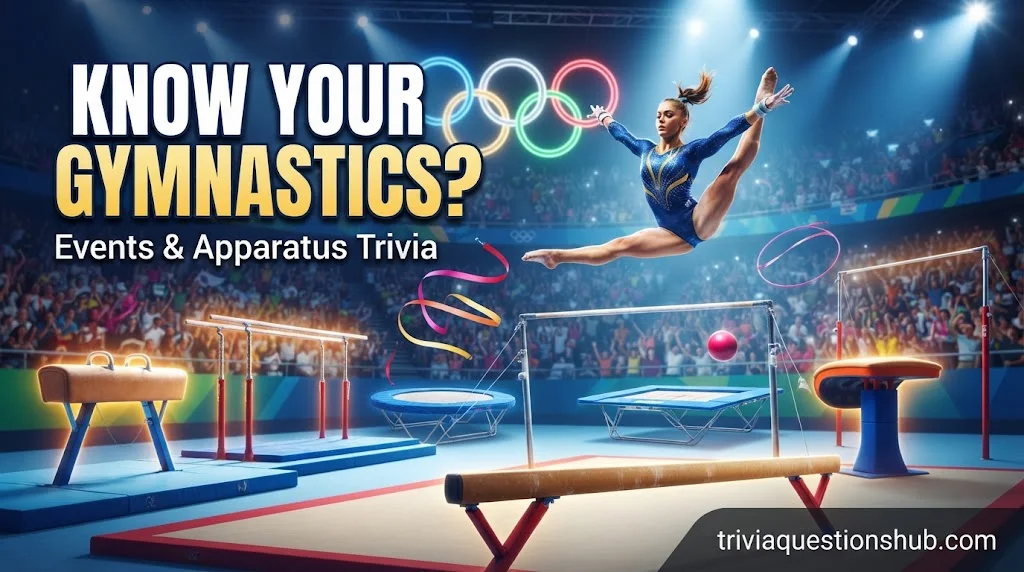
Every gymnastics apparatus demands a different skill set. Here’s what to know about the equipment and event structure.
- Q: What apparatus is sometimes nicknamed “the horse”? A: The vault.
- Q: Why is the vault nicknamed “the horse”? A: Its shape resembles a horse, and it evolved from the pommel horse.
- Q: What apparatus involves a narrow beam performed at height? A: The balance beam.
- Q: What skills are judged on the balance beam? A: Balance, precision, and acrobatic difficulty.
- Q: How many bars make up the uneven bars? A: Two bars, set at different heights.
- Q: How many bars make up the parallel bars? A: Two bars, set at even height (men’s event).
- Q: What apparatus is suspended from the ceiling and requires upper-body strength? A: The rings.
- Q: What is the pommel horse? A: A padded apparatus with handles, used in men’s gymnastics for circular and swinging movements.
- Q: What event has no apparatus at all besides a spring floor? A: The floor exercise.
- Q: Is music used in the women’s floor exercise? A: Yes, women perform choreographed routines set to music.
- Q: Is music used in the men’s floor exercise? A: No, men perform without musical accompaniment.
- Q: What is the high bar? A: A single elevated bar used in men’s gymnastics for swinging and release moves.
- Q: What four events make up women’s Olympic artistic gymnastics? A: Vault, uneven bars, balance beam, and floor exercise.
- Q: What six events make up men’s Olympic artistic gymnastics? A: Floor exercise, pommel horse, rings, vault, parallel bars, and high bar.
- Q: What hand-held apparatus are used in rhythmic gymnastics? A: Ribbon, rope, hoop, clubs, and ball.
- Q: How many rhythmic apparatus are typically used at the Olympics? A: Four, since rope was removed from the Olympic program in recent cycles.
- Q: What discipline involves bouncing to heights of up to eight meters? A: Trampoline.
- Q: How are trampoline routines scored? A: On difficulty, execution, and flight time (time in the air).
- Q: What is a “dismount”? A: The final skill a gymnast performs to land and exit the apparatus.
- Q: What is a “tumbling pass”? A: A sequence of acrobatic skills performed in a straight line, usually on floor.
- Q: What is a “stuck landing”? A: A landing with no extra steps, hops, or wobbles.
- Q: What term describes a routine’s overall skill level? A: Difficulty score.
- Q: What term describes how cleanly a routine is performed? A: Execution score.
- Q: What is a “salto”? A: A somersault performed without hand support.
- Q: What is a “twist” in gymnastics terminology? A: A rotation around the body’s vertical axis, often combined with a salto.
- Q: What is the Yurchenko vault? A: A vault entry named after Soviet gymnast Natalia Yurchenko, involving a round-off onto the springboard.
- Q: Why are vaults often named after gymnasts? A: Because new skills are credited to the first athlete to perform them successfully in competition.
- Q: What is an “optional” routine? A: A routine designed by the gymnast and coach to showcase specific skills, as opposed to a standardized compulsory routine.
- Q: What surface do floor exercises take place on? A: A springed floor designed to absorb impact and aid jumps.
- Q: What is chalk used for in gymnastics? A: To reduce slipping and improve grip on apparatus like bars and rings.
- Q: What is the standard length of a men’s floor routine? A: Roughly 70 seconds.
- Q: Does the floor routine length differ for women? A: Yes, women’s floor routines run about 90 seconds, set to music.
- Q: What does “amplitude” mean in gymnastics judging? A: The height and extension shown during skills, which affects the difficulty score.
- Q: What role does a “spotter” play? A: A coach or assistant who ensures safety during training, though not during Olympic competition.
- Q: What is a “release move” on bars? A: A skill where the gymnast lets go of the bar mid-swing and regrasps it.
- Q: What is meant by “connection value” in scoring? A: Bonus points awarded for successfully linking specific skills together.
- Q: What is an “Olympic trial”? A: A national qualifying competition used to select the team roster for the Olympics.
- Q: How many gymnasts typically make up an Olympic team roster? A: Four to five athletes, depending on the Olympic cycle’s rules.
- Q: What is the significance of the “elite level” in gymnastics? A: It represents the highest competitive tier, from which Olympic teams are selected.
- Q: What is a “vault table”? A: The modern, wider vaulting apparatus that replaced the traditional vaulting horse for safety reasons.
Fun & Surprising Olympic Gymnastics Facts (Trivia Edition)

Beyond the medals and record books, gymnastics history is full of quirky, lesser-known moments.
- Q: When did the U.S. first qualify for men’s Olympic trampoline? A: 2008, in Beijing.
- Q: What happened to gymnast Kevin Tan in 2007? A: He suffered food poisoning after eating a roast beef sandwich.
- Q: How many times did the U.S. win gymnastics medals at the 2000 Sydney Olympics? A: None.
- Q: What injury did Shun Fujimoto compete through in 1976? A: A broken knee, sustained during the team floor exercise.
- Q: What ancient root does the word “gymnastics” trace back to? A: The Greek word for training while unclothed.
- Q: What was once part of the early Olympic gymnastics program but isn’t anymore? A: Rope climbing and club swinging.
- Q: How many judges scored women’s gymnastics at the 1988 Olympics? A: Six.
- Q: What event did Kim Zmeskal medal in at the Olympics? A: The team event, her only Olympic medal.
- Q: What is unusual about men’s and women’s event lists? A: Men compete on six apparatus, while women compete on four; neither gender competes on the other’s exclusive apparatus, like the pommel horse or balance beam.
- Q: What made Dominique Moceanu one of the youngest Olympic gymnasts? A: She competed for the U.S. at just 14 years old in 1996.
- Q: How fast can a vault approach run be? A: Elite gymnasts can reach speeds of roughly 25 kilometers per hour during their vault approach.
- Q: How many types of flexibility does gymnastics training develop? A: Coaches often cite around ten distinct flexibility types needed across events.
- Q: What is a common training age for elite gymnasts to begin? A: Many start structured training as young as four years old.
- Q: How many hours a week might a junior elite gymnast train? A: Upward of 30 hours per week during peak training cycles.
- Q: What percentage of shock can a modern floor exercise mat absorb? A: Roughly 95%, reducing injury risk on landings.
- Q: How many countries typically broadcast major gymnastics competitions? A: Around 100 countries carry international meets like World Championships.
- Q: What is the standard size of an Olympic floor exercise area? A: 12 by 12 meters.
- Q: What material were early trampolines made from? A: Some of the earliest trampolines used kangaroo skin material for the bed.
- Q: Who was Yelena Shushunova? A: A Soviet gymnast who won the rare “grand slam” of Olympic, World, and European all-around titles.
- Q: Who else besides Shushunova achieved the grand slam of all-around titles? A: Ludmilla Tourischeva.
- Q: What Olympic host year introduced trampoline to the program? A: 2000, in Sydney.
- Q: What Olympic sport is closely linked to gymnastics through shared coaching talent? A: Cirque du Soleil-style acrobatic performance, which often recruits former gymnastics coaches.
- Q: Why is gymnastics considered one of the most technically judged Olympic sports? A: Scores often come down to fractions of a point, based on precise execution details.
- Q: What happens if a gymnast falls during a routine? A: A fall typically results in a point deduction from the execution score.
- Q: What is a “junior” gymnast, in competitive terms? A: An athlete who has not yet reached the minimum age to compete at the senior/Olympic level.
- Q: How is degree of difficulty different between a beginner and elite routine? A: Elite routines combine multiple high-value skills with tight connections for maximum difficulty credit.
- Q: What happens during “podium training” at the Olympics? A: Gymnasts get limited practice time on the actual competition apparatus before the event begins.
- Q: Why do gymnasts often compete in glittery, custom leotards? A: Leotard design has become part of team branding and national identity at major competitions.
- Q: What role does a gymnast’s coach play during Olympic competition? A: Coaches can offer brief guidance between rotations but cannot assist during the routine itself.
- Q: What makes gymnastics one of the most-watched Olympic sports? A: Its blend of risk, artistry, and split-second scoring keeps global audiences highly engaged.
How to Use This Olympic Gymnastics Trivia Quiz
This Olympic gymnastics trivia list works well as a party game, classroom activity, or personal challenge.
For trivia night, split guests into teams and award points per correct answer — track scores by section to keep rounds organized. Teachers can pull the history and apparatus sections for a PE or Olympics-themed lesson, pairing questions with a short video of a routine for visual context.
If you want a printable version, group questions into easy, medium, and hard tiers. The history and apparatus sections tend to be easier for casual fans, while the legends and fun-facts sections reward true gym nerds.
FAQs
What are the best Olympic gymnastics trivia questions for a quiz?
The best questions mix eras and difficulty — pairing famous moments like Nadia Comaneci’s perfect 10 with lesser-known facts like judge counts or training details keeps a quiz balanced and engaging for all skill levels.
How much do you know about Olympic gymnastics history?
Olympic gymnastics dates back to the first modern Games in 1896, with women’s events added in 1928. The sport has evolved from a perfect-10 scoring system to today’s open-ended Code of Points, reflecting decades of growing skill and difficulty.
Who was the first gymnast to score a perfect 10 at the Olympics?
Nadia Comaneci of Romania scored the first perfect 10 in Olympic history, on the uneven bars at the 1976 Montreal Games, at just 14 years old.
What are the four women’s Olympic artistic gymnastics events?
Women compete in vault, uneven bars, balance beam, and floor exercise. Scores from all four combine to determine the all-around champion.
Conclusion
Olympic gymnastics has produced some of sports’ most jaw-dropping moments — from perfect 10s to gold-medal vaults on injured ankles. Whether you aced this trivia or learned something new, this sport’s history keeps rewarding a closer look.

Abroy Sohail is the founder and lead content writer at TriviaQuestionsHub.com. Passionate about trivia, general knowledge, and helping readers learn something new every day, Abroy curates and writes engaging quiz content for readers of all ages.