Ultimate Black History Trivia: 150+ Questions to Challenge Your Knowledge
Ready to test what you really know? This Black History trivia collection has over 150 questions and answers, sorted from easy to expert. You’ll find quick warm-ups, deep-cut stumpers, and fun rounds on sports, music, and film.
Whether you’re planning a classroom activity, a family game night, or a workplace trivia round, this Black History Month trivia guide covers names you know and names you should. Grab a pen, pick a round, and see how many you can answer before checking the answer key.Ultimate Black History Trivia .
Table of Contents
Easy Black History Trivia Questions for Beginners and Kids
This round is the perfect warm-up. These easy Black History trivia questions cover the names most people already recognize, so kids, students, and beginners can jump in without feeling lost.Ultimate Black History Trivia.
Must visite :Easter Trivia Questions & Answers: 100 Fun Questions to Test Your Knowledge
- Who refused to give up her bus seat in Montgomery, Alabama, in 1955? Rosa Parks.
- Who delivered the “I Have a Dream” speech in 1963? Martin Luther King Jr.
- Who was the first African American president of the United States? Barack Obama, elected in 2008.
- Who led enslaved people to freedom using the Underground Railroad? Harriet Tubman.
- Who broke the color barrier in Major League Baseball? Jackie Robinson, who signed with the Brooklyn Dodgers in 1947.
- What does NAACP stand for? The National Association for the Advancement of Colored People.
- Who was the first African American Supreme Court Justice? Thurgood Marshall, appointed in 1967.
- Who was the first African American woman elected to the U.S. Congress? Shirley Chisholm, elected in 1968.
- Who was the first African American woman to earn a pilot’s license? Bessie Coleman, who earned it in France in 1921.
- What legislation banned segregation in public places? The Civil Rights Act of 1964.
- Who became the first female Vice President of the United States? Kamala Harris, sworn in during 2021.
- Who was the first Black female billionaire in the world? Oprah Winfrey.
- Who wrote “I Know Why the Caged Bird Sings”? Maya Angelou.
- Which boxer was known as “The Greatest” and refused to fight in the Vietnam War? Muhammad Ali.
- Who was the first Black actor to win an Academy Award for Best Actor? Sidney Poitier, in 1964 for Lilies of the Field.
- Who founded Black History Month? Carter G. Woodson, who started Negro History Week in 1926.
- Why did Carter G. Woodson choose February for Black History Month? It contains the birthdays of Abraham Lincoln and Frederick Douglass.
- What year did the federal government officially recognize Black History Month? 1976.
- Who won four gold medals at the 1936 Berlin Olympics? Jesse Owens.
- Which amendment officially abolished slavery in the United States? The 13th Amendment, ratified in 1865.
- Who wrote “Beloved” and won the Nobel Prize in Literature? Toni Morrison.
- What was the Montgomery Bus Boycott, and how long did it last? A protest against bus segregation that lasted 381 days.
- Who became the first self-made female millionaire in America? Madam C.J. Walker, who built a hair-care and cosmetics empire.
- Which speech did Sojourner Truth deliver in 1851? “Ain’t I a Woman?”
- Who co-founded the NAACP in 1909? W.E.B. Du Bois, along with Ida B. Wells-Barnett and other civil rights leaders.
- What organization did Martin Luther King Jr. help found in 1957? The Southern Christian Leadership Conference (SCLC).
- Which civil rights protests involved activists riding buses into the segregated South? The Freedom Rides of 1961.
- Who was beaten on the Edmund Pettus Bridge during the 1965 Selma march? John Lewis.
- Which movie tells the true story of Black female NASA mathematicians? Hidden Figures.
- Which film covers Martin Luther King Jr.’s voting rights marches? Selma.
- Who played T’Challa in Black Panther? Chadwick Boseman.
- Which singer is known as “the Queen of Jazz”? Ella Fitzgerald.
- What is Juneteenth, and what date is it celebrated? A holiday marking the end of slavery in the U.S., celebrated on June 19.
- Who wrote “Becoming,” a bestselling memoir? Michelle Obama.
- Which young poet performed at President Biden’s 2021 inauguration? Amanda Gorman.
- Who was the first African American to serve as U.S. Secretary of State? Colin Powell.
- Which sport did Jackie Robinson play? Baseball.
- Who is known for the “Lift Every Voice and Sing” anthem? James Weldon Johnson, who wrote the lyrics in 1900.
- Which historical event is Harriet Tubman most famous for? Leading missions on the Underground Railroad, freeing approximately 70 people.
- Who was the first Black president of Harvard University? Claudine Gay, who took office in 2023.
Black History Trivia Questions and Answers on Icons, Movements and Milestones
This round steps up the difficulty. These Black History trivia questions and answers cover the organizations, laws, and turning points that shaped the civil rights era and beyond—topics many quizzes skip over.
- What Supreme Court case in 1896 established “separate but equal”? Plessy v. Ferguson.
- Which 1954 case ruled that school segregation was unconstitutional? Brown v. Board of Education, argued by Thurgood Marshall.
- What was the Student Nonviolent Coordinating Committee (SNCC) formed to do? Organize young activists in nonviolent direct action during the civil rights movement.
- What historic event happened in Tulsa, Oklahoma, in 1921? The Tulsa Race Massacre, which destroyed the prosperous Greenwood District, known as “Black Wall Street.”
- What was “Black Wall Street” before it was destroyed? A thriving Black-owned business district in Tulsa’s Greenwood neighborhood.
- What was the Great Migration? The movement of roughly 6 million Black Americans from the rural South to Northern and Western cities between 1916 and 1970, according to the Smithsonian.
- What does HBCU stand for? Historically Black Colleges and Universities.
- Which university is considered the first HBCU? Cheyney University of Pennsylvania, founded in 1837.
- What was the Voting Rights Act of 1965 designed to do? Eliminate literacy tests and other barriers that stopped Black Americans from voting.
- Which march directly led to the Voting Rights Act of 1965? The Selma to Montgomery marches.
- Who was the first African American to argue a Supreme Court case? Thurgood Marshall, before he joined the bench.
- What did the Emancipation Proclamation accomplish in 1863? It declared enslaved people in Confederate states to be free.
- Which president issued the Emancipation Proclamation? Abraham Lincoln.
- What is the significance of the 14th Amendment? It granted citizenship and equal protection under the law to all people born in the U.S.
- What is the significance of the 15th Amendment? It gave Black men the right to vote in 1870.
- Who was Ida B. Wells-Barnett? A journalist and anti-lynching activist who co-founded the NAACP.
- What did the Fair Housing Act of 1968 prohibit? Housing discrimination based on race, religion, or national origin.
- Which labor leader organized the 1963 March on Washington? A. Philip Randolph.
- How many people attended the March on Washington in 1963? Approximately 250,000 people.
- Who was Bayard Rustin? A civil rights strategist who helped organize the March on Washington and advised MLK on nonviolent protest.
- What was Redlining? A discriminatory practice that denied loans and services to Black neighborhoods, mapped out by federal agencies starting in the 1930s.
- Who was Thurgood Marshall before he became a Supreme Court Justice? The lead attorney for the NAACP Legal Defense Fund.
- What did the 1965 Immigration and Nationality Act have to do with civil rights? It ended a discriminatory quota system rooted in the same era’s racial politics.
- Which activist wrote “The Souls of Black Folk” in 1903? W.E.B. Du Bois.
- What degree did W.E.B. Du Bois earn from Harvard in 1895? He became the first African American to earn a Ph.D. from Harvard.
- Who founded the Black Panther Party in 1966? Huey Newton and Bobby Seale.
- What was the goal of the Black Panther Party’s community programs? Providing free breakfast, healthcare, and education in Black neighborhoods.
- Who was Malcolm X? A civil rights leader who advocated Black empowerment and later founded the Organization of Afro-American Unity.
- What organization did Malcolm X belong to before starting his own movement? The Nation of Islam.
- Who was the first Black woman to serve on the U.S. Supreme Court? Ketanji Brown Jackson, confirmed in 2022.
- Which author wrote “Invisible Man,” a landmark novel on Black identity? Ralph Ellison.
- Who wrote “Native Son,” published in 1940? Richard Wright.
- What was the Harlem Renaissance? A cultural movement in the 1920s that celebrated Black art, music, and literature, centered in New York City.
- Name a key poet of the Harlem Renaissance. Langston Hughes.
- Who was Zora Neale Hurston? A Harlem Renaissance author best known for “Their Eyes Were Watching God.”
- What was the significance of the 1968 Fair Housing Act’s timing? It passed just days after Martin Luther King Jr.’s assassination.
- Who assassinated Martin Luther King Jr., and where? James Earl Ray, in Memphis, Tennessee, in 1968.
- What did the 24th Amendment (1964) eliminate? Poll taxes, which had been used to block Black voters.
- Who led the Children’s Crusade in Birmingham in 1963? Organizers within the SCLC, using student marchers to protest segregation.
- What was the outcome of the 1963 Birmingham campaign? It pressured national leaders and helped push forward the Civil Rights Act of 1964.
Hardest Black History Trivia Questions for Experts and History Buffs
Think you know it all? These hard Black History trivia questions dig into lesser-known figures, inventions, and global history that most quizzes never mention.
- Who led the Haitian Revolution and was nicknamed the “Black Napoleon”? Toussaint L’Ouverture.
- What did the Haitian Revolution accomplish in 1804? It made Haiti the first Black republic and the first nation founded by a successful slave revolt.
- Who led the Pan-Africanism movement in America from 1916 to 1922? Marcus Garvey.
- What organization did Marcus Garvey found? The Universal Negro Improvement Association (UNIA).
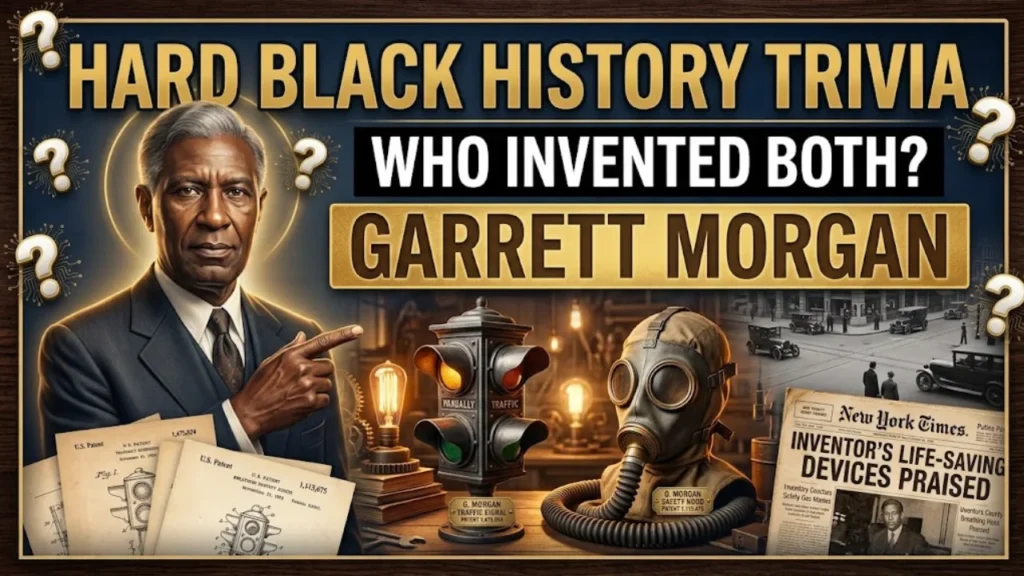
- Who invented the modern traffic signal and the gas mask? Garrett Morgan.
- What agricultural innovations is George Washington Carver best known for? Developing crop rotation methods and hundreds of products from peanuts and sweet potatoes.
- Who invented the carbon filament that made lightbulbs more affordable? Lewis Latimer.
- Who developed methods for storing and processing blood plasma? Dr. Charles Drew, whose research shaped modern blood banks.
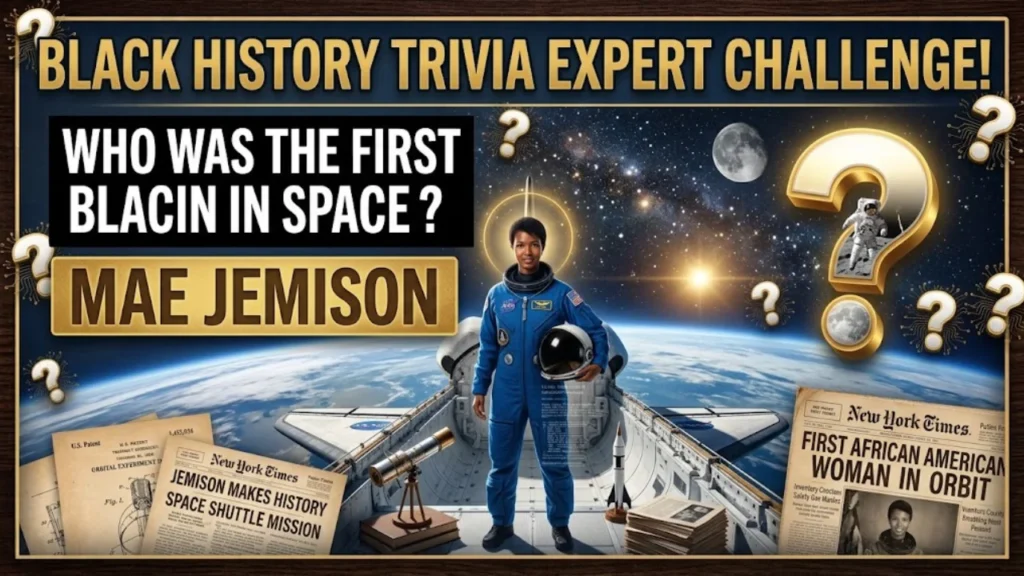
- Who was the first African American woman to travel to space? Mae Jemison, aboard the Space Shuttle Endeavour in 1992.
- Who calculated the trajectory for the first American crewed spaceflight? Katherine Johnson, a NASA mathematician.
- What is the significance of the Tuskegee Airmen? They were the first Black military aviators in the U.S. Armed Forces, serving during World War II.
- How many combat missions did the Tuskegee Airmen fly during WWII? Over 1,500 missions.
- Who were the Buffalo Soldiers? Black U.S. Army regiments formed after the Civil War, known for service on the western frontier.
- Who was the first Black U.S. Army general? Benjamin O. Davis Sr., promoted in 1940.
- Who was Robert Smalls? An enslaved man who commandeered a Confederate ship in 1862 and later served in the U.S. Congress.
- What legal case in 1857 ruled that Black people could not be U.S. citizens? Dred Scott v. Sandford.
- Who was Frederick Douglass before he became an abolitionist leader? An enslaved man who taught himself to read and later escaped to freedom.
- What newspaper did Frederick Douglass publish? The North Star.
- Who was Sojourner Truth’s birth name? Isabella Baumfree.
- What was the significance of the Amistad case in 1841? The Supreme Court ruled that African captives who seized a slave ship had been illegally enslaved and were free.
- Who was the first African American to receive a U.S. patent? Historians credit Thomas Jennings, who patented a dry-cleaning process in 1821.
- Who founded the first Black-owned bank in the United States? True Reformers Bank, founded in 1888 in Richmond, Virginia.
- Who was Maggie Lena Walker? The first woman of any race to charter a bank in the U.S., founding St. Luke Penny Savings Bank in 1903.
- What was the significance of the Niagara Movement, founded in 1905? It was a precursor to the NAACP, formed by W.E.B. Du Bois and other Black leaders.
- Who was the first African American federal judge? William Henry Hastie, appointed in 1937.
- Who was Bass Reeves? One of the first Black deputy U.S. marshals west of the Mississippi River.
- What was the significance of the Combahee River Raid in 1863? Harriet Tubman led a Union Army raid that freed more than 700 enslaved people.
- Who was Crispus Attucks? Often cited as the first person killed in the Boston Massacre of 1770, an early martyr of the American Revolution.
- What percentage of Continental Army soldiers during the Revolutionary War were Black? Historians estimate roughly 5,000 Black soldiers served, among the war’s diverse ranks.
- Who was Phillis Wheatley? The first African American to publish a book of poetry, in 1773, while still enslaved.
- What was significant about Alexander Twilight? He is recognized as the first Black American to earn a college degree, from Middlebury College in 1823.
- Who was Elijah McCoy, and what is he known for? An inventor whose lubrication devices were so reliable that people asked for “the real McCoy.”
- What was the significance of the 1968 Olympics podium protest? Sprinters Tommie Smith and John Carlos raised their fists during the medal ceremony to protest racial injustice.
- Who was the first Black woman to compete for the U.S. in the Winter Olympics? Debi Thomas, a figure skater who competed in 1988.
- Who was Bessie Stringfield? The first Black woman to ride a motorcycle solo across the United States.
Fun Black History Trivia by Category: Sports, Music, Movies and Business
This round covers the fun side of history—sports, music, film, and business. These questions work well for a lighter game night or a casual office round.
- Which basketball legend is nicknamed “His Airness”? Michael Jordan.
- Which tennis player became the first African American man to win Wimbledon? Arthur Ashe, in 1975.
- At what age did Serena Williams win her first U.S. Open? Age 17, in 1999.
- Which athlete holds a record for Olympic gold medals in women’s track and field? Florence Griffith Joyner, known as Flo-Jo.
- Who was the first African American woman to win Olympic gold in gymnastics? Gabby Douglas, in 2012.
- What sport is Simone Biles most decorated in? Gymnastics.
- Which boxer’s professional nickname was “The Greatest”? Muhammad Ali.
- Who created and hosted the music show “Soul Train”? Don Cornelius.
- Which singer is remembered as the “Godfather of Soul”? James Brown.
- What was Michael Jackson’s debut solo album? Off the Wall, released in 1979.
- Which rapper released the album “All Eyez on Me”? Tupac Shakur.
- Which hip-hop group did Ice Cube help found? N.W.A.
- Which singer performed at Super Bowl LVII in 2023? Rihanna.
- Which artist recorded “Let’s Get It On” in 1973? Marvin Gaye.
- Which Motown group did Diana Ross belong to? The Supremes.
- Who played Uncle Phil in The Fresh Prince of Bel-Air? James Avery.
- Which actress won an EGOT (Emmy, Grammy, Oscar, Tony)? Whoopi Goldberg.
- Which sports drama did Michael B. Jordan star in? Creed.
- Who directed Selma and later became the first Black woman to direct a Best Picture Oscar nominee? Ava DuVernay.
- Who played Harriet Tubman in the 2019 film Harriet? Cynthia Erivo.
- Which three NASA mathematicians does Hidden Figures focus on? Katherine Johnson, Dorothy Vaughan, and Mary Jackson.
- Who played Coach Carter in the 2005 sports film? Samuel L. Jackson.
- Which comedian played Prince Akeem in Coming to America? Eddie Murphy.
- Which artist was the artistic director of Louis Vuitton menswear? Virgil Abloh.
- Who became the first African American model on the cover of GQ magazine? Tyra Banks.
- Who founded a media empire after starting with a local talk show? Oprah Winfrey.
- Who was the first African American self-made billionaire? Robert F. Johnson, founder of BET.
- Which entrepreneur built a hair care and cosmetics empire in the early 1900s? Madam C.J. Walker.
- Which basketball player became a majority owner of an NBA franchise? Michael Jordan, with the Charlotte Hornets.
- Who was the first African American to win an Academy Award of any kind? Hattie McDaniel, for Gone with the Wind in 1940.
- Which musician is known for the “Purple Rain” album and film? Prince.
- Which R&B singer’s hit “I Will Always Love You” became one of the best-selling singles of all time? Whitney Houston.
- Which wrestler and actor is regarded as one of the greatest in professional wrestling history? Booker T.
- Which basketball player finished his career with the Boston Celtics? Shaquille O’Neal.
- Who wrote the memoir “The Heart of a Woman”? Maya Angelou.
- Which singer’s Disney Channel debut was in Shake It Up? Zendaya.
- Which sprinter is one of the most celebrated athletes in Olympic history for winning four golds in a single Games? Jesse Owens.
- Who is the first African American woman to become a self-made billionaire? Oprah Winfrey.
- Which film tells the story of the Wakandan superhero T’Challa? Black Panther.
- Who wrote and performed the poem “The Hill We Climb” at a presidential inauguration? Amanda Gorman.
FAQs
What are the best Black History trivia questions to test your knowledge?
The best questions mix well-known figures, like Martin Luther King Jr. and Rosa Parks, with lesser-known names, such as Bessie Coleman or Garrett Morgan. A strong quiz covers civil rights, science, sports, and culture instead of sticking to just one topic.
What are some easy Black History trivia questions for beginners?
Easy questions focus on the most familiar names and events, such as who led the Montgomery Bus Boycott or who wrote “I Have a Dream.” These work well for classrooms, families, and beginners who are just starting to learn.
What are the hardest Black History trivia questions for history experts?
Expert-level questions cover deeper history, including the Haitian Revolution, the Tuskegee Airmen, early Black inventors, and Supreme Court cases like Dred Scott v. Sandford. These questions challenge even serious history buffs.
What are some fun Black History trivia questions for kids and students?
Fun questions for students often center on sports, music, and movies, such as who played T’Challa in Black Panther or who created “Soul Train.” These keep learning light while still building real knowledge.
Conclusion
Black History trivia is more than a game. Every question here connects to a real person who changed law, science, sports, or culture. Whether you started with the easy round or jumped straight to the expert questions, you now have 150+ facts worth remembering long after February ends.
Abroy Sohail is the founder and lead content writer at TriviaQuestionsHub.com. Passionate about trivia, general knowledge, and helping readers learn something new every day, Abroy curates and writes engaging quiz content for readers of all ages.