American Invention History Trivia: 200+ Epic Questions About Inventors, Inventions & U.S. History
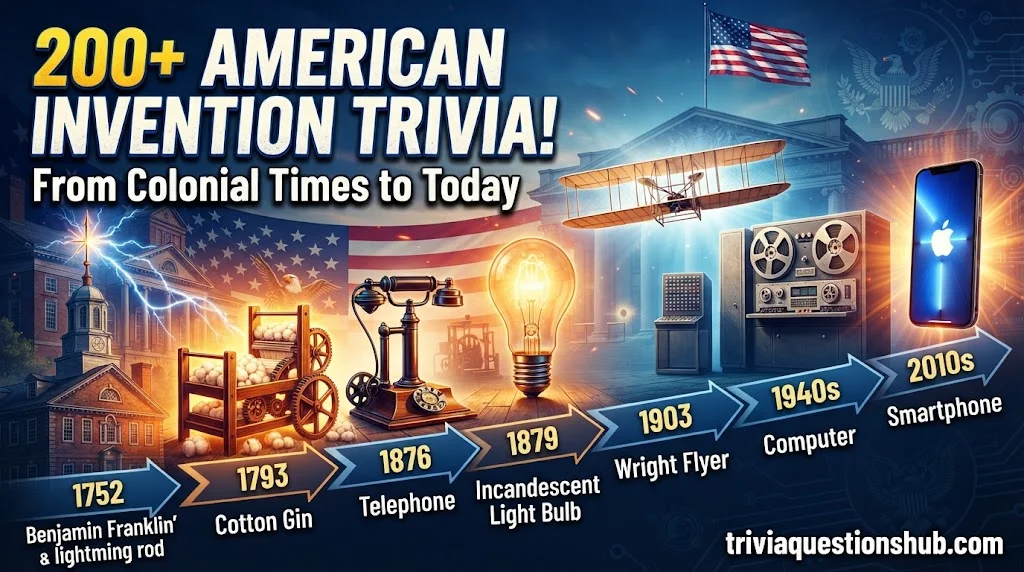
America has always been a nation of tinkerers. From candle-lit workshops to garage startups, American inventors have shaped how the whole world lives, works, and communicates.
This American invention history trivia collection has over 200 questions, sorted by era, so you can test your knowledge from the colonial days all the way to the smartphone age. Grab a notebook, challenge a friend, and see how much U.S. invention history you really know.
Table of Contents
Early American Inventions Trivia (Colonial Era–1700s)
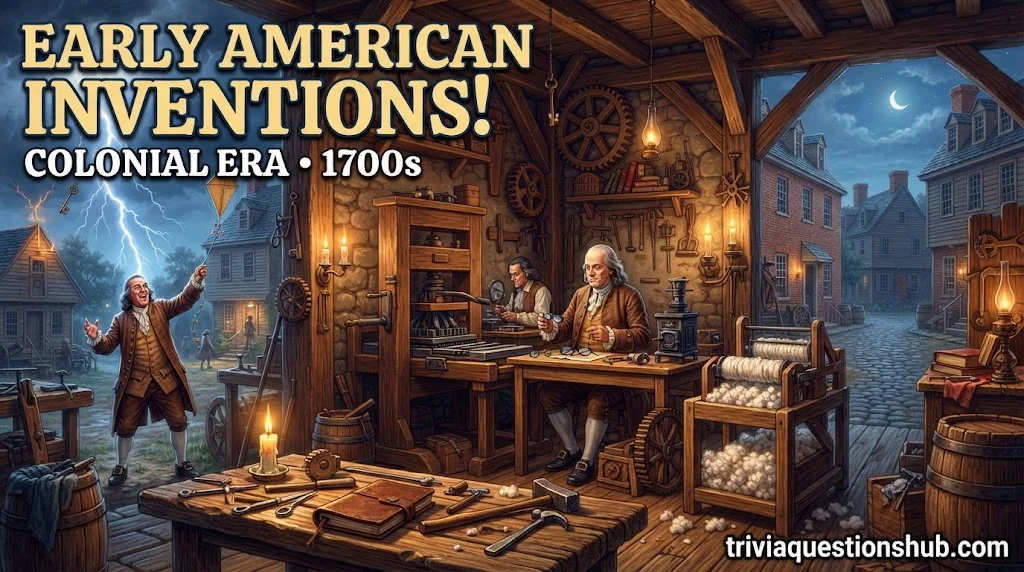
Before the United States even declared independence, colonists were already solving problems with clever new tools. This round of early American inventions trivia covers the founding era’s biggest breakthroughs.
Must visite:Candy History Trivia Questions: 150+ Fascinating Facts About Candy Through the Ages
- Who is credited with inventing the lightning rod in 1752? Benjamin Franklin.
- What famous experiment led Franklin to his lightning rod discovery? The kite experiment, where he flew a kite in a storm to study electricity.
- What was the lightning rod originally designed to protect? Buildings, by giving electricity a safe path to the ground.
- Franklin also invented a heat-efficient stove. What was it called? The Franklin stove.
- What vision problem did Franklin’s bifocals solve? Needing two prescriptions—one for near, one for far—in a single lens.
- Which founding father designed a polygraph-style letter-copying machine? Thomas Jefferson.
- What crop-processing machine, patented in 1794, transformed Southern farming? The cotton gin.
- Who invented the cotton gin? Eli Whitney.
- What did Whitney’s cotton gin actually separate? Cotton fiber from its seeds.
- Whitney is also known for pioneering what manufacturing concept? Interchangeable parts, an idea that later shaped mass production.
- What was the name of the first official U.S. agency to issue patents? The Patent Office, created under the Patent Act of 1790.
- Who signed the first U.S. patent law in 1790? President George Washington.
- What was the very first item ever granted a U.S. patent? A method for making potash, an ingredient used in soap and fertilizer.
- Who received that first U.S. patent in 1790? Samuel Hopkins.
- What early American invention improved farming with a simple metal blade? The cast-iron plow.
- Which Founding Father is often called America’s first true “inventor-statesman”? Benjamin Franklin.
- What communication tool did colonists rely on before the telegraph existed? Hand-written letters carried by post riders.
- What was the name of the printing press style used widely in colonial America? The wooden common press.
- Which invention helped early colonists preserve food through cold winters? The root cellar.
- What natural resource powered most early colonial mills? Water, through water wheels.
- What was one of the first American-made clocks known for? Simple, sturdy wooden gears built by craftsmen instead of imported metal parts.
- Who is considered an early American scientist-inventor for his work with electricity before Franklin’s fame spread internationally? Benjamin Franklin, whose kite experiment made him famous across Europe too.
1800s American Inventions Trivia (Industrial Revolution & Expansion)
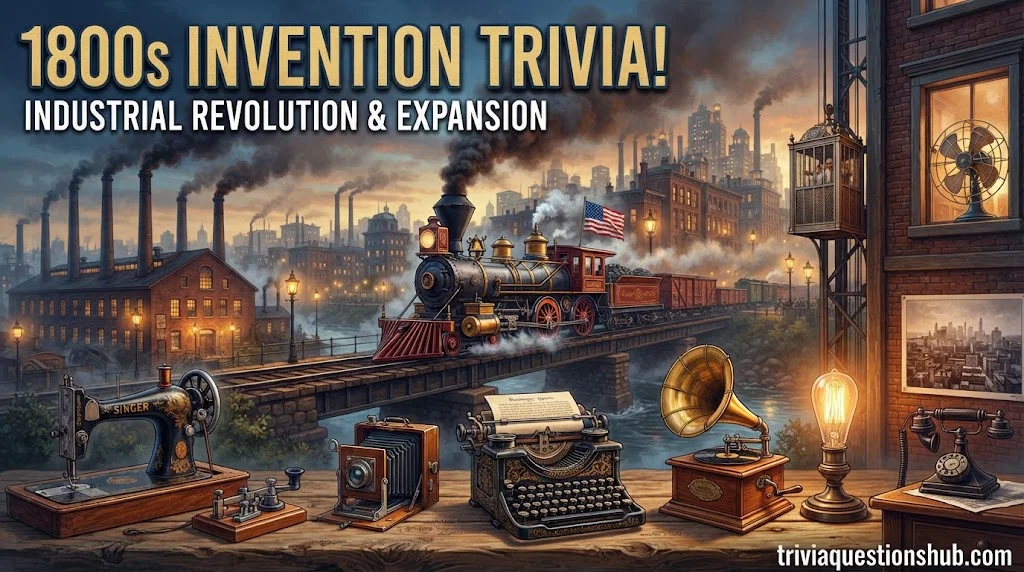
The 1800s turned America into an industrial powerhouse. This section of American inventions trivia questions covers the century’s biggest names—plus the patent fights competitors rarely mention.
- Who invented the telephone in 1876? Alexander Graham Bell.
- What did Bell believe was his most important invention, even more than the telephone? The photophone, a device that transmitted sound on a beam of light.
- Who invented the telegraph? Samuel Morse.
- What code did Morse develop for sending messages? Morse code.
- What was the first message sent over Morse’s telegraph line in 1844? “What hath God wrought.”
- Who is known as “The Wizard of Menlo Park”? Thomas Edison.
- What invention first made Edison a public celebrity? The phonograph, the first device to record and play back sound.
- In what year did Edison demonstrate the phonograph? 1877.
- What did Edison introduce in 1879 that changed nighttime life forever? A commercially viable incandescent light bulb.
- How many U.S. patents did Edison hold in total? Over 1,000.
- What standard socket did Edison create for light bulbs? The Edison screw.
- Who accidentally discovered vulcanized rubber? Charles Goodyear.
- How did Goodyear’s discovery reportedly happen? A rubber-and-sulfur mixture accidentally landed on a hot stove, hardening it into a durable material.
- What company was later named in Goodyear’s honor, though he had no ties to it? Goodyear Tire and Rubber Company.
- Who patented the first practical sewing machine with a lockstitch in 1846? Elias Howe.
- Which inventor did Howe successfully sue for stealing his lockstitch design? Isaac Singer.
- Where did Howe reportedly get the idea to place the eye at the point of the sewing needle? A dream.
- Who invented the first successful air conditioning system? Willis Carrier.
- What insight helped Carrier design his invention? Standing on a foggy train platform, which showed him how humidity control worked.
- What company did Carrier found? Carrier Corporation.
- What rival of Edison invented the air brake for trains? George Westinghouse.
- What electrical current did Westinghouse champion over Edison’s preferred system? Alternating current (AC).
- What was Edison’s preferred, competing electrical system called? Direct current (DC).
- This rivalry became known by what nickname? The “War of the Currents.”
- Who invented the machine gun’s forerunner, meant to reduce the number of soldiers needed in battle? Richard Gatling.
- What was this rapid-fire weapon called? The Gatling gun.
- Which famous gunmaker eventually bought Gatling’s patent? Samuel Colt.
- Who patented roll film and founded a major photography company? George Eastman.
- What company did Eastman found in 1888? Eastman Kodak.
- What communication device could send multiple telegraph messages on one wire, an Edison-era improvement? The quadruplex telegraph.
- Which inventor is credited with early wireless radio innovations, though often overshadowed by Marconi? Nikola Tesla.
- Tesla is best known for his work in what electrical field? Alternating current systems.
- What common household item did Josephine Cochrane patent in 1886? The dishwasher.
- What motivated Cochrane to invent it? She wanted a machine that would wash dishes without chipping her fine china.
- What safety pin was patented in 1849 by which American inventor? Walter Hunt.
- What repeating rifle, key to the “Wild West,” was refined by Oliver Winchester? The Winchester rifle.
- Who developed the first practical typewriter sold commercially in the U.S.? Christopher Latham Sholes.
- What keyboard layout did Sholes help create, still used today? QWERTY.
- What invention by Elisha Otis made skyscrapers possible? The safety elevator brake.
- What demonstration made Otis famous in 1854? He cut the elevator’s cable in front of a crowd to show the safety brake worked.
- Who is credited with inventing the modern refrigerator car for shipping meat? Gustavus Swift popularized its use in the meatpacking industry.
- What invention by Margaret Knight automated the production of flat-bottomed paper bags? The paper bag machine.
- What was unusual about Knight’s fight to patent her invention? A man tried to steal her design, but she proved it in court and won the patent.
- Who developed the incandescent light bulb filament using carbonized bamboo, extending bulb life? Thomas Edison’s lab team.
- Which inventor patented the fountain pen in 1884? Lewis Waterman.
Early-to-Mid 1900s American Inventions Trivia (World Wars & Innovation Boom)
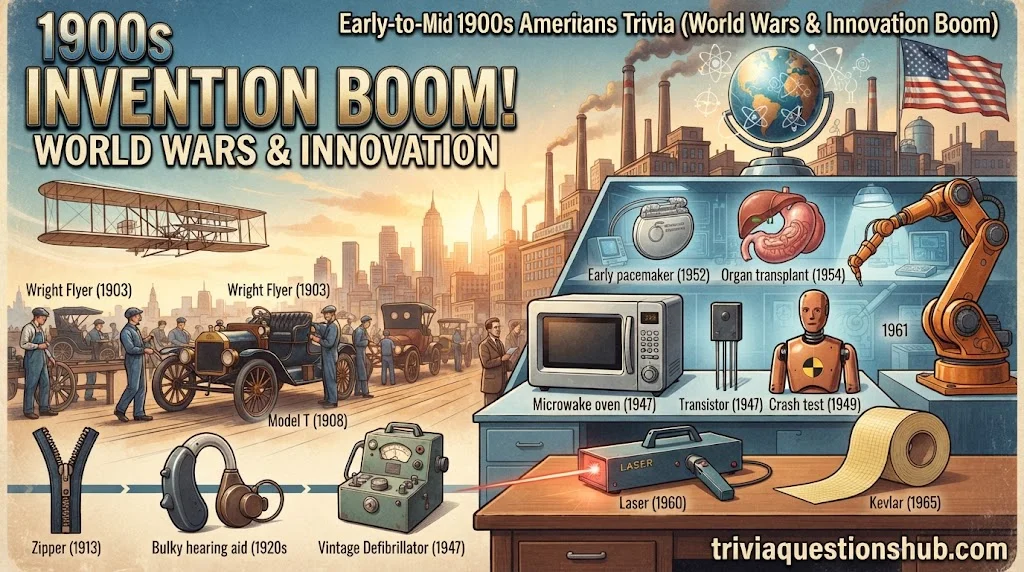
The early 20th century brought American inventions that reshaped transportation, medicine, and daily convenience. Here’s this era’s trivia, from the first flight to the first microwave.
- Who is credited with inventing the first successful airplane? The Wright brothers, Wilbur and Orville.
- Where did the Wright brothers achieve the first powered flight in 1903? Kitty Hawk, North Carolina.
- What was their aircraft named? The Wright Flyer.
- What manufacturing process did Ransom Olds introduce in 1901? The assembly line.
- Who is more famously linked to the moving assembly line, though he improved on Olds’s idea? Henry Ford.
- What Ford car became affordable thanks to assembly-line production? The Model T.
- About how long did it take Ford’s workers to assemble one Model T using the moving line? 93 minutes.
- Why were so many early Model Ts black? Black paint dried fastest, speeding up production.
- Who invented the modern zipper in 1917? Gideon Sundback.
- What clothing problem did the zipper solve better than buttons and laces? Faster, more secure fastening.
- Who invented the first portable electric hearing aid, called the Akouphone? Miller Hutchison.
- In what year was this early hearing aid introduced? 1898.
- Who developed the first cardiac defibrillator? William Kouwenhoven.
- In what year was the first defibrillator introduced? 1930.
- What accidental discovery led to the invention of the microwave oven? A candy bar melted in an engineer’s pocket near radar equipment.
- Who made this discovery? Percy Spencer, in 1945.
- What company did Spencer work for when he made this discovery? Raytheon.
- What dating method, developed in 1946, helps scientists determine the age of ancient organic material? Radiocarbon dating.
- Who developed radiocarbon dating? Willard Libby.
- What element does radiocarbon dating measure? Carbon-14.
- What lab invented the transistor in 1947? Bell Labs.
- Why was the transistor such a huge leap forward? It replaced bulky vacuum tubes, enabling smaller, faster electronics.
- What was the name of the first crash-test dummy, introduced in 1949? Sierra Sam.
- Who created the first crash-test dummy? Samuel Alderson.
- Who designed the first cardiac pacemaker in 1952? Paul Zoll.
- Where was the first successful human organ transplant performed in 1954? Boston.
- What organ was transplanted in that first successful surgery? A kidney, between identical twins.
- Who performed this first organ transplant? Joseph Murray and David Hume.
- Who invented the first modern programmable industrial robot? George Devol.
- What was that robot called? The Unimate.
- Who is known as the “Father of Robotics” for commercializing the Unimate? Joseph Engelberger.
- Who invented the first working laser in 1960? Theodore Maiman.
- What medical procedure today relies heavily on laser technology? LASIK eye surgery.
- What synthetic fiber, five times stronger than steel, did Stephanie Kwolek invent in 1965? Kevlar.
- What is Kevlar most famously used to make? Bulletproof vests.
- Who invented the first Taser in the 1960s? Jack Cover.
- What did “Taser” originally stand for? Thomas A. Swift’s Electric Rifle, named after a fictional character.
- Which American company developed the intercontinental jet engines that made commercial air travel practical after WWII? Pratt & Whitney, among other U.S. manufacturers.
- What wartime technology led directly to the invention of the microwave oven? Radar systems.
Late 1900s–Today: American Inventions Trivia (Space Age to Digital Age)
From moon landings to smartphones, modern American inventions moved faster than ever. This round covers Cold War breakthroughs through today’s digital tools.
- What satellite navigation system did the U.S. Department of Defense originally develop for military use? GPS, the Global Positioning System.
- Between what years was GPS developed? 1973 to 1993.
- Who is credited with inventing the concept for a portable computer called the Dynabook? Alan Kay, in 1968.
- What personal computer, released in 1971, is considered one of the first true PCs? The Kenbak-1.
- Who invented the Kenbak-1? John Blankenbaker.
- What internet backbone protocol did Vinton Cerf and Robert Kahn create in the 1970s? TCP/IP (Transmission Control Protocol/Internet Protocol).
- What U.S. defense agency funded the early internet research project? DARPA.
- Who sent the first email in 1971? Ray Tomlinson.
- What symbol did Tomlinson introduce to separate a username from a location in email addresses? The @ symbol.
- Who made the first public handheld cellphone call in 1973? Martin Cooper, an engineer at Motorola.
- What was the first commercially available handheld cellphone, released a decade later? The Motorola DynaTAC 8000x.
- What was the world’s first smartphone, released in 1992? The IBM Simon.
- Who is credited with designing the IBM Simon? Frank Canova.
- What was the world’s first social media site, launched in 1997? Six Degrees.
- Who founded Six Degrees? Andrew Weinreich.
- What video-sharing platform, founded in 2005, changed how people share content online? YouTube.
- In what year did Netflix launch its streaming service? 2007.
- What company demonstrated some of the earliest live video streaming over the internet? Xerox PARC, in the 1990s.
- What ranking category does the U.S. lead in the Global Innovation Index? Market sophistication.
- What field is the U.S. currently pushing forward alongside space exploration, according to modern innovation reports? Artificial intelligence.
- What company co-founded by Larry Page and Sergey Brin transformed internet search? Google.
- What was Google originally called in its early years? Backrub.
- Where does the name “Google” come from? The mathematical term “googol,” meaning a huge number.
- Who co-founded Microsoft and helped build MS-DOS and Windows? Bill Gates, along with Paul Allen.
- Who co-founded Facebook while a student at Harvard in 2004? Mark Zuckerberg.
- What decade saw the rise of both personal computers and early home video game consoles? The 1970s.
- What company is widely credited with popularizing the personal computer for home use in the late 1970s? Apple, founded by Steve Jobs and Steve Wozniak.
- What technology, first used in fiber optics, allows lasers to carry high-speed internet data? Fiber optic cable transmission.
- What was the primary original purpose of GPS before civilian use expanded? Military satellite navigation.
Famous American Inventors Trivia Challenge (The Deep-Cut Round)
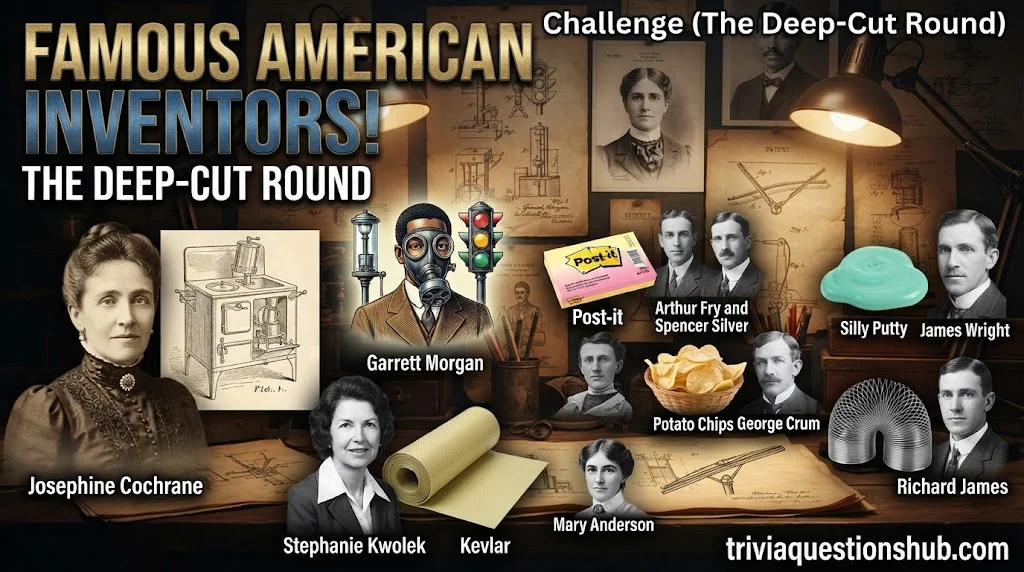
Most trivia lists repeat the same handful of names. This section digs deeper into women inventors, Black American inventors, and strange accidental discoveries most quizzes skip entirely.
Women Inventors in American History
- Who invented the dishwasher in 1886? Josephine Cochrane.
- Who invented Kevlar? Stephanie Kwolek.
- What actress and inventor co-developed early frequency-hopping technology used in modern Wi-Fi and Bluetooth? Hedy Lamarr.
- What did Lamarr’s frequency-hopping invention originally help guide during WWII? Torpedoes.
- Who invented the paper bag machine that produced flat-bottomed bags? Margaret Knight.
- What did Mary Anderson invent in 1903 to improve car safety in bad weather? The windshield wiper.
- Who invented Liquid Paper, the correction fluid used before computers? Bette Nesmith Graham.
- What life-saving heart monitor did Marie Van Brittan Brown help pioneer through her broader home security invention? The home security system with video monitoring, patented in 1969.
- Who developed the formula for a chocolate chip cookie dough used in a baking innovation story tied to Toll House? Ruth Wakefield.
- What material did Patricia Bath, an ophthalmologist, invent a laser device to treat? Cataracts.
Black American Inventors
- Who invented the traffic signal improvement known as the three-position signal? Garrett Morgan.
- What safety device did Garrett Morgan also invent, used by firefighters? The gas mask (safety hood).
- Who improved the carbon filament used in light bulbs, extending their life? Lewis Latimer.
- What company did Lewis Latimer work for as a draftsman and inventor? Edison’s company, General Electric.
- Who became one of the first American women to become a self-made millionaire through hair-care inventions? Madam C.J. Walker.
- Who invented an early version of the gas mask used widely before Morgan’s improvements? Garrett Morgan, again credited for the 1914 design.
- Who patented an improved ironing board design in 1892? Sarah Boone.
- What did Sarah Boone’s ironing board design improve for pressing clothing? Its curved, narrow shape, which made it easier to iron sleeves and fitted garments.
- Who invented an early automatic gear shift used in modern automatic transmissions? Richard Spikes.
- Who patented the shoe-lasting machine, which sped up shoe manufacturing? Jan Ernst Matzeliger.
Accidental & Surprising American Inventions
- What snack food’s popularity boomed after a chef accidentally over-fried potato slices? Potato chips.
- What sticky note product came from a “failed” weak adhesive experiment at 3M? Post-it Notes.
- What soft, colorful children’s toy came from a failed attempt at making a rubber substitute during WWII? Silly Putty.
- What sweetener was discovered accidentally by a chemist who forgot to wash his hands? Saccharin.
- What kitchen appliance came from Percy Spencer’s melted candy bar experiment? The microwave oven.
- What material, discovered by accident during Charles Goodyear’s rubber experiments, revolutionized tires? Vulcanized rubber.
- What popular soft drink was originally created as a medicinal tonic in a pharmacy? Coca-Cola.
- What common building material was discovered when a scientist accidentally overheated a mix of chemicals? Bakelite, the first synthetic plastic.
- What safety glass, now used in windshields, was discovered when a flask coated in dried plastic didn’t shatter? Laminated safety glass.
- What breakfast cereal was invented by accident when boiled wheat was left out too long? Corn flakes, created at the Kellogg brothers’ sanitarium.
- What popsicle treat was invented accidentally by an 11-year-old who left a drink outside overnight? The Popsicle.
- What common food product was created when a cheesemaker accidentally left milk out too long? Some early forms of processed cheese, refined later by James L. Kraft.
- What toy was originally designed as a ship-stabilizing spring before becoming a children’s favorite? The Slinky.
- What was Slinky inventor Richard James originally trying to build? A spring to stabilize equipment on Navy ships.
- What synthetic fabric, invented at DuPont, came from experiments meant to replace silk? Nylon.
- Who is credited with inventing nylon? Wallace Carothers, working at DuPont in the 1930s.
Extra Deep-Cut Inventor & Invention Trivia
- What did Levi Strauss and Jacob Davis patent in 1873 that changed American workwear forever? Riveted blue jeans.
- What was added to jeans to make them stronger for laborers? Copper rivets.
- Who invented barbed wire, a fencing tool that transformed the American West? Joseph Glidden.
- In what year was barbed wire patented? 1874.
- What device, patented in 1888, let people take a step back from bulky camera equipment? The Kodak camera.
- What slogan did George Eastman use to market his easy-to-use camera? “You press the button, we do the rest.”
- What machine, patented in 1903, allowed for cheaper, faster book and newspaper printing? The rotary printing press (improved American models).
- Who invented the modern traffic light system used in most U.S. cities? Garrett Morgan.
- What household staple did Whitcomb Judson help pioneer before Sundback perfected it? An early clasp locker, a precursor to the zipper.
- What common tool did Duncan Black and Alonzo Decker develop, founding a power tool company? The portable power drill.
- What company did Black and Decker found? Black & Decker.
- What invention by Chester Carlson, patented in 1942, transformed offices worldwide? The photocopier (xerography).
- What company later commercialized Carlson’s photocopier technology? Xerox.
- What credit card technology did IBM engineer Forrest Parry help develop in the 1960s? The magnetic stripe card.
- What household cleaning appliance did James Spangler invent, later sold by Hoover? The portable vacuum cleaner.
- What year did Spangler patent his vacuum cleaner design? 1908.
- What common water-safety device, the life jacket, saw major U.S. innovation during wartime shipping needs? The inflatable life vest.
- What synthetic rubber material was developed in the U.S. during WWII due to natural rubber shortages? Neoprene, developed earlier by DuPont and expanded during the war.
- What compact disc and CD-related storage technology had major U.S. corporate contributions in the 1980s? Optical disc storage, developed with U.S. tech companies alongside Sony and Philips.
- What handheld calculator innovation did Texas Instruments help pioneer in the 1960s and 1970s? The portable electronic calculator.
- What barcode scanning system, now used at every checkout counter, was developed with major U.S. research input? The UPC (Universal Product Code) barcode system.
- In what year was the first UPC barcode scanned on a retail product? 1974.
- What was the first product ever scanned with a UPC barcode? A pack of Wrigley’s chewing gum.
- What American company introduced the first commercial ATM machine in the late 1960s? Chemical Bank, in New York.
- What year did the first U.S. ATM open to the public? 1969.
- What invention, patented by Willis Haviland Carrier alongside air conditioning, also transformed food storage? Modern refrigeration systems.
- What water-safety invention, the fire hydrant, saw major American design patents in the 1800s? The modern fire hydrant.
- Who patented an early fire hydrant design in 1801, though records were lost in a fire? Frederick Graff, according to historical accounts.
- What material, invented by Waldo Semon at BFGoodrich, became one of the most widely used plastics in the world? PVC (polyvinyl chloride), developed into flexible vinyl in the 1920s.
- What snack-food packaging innovation, the resealable bag, became a U.S. manufacturing standard in the 20th century? The zip-lock plastic bag.
- Who is credited with patenting the modern zip-lock bag design? Steven Ausnit, through his work with Minigrip.
FAQs
Who are the most famous American inventors in history?
The most famous names include Thomas Edison (light bulb, phonograph), Alexander Graham Bell (telephone), the Wright brothers (airplane), Benjamin Franklin (lightning rod), and Henry Ford (moving assembly line). These inventors are consistently named across sources like the Smithsonian Institution and the U.S. Patent and Trademark Office as some of the most influential in American history.
What was the first invention patented in the United States?
The first U.S. patent was granted in 1790 to Samuel Hopkins for an improved method of making potash, a chemical used in soap and fertilizer production. President George Washington personally signed this patent.
Which American inventions changed everyday life the most?
Everyday life-changers include the light bulb, telephone, automobile assembly line, internet protocols, and the smartphone. These inventions reshaped how Americans work, communicate, travel, and stay connected, and their impact is still visible in daily routines today.
What inventions did Thomas Edison create or improve?
Edison is credited with the phonograph, a commercially viable incandescent light bulb, and major improvements to the telegraph. He held over 1,000 patents, including work on motion pictures, the fluoroscope, and the stock ticker.
Conclusion
American invention history is packed with bold risk-takers, accidental breakthroughs, and everyday problem-solvers who changed the world. Whether you scored high on this American invention history trivia or learned something brand new, one thing is clear: American ingenuity never really stops.

Abroy Sohail is the founder and lead content writer at TriviaQuestionsHub.com. Passionate about trivia, general knowledge, and helping readers learn something new every day, Abroy curates and writes engaging quiz content for readers of all ages.