Beer is one of the oldest drinks on earth, and craft beer has turned an ancient recipe into a modern obsession. From backyard homebrewers to award-winning breweries, millions of Americans now chase flavor, not just a buzz.
This craft beer and brewing trivia guide packs in 250+ questions and answers across history, brewing science, beer styles, big brands, and hard-mode trivia. Whether you’re hosting trivia night or just love a cold one, there’s something here to test you.
Table of Contents
Craft Beer History Trivia: Questions and Answers
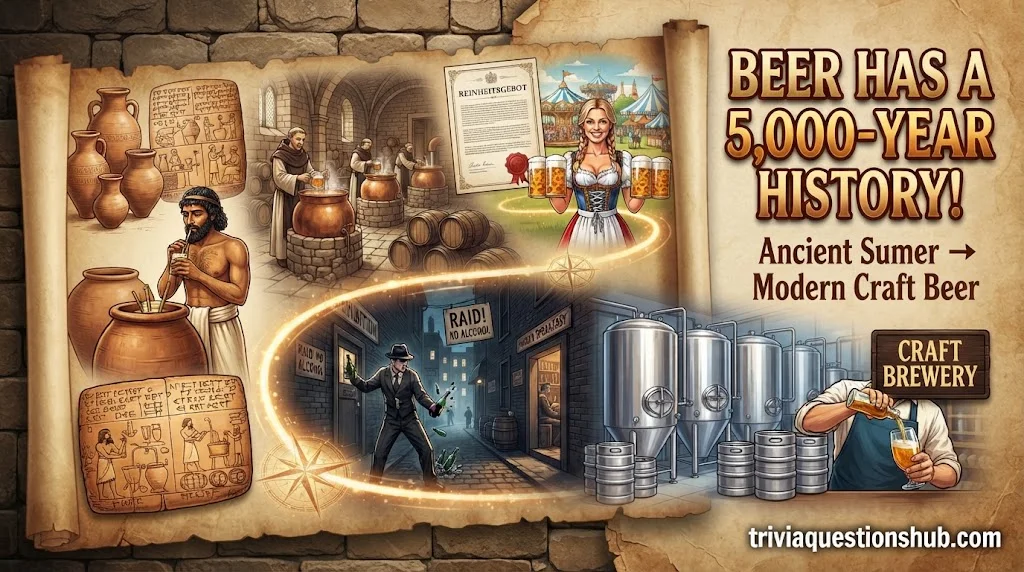
Beer has been around for thousands of years, long before “craft” was even a word. This section covers the roots of craft beer history, from ancient Sumer to the modern American beer boom.Craft Beer and Brewing Trivia.
What ancient civilization is credited with the earliest known beer recipe? Answer: The Sumerians, in Mesopotamia (modern-day Iraq).
What Sumerian goddess was worshipped as the patron of beer? Answer: Ninkasi.
What ancient Babylonian law code included rules for beer sellers? Answer: The Code of Hammurabi.
What German law, passed in 1516, limited beer ingredients to water, barley, and hops? Answer: The Reinheitsgebot, or German Beer Purity Law.
What ingredient was later added to the Reinheitsgebot once its role in fermentation was understood? Answer: Yeast.
In what German region did the Reinheitsgebot first take effect? Answer: Bavaria.
What 1810 royal wedding celebration became the annual festival known as Oktoberfest? Answer: The marriage of Bavarian Crown Prince Ludwig.
Which U.S. constitutional amendment banned the production and sale of alcohol, starting in 1920? Answer: The 18th Amendment.
What amendment repealed Prohibition in 1933? Answer: The 21st Amendment.
What year did Prohibition officially end in the United States? Answer: 1933.
Which U.S. president signed the 1978 federal bill that legalized homebrewing? Answer: Jimmy Carter.
Which U.S. Senator sponsored the homebrewing legalization bill? Answer: Alan Cranston.
What is widely considered the spark that started the modern American craft beer movement? Answer: The legalization of homebrewing in 1978, which trained a generation of future brewers.
What California brewery, founded in 1979 in Chico, became one of the pioneers of American craft beer? Answer: Sierra Nevada Brewing Company.
What Colorado brewery, founded in Fort Collins in 1991, is known for Fat Tire Ale? Answer: New Belgium Brewing.
What organization tracks U.S. brewery counts and craft beer statistics each year? Answer: The Brewers Association.
Roughly how many breweries are operating in the United States today? Answer: Over 9,000, according to Brewers Association data, up from fewer than 100 in the early 1980s.
What nickname is given to beer’s oldest known written recipe, found on a Sumerian tablet? Answer: The Hymn to Ninkasi.
What ancient Egyptian staple was made using barley bread, similar to early beer? Answer: Barley bread beer.
What was the primary role of beer in medieval Europe, besides being a drink? Answer: It was often safer to drink than water, since brewing killed off many pathogens.
What type of beer did monks in medieval monasteries famously brew? Answer: Trappist ales.
Which Belgian monastic order still brews beers like Chimay and Orval today? Answer: The Trappists.
What German city is home to the world’s oldest still-operating brewery, founded in 1040? Answer: Weihenstephan.
What annual Munich festival celebrates a “stronger” style of beer than Oktoberfest? Answer: Starkbierfest.
What percentage of the world’s grain harvest reportedly went toward beer production in 1335? Answer: About one-third.
What was the standard beer bottle size used by most American brewers in the 1990s? Answer: 12 ounces.
What year did canned beer first go on sale in the United States? Answer: 1935.
What New Jersey brewery introduced the first canned beer? Answer: Krueger Brewing Company.
What invention did Iron City Beer introduce to the canned beer market? Answer: The aluminum pull-tab can.
What decade saw the explosive growth of microbreweries across the U.S.? Answer: The 1990s and 2000s.
What term describes a small brewery that also serves food, brewing on-site? Answer: A brewpub.
What is a contract brewing company? Answer: A business that hires an existing brewery to produce its beer under its own label.
What English word for a female brewer dates back to medieval times? Answer: Brewster.
What was beer’s main use besides drinking in ancient Mesopotamia? Answer: It served as payment for laborers, including those who built the pyramids in Egypt.
What historic drinking measurement, still used today, is equal to 31 gallons for beer? Answer: A barrel.
Which country’s beer purity law is the oldest known food-safety regulation still partly in effect? Answer: Germany’s.
What decade is credited with birthing the modern India Pale Ale style for export to colonial India? Answer: The early-to-mid 1800s.
Why were IPAs originally brewed with extra hops? Answer: Hops acted as a natural preservative during the long sea voyage to India.
What annual event, founded in 1982, brings thousands of American brewers together to compete? Answer: The Great American Beer Festival, held in Denver.
What decade marked the rise of hazy, juicy New England IPAs? Answer: The 2010s.
What term describes beer trends shifting toward lower-alcohol, easy-drinking options in recent years? Answer: The rise of session beers.
What sustainability trend has many modern craft breweries adopted around fermentation gasses? Answer: Capturing and reusing CO2 produced during fermentation.
What was the original purpose of adding hops to beer, beyond flavor? Answer: Preservation and bitterness balance against sweet malt.
Before hops became standard, what herb blend did early brewers use to flavor beer? Answer: Gruit.
What 1970s writer is often credited with defining modern “beer styles” as we know them today? Answer: Michael Jackson, the beer and whisky writer.
What decade saw beer styles get formally organized into competition categories in the U.S.? Answer: The 1970s and 1980s.
What historic English brewing profession inspired the name of the porter beer style? Answer: Street and market porters, who carried goods and favored the dark, hearty beer.
What 18th-century Russian empress inspired the creation of the Imperial Stout? Answer: Catherine the Great.
What was the original purpose of brewing an Imperial Stout stronger than a regular stout? Answer: To survive the long trip from England to the Russian court without spoiling.
What modern shorthand describes the wave of small, independent, flavor-focused U.S. breweries? Answer: Craft beer.
Beer Brewing Process Trivia: Grain to Glass
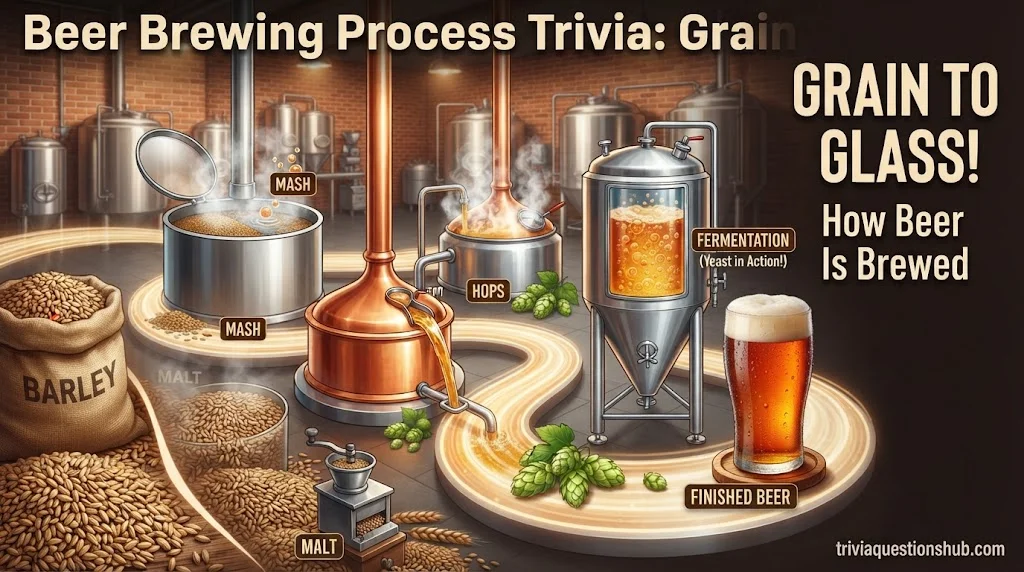
Every beer starts as grain and ends as a glass in your hand. This section breaks down the actual beer brewing process, step by step, from mashing to fermentation.
What are the four core ingredients used in almost all beer? Answer: Water, malt (usually barley), hops, and yeast.
What is the first step in brewing, where crushed grain is mixed with hot water? Answer: The mash.
What sweet liquid is created after the mash is strained? Answer: Wort.
What is the process called that separates the wort from the leftover grain? Answer: Lautering.
What happens to wort once it’s separated from the grain? Answer: It’s boiled, usually for about an hour.
Why is wort boiled before fermentation? Answer: Boiling sterilizes the wort and helps extract bitterness and aroma from the hops.
At what stage during the boil are hops usually added? Answer: Hops are added at different times during the boil for bitterness, flavor, and aroma.
What role do hops play in the brewing process? Answer: Hops add bitterness, flavor, and aroma, and they act as a natural preservative that balances the sweetness of malt.
What plant species do hops come from? Answer: Humulus lupulus.
What U.S. state produces the most hops by far? Answer: Washington, mainly in the Yakima Valley.
What term measures a beer’s bitterness level? Answer: IBU, or International Bitterness Units.
What does yeast do during beer fermentation? Answer: Yeast eats sugar from the wort and converts it into alcohol and carbon dioxide, the process that turns wort into beer.
What single-celled organism is responsible for fermentation? Answer: Yeast, a type of fungus.
What two fermentation byproducts give beer its alcohol and its fizz? Answer: Ethanol (alcohol) and carbon dioxide.
What term describes yeast that ferments at the top of the beer at warmer temperatures? Answer: Ale yeast.
What term describes yeast that ferments at the bottom of the beer at cooler temperatures? Answer: Lager yeast.
What tool measures the sugar content of wort before fermentation? Answer: A hydrometer.
What does a hydrometer reading help brewers calculate? Answer: The beer’s potential alcohol content.
What is the term for a beer’s alcohol content by volume? Answer: ABV, or Alcohol By Volume.
What process adds young, actively fermenting beer to a finished batch to naturally carbonate it? Answer: Kräusening.
What is the general name for the resting period after fermentation, where flavors mellow? Answer: Conditioning.
What brewing step involves adding hops after the boil, without heat, for extra aroma? Answer: Dry-hopping.
What term describes the process of malting barley before brewing? Answer: Germination and drying of the grain to convert starches for brewing.
What professional title describes someone who prepares barley for brewing or distilling? Answer: A maltster.
What common grain, besides barley, is used in some lagers like Japanese Asahi and Sapporo? Answer: Rice.
What is beer made entirely from malted barley, without adjuncts like corn or rice, called? Answer: All-grain beer.
What sugar, derived from milk, is added to give milk stout its signature sweetness? Answer: Lactose.
What process, named for an English town, adds gypsum to brewing water to boost hop flavor? Answer: Burtonisation.
What is the brewing process from grain to glass, in order? Answer: Malting, mashing, lautering, boiling, fermenting, conditioning, and packaging — from raw grain to a finished beer in your glass.
What container is traditionally used to ferment and store beer before kegging or bottling? Answer: A cask, or fermentation tank.
What is a beer’s cloudy, unfiltered version, often labeled “mit hefe” in Germany, made with? Answer: Live yeast left in the bottle.
What word describes beer that still contains active yeast for extra flavor and complexity? Answer: Unfiltered.
What gas is contained in the plastic widget found inside a can of Guinness? Answer: Nitrogen.
Why does nitrogen create a smoother, creamier head than carbon dioxide? Answer: Nitrogen bubbles are smaller and less fizzy, giving a silkier texture.
What is the term for beer brewed with lager yeast but fermented at warmer ale temperatures? Answer: Steam beer.
What West Coast city is historically tied to the steam beer style? Answer: San Francisco.
What is the term for the spontaneous fermentation process used to brew Belgian lambics? Answer: Wild fermentation, using airborne wild yeast and bacteria.
Why can authentic Belgian gueuze only be brewed near Brussels? Answer: It depends on local wild yeast and bacteria unique to that region’s air.
What device measures a beer’s carbonation and pressure during packaging? Answer: A carbonation stone or pressure gauge.
What term describes adding fruit directly to a fermenting beer, common in lambics? Answer: Fruiting.
What raspberry-flavored Belgian lambic style is a common example of fruited beer? Answer: Framboise.
What cherry-flavored Belgian lambic style uses Morello cherries? Answer: Kriek.
What is the general term for hops added purely for aroma near the very end of the boil? Answer: Aroma hops, sometimes called “finishing hops.”
What is the difference between bittering hops and aroma hops? Answer: Bittering hops are added early in the boil for bitterness; aroma hops are added late for smell and flavor.
What are the four classic European hop varieties, prized for low bitterness and high aroma? Answer: The noble hops: Saaz, Hallertauer, Tettnang, and Spalt.
What modern American hop variety, released in 2012, is known for citrus and pine notes in IPAs? Answer: Mosaic hops.
What does the acronym IBU stand for, and what does it measure? Answer: International Bitterness Units, measuring a beer’s hop bitterness.
Why do many beers taste less flavorful when served ice cold? Answer: Cold temperatures dull the tongue’s ability to detect complex flavors.
What term describes beer with lower alcohol content, meant for easy, extended drinking? Answer: A session beer, generally under 5% ABV.
What single step turns sweet wort into alcoholic beer? Answer: Fermentation, driven entirely by yeast.
Beer Styles Trivia: Ales, Lagers, IPAs, and Stouts
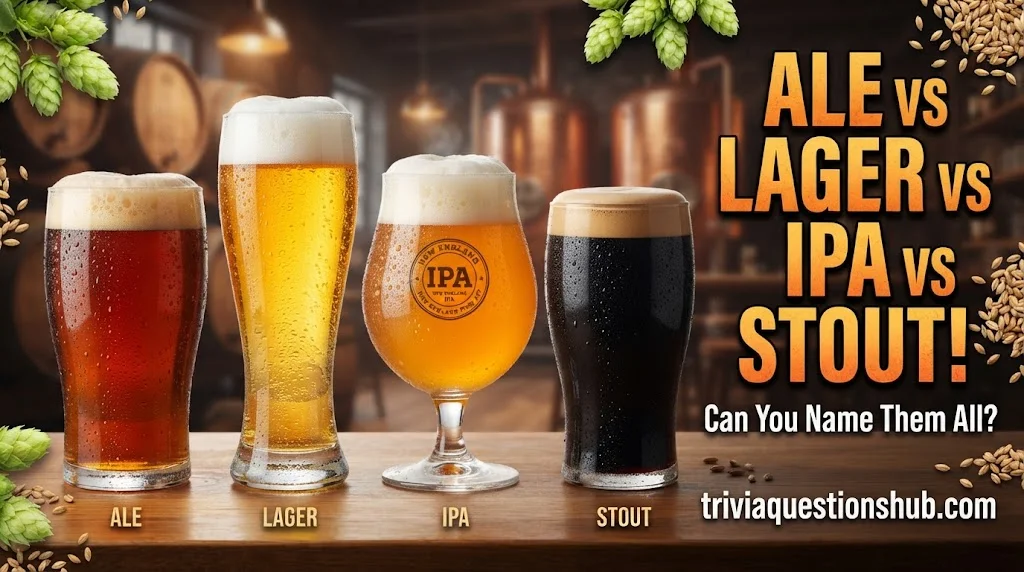
Not all beer is the same. This section dives into beer styles trivia, covering everything from crisp lagers to sour Belgian classics.
What is the difference between an ale and a lager? Answer: Ales ferment warm with top-fermenting yeast and finish fast; lagers ferment cold with bottom-fermenting yeast and age longer, giving a crisper, cleaner taste.
What defines an ale in the simplest terms? Answer: A beer fermented warm, using top-fermenting yeast.
What defines a lager in the simplest terms? Answer: A beer fermented cold, using bottom-fermenting yeast.
What hoppy, bitter beer style was originally brewed strong for the trip from Britain to India? Answer: India Pale Ale (IPA).
What stronger, hoppier version of an IPA typically has a higher ABV? Answer: Double IPA, also called Imperial IPA.
What brewer helped popularize the modern Double IPA at Blind Pig Brewery? Answer: Vinnie Cilurzo.
What dark, roasty beer style is often mistaken as being made with actual chocolate or coffee? Answer: Stout.
What stout variation includes lactose for a sweeter, creamier finish? Answer: Milk stout.
What stronger, richer stout style was originally brewed for Russian royalty? Answer: Imperial stout.
What dark English beer style, named for the workers who loved it, predates the modern stout? Answer: Porter.
What pale, hoppy lager style is named after a town in the Czech Republic? Answer: Pilsner.
What Czech city gave the pilsner style its name? Answer: Pilsen (Plzeň).
Who is credited with brewing the first pilsner in 1842? Answer: Josef Groll.
What Belgian-style wheat beer is brewed with orange peel and coriander? Answer: Witbier.
What American brand, made by MillerCoors, is a well-known witbier? Answer: Blue Moon.
What French word describes a farmhouse-style ale known for spicy, fruity flavor? Answer: Saison.
What class of beers does saison belong to? Answer: Farmhouse ales.
What sour Belgian beer style blends old and young lambics together? Answer: Gueuze.
What tart, salty German beer style has grown popular in American craft brewing? Answer: Gose.
What umbrella term covers gose, lambic, and Flanders red ale? Answer: Sour beers.
What German word describes a dark amber lager, literally meaning “dark”? Answer: Dunkel.
What German dark lager style is even darker than a dunkel, often compared to a black lager? Answer: Schwarzbier.
What strong Belgian Trappist style, brewed dark and malty, comes just before a “tripel” in strength? Answer: Dubbel.
What traditionally strong style, brewed in March and stored for Oktoberfest, is known as Märzen? Answer: Oktoberfest/Märzen lager.
What English style is made by aging mild ale before selling it at a higher price? Answer: Old ale.
What creamy, dry beer style, despite its name, contains no dairy? Answer: Cream ale.
What strong English ale style, despite its name, contains no grapes? Answer: Barleywine.
What is barleywine’s defining trait compared to other ales? Answer: A high alcohol content, usually 6% to 8% ABV or more.
What German shandy-style drink mixes beer with lemon soda? Answer: Radler.
What British drinking term describes an equal mix of cider and lager? Answer: Snakebite.
What Bavarian-origin lager style is traditionally strong and associated with bock festivals? Answer: Bock.
What lighter, more drinkable version of bock is brewed for early spring? Answer: Maibock.
What Finnish farmhouse ale is filtered through juniper twigs? Answer: Sahti.
What style describes beer brewed by freezing and removing ice crystals to boost strength? Answer: Ice beer.
What malt-heavy, high-alcohol beer style is often confused with regular beer but closer to malt liquor? Answer: Malt liquor.
What term describes an unfiltered German wheat beer with a cloudy appearance? Answer: Hefeweizen.
What Belgian strong ale style, often golden and deceptively smooth, shares a name with a religious order? Answer: Trappist ale.
What sour, wild-fermented Belgian style is the base for fruited beers like kriek and framboise? Answer: Lambic.
What juicy, hazy IPA substyle became hugely popular in the 2010s? Answer: New England IPA (NEIPA).
What defines a New England IPA compared to a West Coast IPA? Answer: NEIPAs are hazy, soft, and juicy; West Coast IPAs are clear, bitter, and piney.
What term describes beer brewed with fruit, spices, or other non-traditional flavorings? Answer: Specialty beer, or flavored craft beer.
What English term for pale ale, often cask-conditioned, is common in British pubs? Answer: Bitter.
What golden, hoppy American beer style bridges the gap between a pale ale and a lager? Answer: American pale ale.
What term describes an unpasteurized beer served straight from a cask without extra carbonation? Answer: Cask ale, or “real ale.”
What sweeter, lower-hop lager style is popular in Mexico and often served with lime? Answer: Mexican lager.
What smoky German beer style is made using malt dried over an open flame? Answer: Rauchbier.
What is the general difference in flavor complexity between ales and lagers? Answer: Ales tend to be fruitier and more complex; lagers are cleaner and crisper.
What beer style category do Budweiser, Coors, and Heineken all fall into? Answer: Pilsner-style lagers.
What describes a low-alcohol, easy-drinking beer meant for long drinking sessions? Answer: Session beer, often under 4-5% ABV.
What style term describes beer aged in wooden barrels, often previously used for wine or spirits? Answer: Barrel-aged beer.
Beer Brands and Breweries Trivia: USA and World
Big brands built beer’s global reputation, but American craft breweries changed the game. This section covers both.
What American beer brand is nicknamed the “King of Beers”? Answer: Budweiser.
What Missouri city is home to the Anheuser-Busch brewery? Answer: St. Louis.
What horse breed has been used in Budweiser advertising since 1933? Answer: Clydesdales.
What founding father inspired the name of Samuel Adams beer? Answer: Samuel Adams, the American patriot.
What Boston-based company brews Samuel Adams? Answer: Boston Beer Company.
What California brewery, founded in Chico in 1979, is a pioneer of American craft beer? Answer: Sierra Nevada Brewing Company.
What Colorado brewery is known for Fat Tire Amber Ale and Voodoo Ranger IPA? Answer: New Belgium Brewing.
What Michigan brewery, founded in 1997, makes Kentucky Breakfast Stout (KBS)? Answer: Founders Brewing Company.
What San Diego brewery names many beers after local fish, like Sculpin and Wahoo? Answer: Ballast Point Brewing.
What Scottish brewery known for Punk IPA also operates bars around the world? Answer: BrewDog.
What California brewery makes Lagunitas IPA, named for a small California town? Answer: Lagunitas Brewing Company.
What Pennsylvania brewery, founded in 1829, is the oldest operating brewery in the United States? Answer: Yuengling.
What Texas beer brand markets itself as the “national beer of Texas”? Answer: Lone Star.
What Rhode Island brewery sponsored the first televised Boston Red Sox games in 1945? Answer: Narragansett Beer.
What Pennsylvania beer brand, founded in Latrobe in 1939, is known for green bottles and the number “33”? Answer: Rolling Rock.
What Wisconsin city was once called the beer capital of the world? Answer: Milwaukee.
What Milwaukee beer brand, no longer brewed there, once made the city famous? Answer: Schlitz.
What Colorado city hosts the Great American Beer Festival every year? Answer: Denver.
What Dutch beer brand exports its beer worldwide in signature green bottles? Answer: Heineken.
What country is Heineken headquartered in? Answer: The Netherlands.
What Irish beer brand’s logo features a Celtic harp and the number 1759? Answer: Guinness.
What year was Guinness founded? Answer: 1759.
What Mexican beer brand is famously served with a lime wedge? Answer: Corona.
What Mexican brewery makes Corona and Modelo? Answer: Grupo Modelo, now part of Constellation Brands in the U.S.
What Danish beer brand, founded in Copenhagen in 1847, is known for its green bottles? Answer: Carlsberg.
What Jamaican beer brand is known for its red-and-white label? Answer: Red Stripe.
What Australian beer brand is one of the oldest and best-selling in the country? Answer: Victoria Bitter.
What Singapore-based beer, owned by Heineken, features a big cat on its logo? Answer: Tiger Beer.
What Belgian beer, first brewed in 1926 in Leuven, is one of the best-selling Belgian imports? Answer: Stella Artois.
What Japanese beer brand offers a frozen beer product that reportedly stays cold for 30 minutes? Answer: Kirin.
What Chinese beer is considered the best-selling beer brand in the world by volume? Answer: Snow Beer.
What Belgian beer, brewed by Trappist monks, is famous alongside Orval and Westvleteren? Answer: Chimay.
What food item has the Chimay monastery produced alongside beer since 1876? Answer: Cheese.
What Thai beer brand uses a lion as its logo? Answer: Singha.
What Philippine beer brand is one of the most recognized in Southeast Asia? Answer: San Miguel.
What South African beer brand sponsors the national rugby team, the Springboks? Answer: Castle Beer.
What Namibian brewing tradition traces back to German colonization in the late 1800s? Answer: Namibia’s own Oktoberfest-style beer culture.
What Vermont breweries are known for small-batch, highly sought-after beers? Answer: The Alchemist, Lawson’s Finest Liquids, and Hill Farmstead.
What is special about beer releases from The Alchemist, maker of Heady Topper? Answer: They’re known for extremely limited, highly demanded small-batch IPAs.
What Virginia breweries are commonly grouped together in craft beer trivia? Answer: Starr Hill, Three Notch’d, and Devils Backbone.
What Boston brewery, founded in 1986, is known for its UFO beer series? Answer: Harpoon Brewery.
What Oregon brewery is named after the Sumerian goddess of beer? Answer: Ninkasi Brewing.
What Los Angeles brewery makes Mango Cart Ale and Wolf Pup Session IPA? Answer: Golden Road Brewing.
What term describes a beer brewery owned by a larger corporation but marketed as independent? Answer: A crafty brewery, a term some craft fans use critically.
What certification from the Brewers Association distinguishes true independent craft breweries? Answer: The Independent Craft Brewer Seal.
What percentage ownership limit does the Brewers Association use to define “craft”? Answer: Less than 25% ownership by a non-craft beverage company.
What Colorado brewery, founded in Golden in 1873, remains one of the largest single-site breweries in the world? Answer: Coors.
What beer trademarked a color-changing label that turns blue when “cold as the Rockies”? Answer: Coors Light.
What Missouri-based brewer is now part of the global company AB InBev? Answer: Anheuser-Busch.
What term describes small, local breweries built around community taprooms rather than wide distribution? Answer: Nano breweries or neighborhood breweries.
Hard Beer Trivia Questions: Test True Beer Fans
Think you know beer? These hard beer trivia questions dig into science, cocktails, and pop culture to really put your knowledge to the test.
What is the world’s strongest commercially brewed beer, at 67.5% ABV? Answer: Snake Venom, brewed by Brewmeister in Scotland.
What Scottish brewery made Snake Venom? Answer: Brewmeister.
What cocktail mixes beer with tomato juice, hot sauce, and lime? Answer: A Michelada.
What dark cocktail combines Guinness stout with champagne? Answer: Black Velvet.
What drinking combo pairs a shot of whiskey with a beer chaser? Answer: A Boilermaker.
What rum-and-ginger-beer cocktail is a bar staple in Bermuda and England? Answer: A Dark ‘n’ Stormy.
What rum brand has trademarked the name “Dark ‘n’ Stormy”? Answer: Gosling’s.
What Irish-style cocktail layers stout on top of pale ale? Answer: A Black and Tan.
What term describes a 32-ounce beer container, a portmanteau of “half” and “growler”? Answer: A howler.
What drinking game involves bouncing a quarter into a shot glass? Answer: Quarters.
What popular party drinking game shares its name with a Middle Eastern capital city? Answer: Beirut, a nickname for beer pong.
What snack food, despite the name, contains no actual beer? Answer: Beer Nuts, which are simply glazed peanuts.
What movie alien famously gets tipsy on beer found in a home refrigerator? Answer: E.T., from E.T. the Extra-Terrestrial.
What 1995 Super Bowl commercial featured three animals repeatedly croaking “Budweiser”? Answer: The Budweiser Frogs commercial.
What ad campaign featured “The Most Interesting Man in the World” for Dos Equis? Answer: Dos Equis’s long-running ad campaign, starring actor Jonathan Goldsmith.
What sitcom featured Cleveland friends drinking a fictional brew called “Buzz Beer”? Answer: The Drew Carey Show.
What James Bond film featured 007 drinking an on-screen Heineken? Answer: Skyfall (2012).
What Charles Dickens novel features an abandoned brewery once run by Miss Havisham? Answer: Great Expectations.
What large mug for drinking beer, traditionally made of clay with a lid, gets its name from the German word for “stone”? Answer: A stein.
What two-pint tall glass shares its name with a unit of length? Answer: A yard glass, sometimes just called a “yard.”
What barrel-shaped drinking container is a fixture at college parties? Answer: A keg.
What is the correct term for the circular opening in a keg or barrel where beer flows out? Answer: A bunghole.
What sommelier-style certification exists specifically for beer experts? Answer: A Cicerone.
What byproduct of brewer’s yeast became a famous Australian food spread? Answer: Vegemite.
What term describes flat, low-strength beer traditionally served at medieval English mealtimes? Answer: Small beer.
What frozen dessert drink classically combines vanilla ice cream and root beer? Answer: A beer float.
What Finnish tradition involves men competing while carrying their wives, with beer as a prize? Answer: Wife-carrying.
What acronym describes a strong, high-fermentable-sugar beer, often above 1.075 original gravity? Answer: High-gravity beer.
What term describes beer aged and fermented using bacteria typically considered “off-flavors” elsewhere? Answer: Sour beer or wild ale.
What describes the natural aging process that mellows a barleywine or imperial stout over time? Answer: Cellaring.
What packaging trend has grown fastest in craft beer over the last decade, replacing many bottles? Answer: Canning, largely due to freshness and portability.
What common misconception exists about dark beers like stout and porter? Answer: That they’re automatically higher in alcohol than light beers — many aren’t.
What determines a beer’s calorie count more than its color? Answer: Its alcohol and residual sugar content, not how dark it looks.
What scientific tool tracks fermentation progress by measuring sugar density over time? Answer: A hydrometer, used before and during fermentation.
What gas, other than carbon dioxide, is sometimes used for a creamier beer pour? Answer: Nitrogen.
What term describes the foam that forms on top of a poured beer? Answer: The head.
What compounds in hops and malt contribute most to a beer’s aroma? Answer: Essential oils and Maillard reaction compounds from roasted malt.
What household chemistry concept explains why shaking a beer makes it foam more? Answer: Agitation releases dissolved carbon dioxide rapidly.
What is the correct glassware shape for capturing a Belgian ale’s aroma? Answer: A tulip glass.
What is the ideal serving temperature range for most craft ales, according to brewers? Answer: Roughly 45–55°F, warmer than a typical refrigerator.
What ideal serving temperature is recommended for crisp lagers? Answer: Around 38–45°F.
What packaging trend lets breweries test small-batch beers before wide release? Answer: Limited-release cans, often sold only at the taproom.
What modern trend uses QR codes on cans to share brewing details with drinkers? Answer: Smart packaging or QR-linked tasting notes.
What term describes a beer release so anticipated that fans camp out or wait in long lines? Answer: A hype release.
What Vermont beer, Heady Topper, is often cited as starting the hype-release trend? Answer: The Alchemist’s Heady Topper.
What describes beer collaborations between two or more breweries on a single batch? Answer: A collab beer or collaboration brew.
What global event, held every fall, promotes the sale and awareness of American craft beer? Answer: American Craft Beer Week.
What is a “beer flight,” commonly offered at taprooms? Answer: A sampler set of small pours, usually 4 to 6 different beers.
What term describes a beer enthusiast deeply engaged with tasting, rating, and collecting rare beers? Answer: A beer geek or beer nerd.
What overall trend best sums up American beer culture in the 21st century? Answer: The shift from a handful of mass-market lagers to thousands of independent craft breweries offering huge variety.
FAQs
What role do hops play in the brewing process?
Answer: Hops add bitterness, flavor, and aroma to beer. They also act as a natural preservative, which is why hop-heavy styles like IPA were originally brewed strong for long voyages.
What does yeast do during beer fermentation?
Answer: Yeast consumes sugar from the wort and converts it into alcohol and carbon dioxide. This single process is what turns sweet wort into finished beer.
What is the difference between an ale and a lager?
Answer: Ales ferment warm with top-fermenting yeast, giving a fruitier, more complex taste. Lagers ferment cold with bottom-fermenting yeast, giving a cleaner, crisper finish.
What is the brewing process from grain to glass?
Answer: It runs through malting, mashing, lautering, boiling, fermenting, conditioning, and packaging — each step turning raw grain into the beer poured into your glass.
Conclusion
Beer’s story runs from ancient Sumerian tablets to modern American craft breweries pouring hazy IPAs. With 250+ questions covering history, brewing science, styles, and brands, this guide gives true beer fans plenty to test their knowledge — and plenty to argue about over the next round.
Abroy Sohail is the founder and lead content writer at TriviaQuestionsHub.com. Passionate about trivia, general knowledge, and helping readers learn something new every day, Abroy curates and writes engaging quiz content for readers of all ages.