Hawaiian Heritage Trivia: 100+ Amazing Questions & Answers
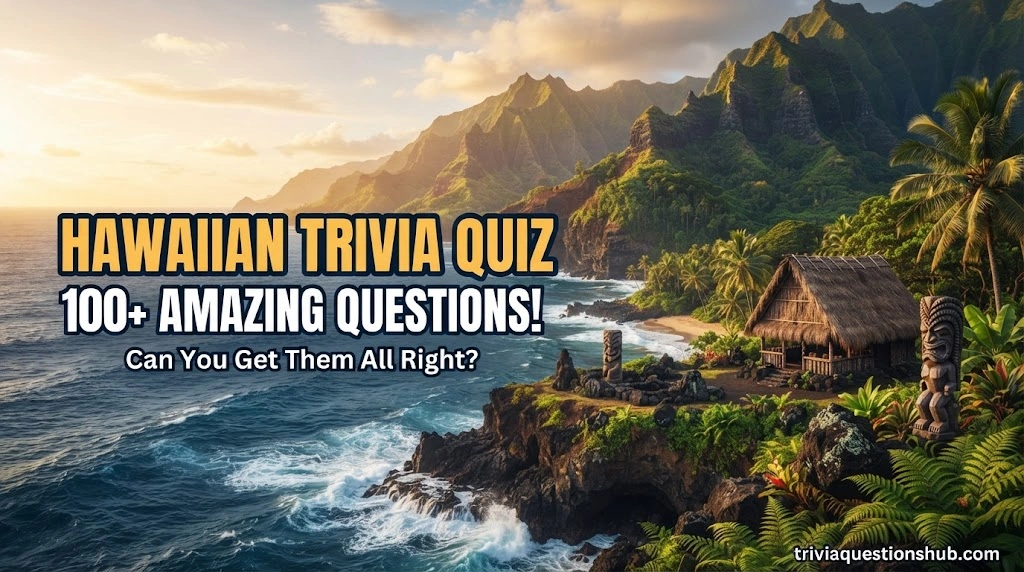
Hawaii is more than beaches and sunsets. Its islands hold thousands of years of stories about gods, demigods, and spirits that still shape local life today. This Hawaiian mythology and culture trivia collection pulls together 100+ questions on everything from fire goddesses to hidden forest people.
Whether you’re studying for a quiz night, planning a trip, or just curious about Hawaiian culture trivia, this guide covers the gods, the legends, the language, and the real history behind them. Every question comes with a full answer, not just a one-line fact.Hawaiian Heritage Trivia.
Table of Contents
What Is Hawaiian Mythology and Culture Trivia?
Hawaiian mythology and culture trivia covers questions about the gods, spirits, legends, and traditions of the Hawaiian Islands. It blends two things: mythology (gods like Pele and demigods like Māui) and living culture (language, food, hula, and customs still practiced today).Hawaiian Heritage Trivia.
Must visite:New England Historical Landmarks Trivia: 100+ Amazing Questions & Answers
This kind of trivia is popular because Hawaiian stories are dramatic and still visible in real places. You can visit Kīlauea, the volcano tied to Pele, or Haleakalā, where Māui supposedly caught the sun. Below, the questions are grouped into four sections: gods and goddesses, demigods and legendary creatures, culture and language, and real history tied to legend.
Gods and Goddesses in Hawaiian Mythology Trivia
Hawaiian mythology has a rich pantheon of gods tied to nature. Here are 25 questions on the major deities every fan of Hawaiian mythology trivia should know.
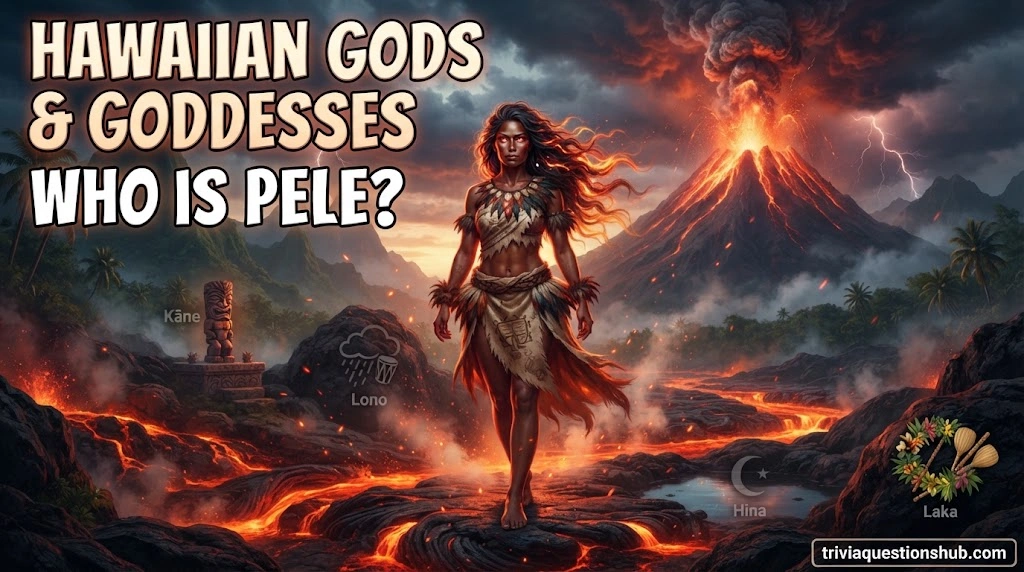
1. Who is Pele in Hawaiian mythology?
Pele is the goddess of fire, lightning, wind, and volcanoes. She is believed to live inside Kīlauea, one of the most active volcanoes on Earth, according to the U.S. Geological Survey. Locals still describe her as hot-tempered and protective of her territory.
2. Why do people avoid taking lava rocks from Hawaii?
Legend says Pele curses anyone who removes lava rock or sand from the islands. Hawaii’s national parks receive so many “conscience letters” and mailed-back rocks each year that rangers keep a special collection of them.
3. Who is Kāne in Hawaiian mythology?
Kāne is considered the highest god and the creator of life. He is credited with breathing life into the first man, and he represents sunlight, fresh water, and forests.
4. What does Kanaloa represent?
Kanaloa is the god of the ocean and often linked to the octopus or squid. He is usually paired with Kāne in Hawaiian chants and stories about creation.
5. Who is Lono in Hawaiian mythology?
Lono is the god of agriculture, rain, fertility, and peace. He is closely tied to the Makahiki season, a traditional harvest festival that included rest from war.
6. Why was Captain Cook mistaken for the god Lono?
When British explorer James Cook arrived in 1778 during the Makahiki season, some Hawaiians believed his ships resembled symbols associated with Lono. This mistaken identity is a well-documented part of Hawaiian contact history.
7. Who is Wākea in Hawaiian mythology?
Wākea is the sky father, one of the earliest ancestral figures in Hawaiian genealogy chants. He is often paired with the earth mother, Papahānaumoku.
8. Who is Papahānaumoku?
Papahānaumoku, or Papa, is the earth mother goddess. Together with Wākea, she is considered an ancestor of the Hawaiian Islands themselves in traditional genealogy.
9. Who is Haumea in Hawaiian mythology?
Haumea is the goddess of childbirth and fertility. She is also linked to the natural landscape and considered an ancient form of Papa in some traditions.
10. Who is Hina in Hawaiian mythology?
Hina is a moon goddess and the mother of the demigod Māui. Stories describe her carrying the moon in a calabash (a gourd container) before eventually living there.
11. What are Hina’s daughters known for?
Hina had several daughters connected to natural forces, including ones associated with fire, the sea, and rain. This shows how Hawaiian mythology often links family lines to elements of nature.
12. Who is Laka in Hawaiian mythology?
Laka is the goddess of hula, forests, and dance. Hula dancers traditionally honor her before performances as the patron spirit of the art form.
13. What is the relationship between Pele and Hiʻiaka?
Hiʻiakaikapoliopele, often shortened to Hiʻiaka, is Pele’s younger sister. She is a goddess associated with hula, healing, and sorcery, and one of the most famous Hawaiian epic stories, the “Pele and Hiʻiaka” saga, follows her journey.
14. How did Pele carry Hiʻiaka as an infant?
According to legend, Pele carried Hiʻiaka in the form of an egg tucked under her arm from island to island. This detail appears across multiple versions of the Pele mythology.
15. Who is Kamapuaʻa?
Kamapuaʻa is a shapeshifting hog-god who could also appear as a man or fish. He is best known for his stormy romance and rivalry with Pele.
16. What happened between Pele and Kamapuaʻa?
The two fell in love and married, but their opposite temperaments led to fierce conflict—Pele using lava and Kamapuaʻa using rain and floods. Their feud is a classic example of nature-based storytelling in Hawaiian myth.
17. Why is the reef triggerfish connected to Kamapuaʻa?
Legend says Kamapuaʻa transformed into a fish to escape Pele’s wrath. That fish, the humuhumunukunukuāpuaʻa, is now Hawaii’s official state fish.
18. Who is Kihawahine in Hawaiian mythology?
Kihawahine is a lizard or dragon-like goddess connected to royal lineages, particularly in Maui traditions. She was worshipped as a protective deity by Hawaiian chiefs.
19. What is the Hawaiian concept of an ʻaumakua?
An ʻaumakua is a family or personal guardian spirit, often taking the form of an animal like a shark, owl, or turtle. Families are taught to respect and never harm their ʻaumakua.
20. What animal is a common ʻaumakua in Hawaiian belief?
The honu, or green sea turtle, is one of the most common ʻaumakua. It is seen as a symbol of guidance, longevity, and protection.
21. Who is Kūkaʻilimoku?
Kūkaʻilimoku, often called Kū, is the god of war. King Kamehameha I is said to have carried a feathered image of Kū into battle for protection and strength.
22. What is the Hawaiian creation chant called?
The Kumulipo is the traditional Hawaiian creation chant, tracing the origin of the universe and the genealogy of Hawaiian royalty across thousands of lines.
23. What role did chants play in passing down mythology?
Hawaiian myths were passed down orally for generations through chants, or mele, long before they were ever written down. This oral tradition preserved genealogy, history, and religious belief.
24. Are Hawaiian gods tied to specific natural elements?
Yes. Almost every major god or goddess represents a force of nature—fire, ocean, sky, rain, or forest—reflecting how closely Hawaiian spirituality is tied to the land.
25. Why does Hawaiian mythology feature so many nature deities?
Traditional Hawaiian life depended entirely on the land and sea for survival. Assigning gods to natural forces helped explain events like eruptions, storms, and harvests, and encouraged respect for the environment.
Demigods, Legends, and Mythical Creatures Trivia
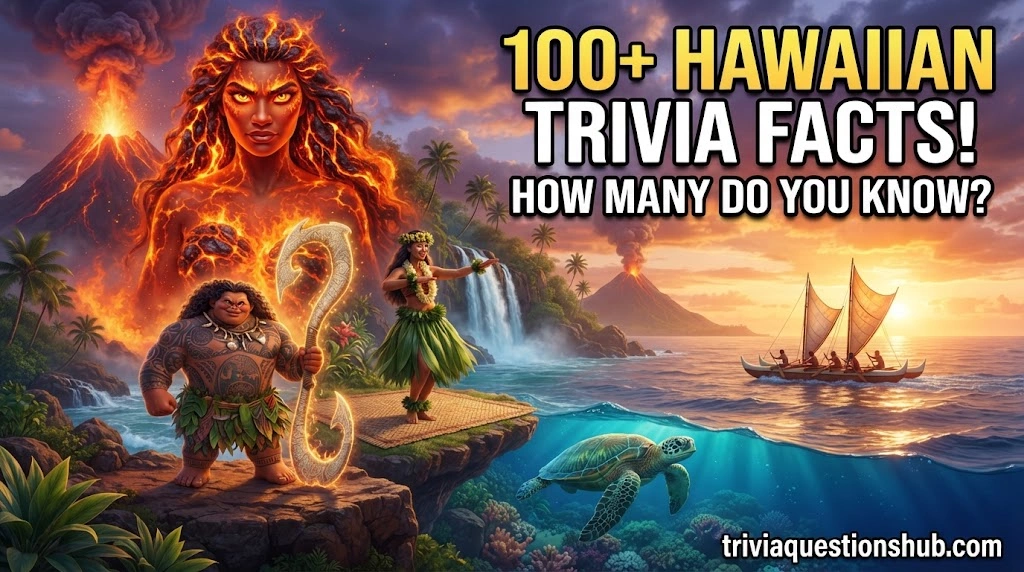
Beyond the gods, Hawaiian folklore is full of tricksters, spirits, and legendary creatures. These 25 questions dig into the demigods and beings that make Hawaiian mythology trivia so memorable.
26. What is Maui known for in Hawaiian mythology?
Māui is a trickster demigod famous for fishing up the Hawaiian Islands with a magic hook and slowing down the sun. He is one of the most beloved figures across all of Polynesian mythology, not just Hawaii.
27. How did Māui pull up the Hawaiian Islands?
Legend says Māui used a magic fishhook to drag the islands up from the ocean floor while fishing with his brothers. He tricked his brothers into not looking back, which the story says is why the islands separated instead of joining as one landmass.
28. Why did Māui capture the sun?
Early stories say the sun moved so fast that days lasted only a few minutes, making it impossible to dry cloth or grow crops. Māui lassoed the sun at the summit of Haleakalā and forced it to slow down.
29. What does the name Haleakalā mean?
Haleakalā translates to “House of the Sun” in Hawaiian. The name directly references the legend of Māui capturing the sun at its summit.
30. How did Māui lift the sky?
One legend says the sky once hung so low that people had to crawl and trees were crushed. Māui lifted it first to the treetops, then the mountains, and finally into place, all to win a drink of water from a woman’s calabash.
31. Who are the Menehune in Hawaiian legend?
The Menehune are a legendary race of small, skilled builders said to predate the arrival of Polynesian settlers. They are described as expert craftsmen who built fishponds, roads, and temples.
32. What is the Menehune Fishpond?
The Alekoko Fishpond on Kauai, also called the Menehune Fishpond, is said to have been built by the Menehune in a single night. The stone wall stretches roughly 900 feet long, and the site is now listed on the National Register of Historic Places.
33. What happens if you break a promise to the Menehune?
Legend says the Menehune are helpful but can turn vengeful if humans fail to honor a deal. One story tells of a chief who nearly angered them by running out of fish payment before substituting tiny shrimp instead.
34. Who are the Night Marchers in Hawaiian legend?
The Night Marchers, or huakaʻi pō, are ghostly processions of ancient warriors said to march at night, often to the sound of drums and conch shells. They are believed to be searching for lost territory or an exit to the afterlife.
35. Where are Night Marchers commonly reported?
Popular sighting locations include Nuʻuanu Pali Lookout, Kaʻaʻawa Valley, and Kalihi Valley on Oahu, along with Kaunakakai on Molokai. Locals traditionally show respect by staying silent and avoiding eye contact if they encounter one.
36. What should you do if you see a Night Marcher?
Tradition says you should never look directly at them or interrupt their path. Locals believe locking eyes with a Night Marcher can bring serious bad luck.
37. What is the legend of the honu, or sea turtle?
The honu is considered a sacred ancestral spirit, or ʻaumakua, believed to offer protection and guidance. One legend describes a female turtle transforming into a human child to play with local kids near the shore.
38. Where can you commonly see honu in Hawaii?
Kahaluʻu Bay on the Big Island is a well-known spot for snorkelers to see green sea turtles resting near shore. Hawaii state law protects honu, making it illegal to touch or disturb them.
39. What is the legend behind the shark god?
Hawaiian legend tells of a shark god who disguised himself as a chief to walk among people, eventually marrying a mortal woman. Fishermen historically avoided revealing their fishing spots out loud in case the shark god was listening in disguise.
40. What is Kihawahine’s connection to Puna’s legend?
In one Kauai legend, a man named Puna tricks a dragon or lizard goddess, sometimes identified as Kihawahine, to escape danger. These “trickster outsmarts the monster” stories are common across Hawaiian folklore.
41. What is a moʻo in Hawaiian mythology?
A moʻo is a lizard or dragon-like spirit, often female, that can be either protective or dangerous depending on the story. Moʻo are commonly tied to freshwater pools, streams, and fishponds.
42. What creature is said to live in the pools above Hanalei?
Legend describes Moʻo, a giant lizard spirit, guarding the freshwater pools above Hanalei on Kauai. Stories like this reflect the broader belief that moʻo protect specific bodies of water.
43. What is the legend of the Sleeping Giant on Kauai?
One legend claims Nounou Mountain, known as the Sleeping Giant, is a giant who helped build Kauai and simply fell asleep after his work was done. The mountain’s silhouette does resemble a resting figure lying on its back.
44. Who was Kamapuaʻa’s mother, and what does she represent?
Kamapuaʻa’s mother is sometimes tied to Hina in various versions of the legend, connecting the hog-god’s lineage back to the wider moon goddess tradition. This overlap shows how Hawaiian mythology often links separate stories through shared family trees.
45. What are the wolphins connected to in Hawaiian trivia?
While not mythology, the wolphin Kekaimalu, a real hybrid born at Sea Life Park in Oahu from a false killer whale and bottlenose dolphin, is a well-known piece of modern Hawaiian trivia often confused with legend.
46. What role do sharks play in Hawaiian belief overall?
Sharks are often treated as ʻaumakua, or family guardian spirits, rather than simple predators. Many Hawaiian families trace protective relationships with specific sharks passed down through generations.
47. Are Hawaiian legendary creatures always dangerous?
No. Many, like the honu and certain moʻo, are protective rather than threatening. Danger in these stories usually comes from disrespect, broken promises, or disturbing sacred sites, not the creatures themselves.
48. What is the difference between a Hawaiian myth and a legend?
A myth typically explains natural events or the origin of the world through gods, while a legend is tied to real places or people with an added supernatural element. The Menehune and Night Marchers are usually classified as legends rather than myths.
49. Why are so many Hawaiian legends tied to real locations?
Hawaiian oral tradition used the landscape itself as a memory tool, linking stories to mountains, valleys, and shorelines. This made the legends easier to pass down and kept them connected to daily life.
50. What lesson do most Hawaiian trickster stories share?
Many stories about Māui, Kamapuaʻa, and the Menehune reward cleverness and respect while punishing arrogance or broken promises. This reflects core Hawaiian cultural values around humility and community.
Hawaiian Culture, Language, and Traditions Trivia
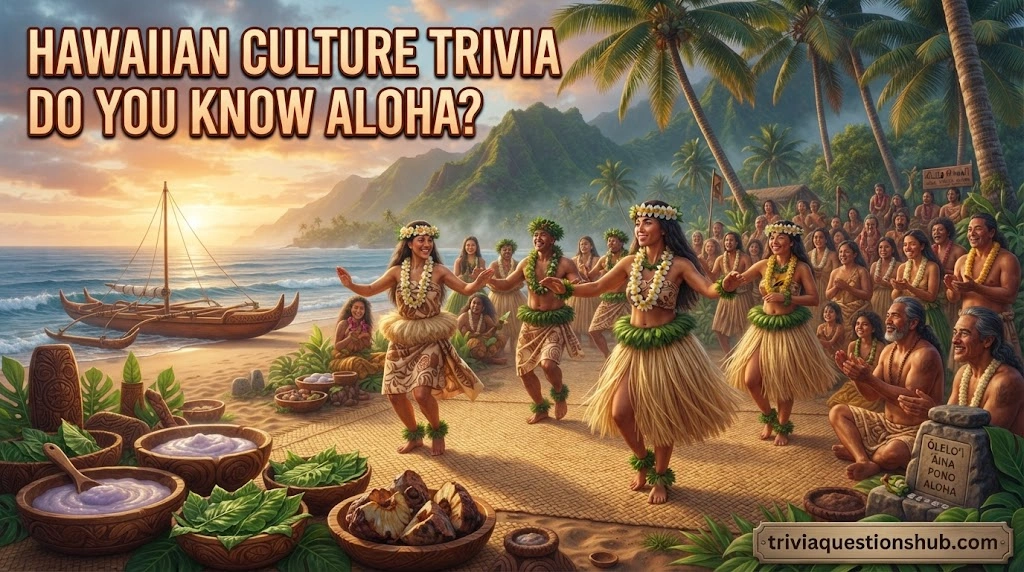
Mythology is only part of the picture. This next set of Hawaiian culture trivia questions covers real traditions, language, and customs still practiced across the islands.
51. What is hula in Hawaiian culture?
Hula is a traditional dance form used to tell stories, honor gods, and preserve history through movement. It was historically considered a sacred art, not just entertainment.
52. What is a halau in Hawaiian culture?
A hālau is a school or group where hula is taught and practiced. Each hālau typically follows the teaching style and traditions passed down from its kumu hula, or hula master.
53. What is an oli?
An oli is a chant performed without instruments, often used to open or close hula performances and formal gatherings. It serves as the narrative backbone for many traditional stories.
54. What is the kapu system?
The kapu system was a strict set of sacred laws governing daily life, including what people could eat and who could interact with whom. Breaking a kapu could result in severe punishment, including death, before the system was abolished in 1819.
55. What food were women forbidden from eating under kapu?
Under the old kapu system, women were forbidden from eating bananas, coconuts, and certain other foods considered sacred to male gods. This rule ended when King Kamehameha II abolished the kapu system in 1819.
56. What is the ʻokina in the Hawaiian language?
The ʻokina is a glottal stop mark that looks like a backward apostrophe, found in words like Hawaiʻi. It changes pronunciation and meaning, making it an essential part of written Hawaiian.
57. How many letters are in the Hawaiian alphabet?
The modern Hawaiian alphabet has just 13 letters: five vowels, seven consonants, and the ʻokina. This small alphabet is one reason many Hawaiian words feature repeated syllables.
58. What does the word aloha really mean?
Aloha means far more than “hello” or “goodbye”—it represents love, compassion, and mutual respect. Many locals describe it as a way of life rather than just a greeting.
59. What does kokua mean in Hawaiian?
Kokua means help or cooperation. It’s commonly used in Hawaii in public messaging, such as asking residents for kokua during emergencies.
60. What are pupus in Hawaiian culture?
Pupu refers to appetizers or small snacks, often served at gatherings. The term is widely used in Hawaii’s restaurant menus today.
61. What does the word honu mean?
Honu is the Hawaiian word for sea turtle. As mentioned earlier, it also carries deep spiritual meaning as a protective ʻaumakua.
62. What is poi, and why is it culturally important?
Poi is a starchy paste made from pounded taro root, a staple food in traditional Hawaiian diets. Taro itself is considered sacred, tracing back to the origin story of Hāloa, an ancestor figure in Hawaiian genealogy.
63. What is the Makahiki season?
The Makahiki is a traditional four-month harvest season dedicated to the god Lono, marked by rest from war and celebration of agriculture. Games, feasting, and tribute-giving were central parts of the season.
64. What is a heiau?
A heiau is a sacred temple or place of worship, often built from stacked lava rock. Many heiau still stand today and are protected historic sites across the islands.
65. What makes the Moʻokini Heiau significant?
The Moʻokini Heiau on the Big Island is considered one of the oldest and most sacred temples in Hawaii, believed to be over 1,500 years old. The same family has overseen its care for generations, according to Hawaii state historic records.
66. What is a luau, and how did it start?
A luau is a traditional feast that today includes food, music, and hula performances. Modern luaus trace back to celebratory feasts historically held for royalty and special occasions.
67. Why did Hawaiian missionaries once ban surfing?
In the 1800s, Christian missionaries discouraged surfing and canoeing partly because the activities interfered with religious observance, including Sunday worship. Surfing later saw a major revival in the early 1900s thanks to figures like Duke Kahanamoku.
68. Who was Duke Kahanamoku?
Duke Kahanamoku was an Olympic swimmer and surfing legend credited with popularizing surfing worldwide. He remains one of Hawaii’s most celebrated cultural icons.
69. What is the significance of the Hawaiian flag’s stripes?
Hawaii’s flag has eight horizontal stripes, each representing one of the state’s main islands. It is the only U.S. state flag to feature the British Union Jack, a nod to early relations with Britain.
70. What does the Hawaii state motto mean?
Hawaii’s official motto is “Ua Mau ke Ea o ka ʻĀina i ka Pono,” translated as “The life of the land is perpetuated in righteousness.” It reflects the deep cultural link between land stewardship and moral responsibility.
71. What is the significance of the taro plant in Hawaiian belief?
Taro, or kalo, is considered a sacred ancestor plant in Hawaiian genealogy, directly linked to the origin story of the Hawaiian people. This is one reason taro farming still carries cultural weight beyond food production.
72. What is a kumu in Hawaiian culture?
A kumu is a teacher or source of knowledge, most often used for a hula instructor. The word literally translates to “source” or “foundation.”
73. Why is respect for the land, or aina, central to Hawaiian culture?
Traditional Hawaiian belief treats the land, or ʻāina, as a living relative rather than property. This value shapes many modern Hawaiian conservation and cultural preservation efforts today.
74. What is the difference between Hawaiian and Native Hawaiian identity in trivia terms?
“Hawaiian” often refers to residents of the islands broadly, while “Native Hawaiian” specifically refers to descendants of the indigenous Polynesian people who settled the islands centuries ago. This distinction matters for accuracy in cultural trivia.
75. Why do Hawaiian words often repeat syllables?
Reduplication, or repeating syllables like in “humuhumunukunukuāpuaʻa,” is a natural feature of the Hawaiian language used for emphasis or specific meaning. It’s one reason Hawaiian words can look long and complex to English speakers.
Hawaii History and Real-World Legends Trivia
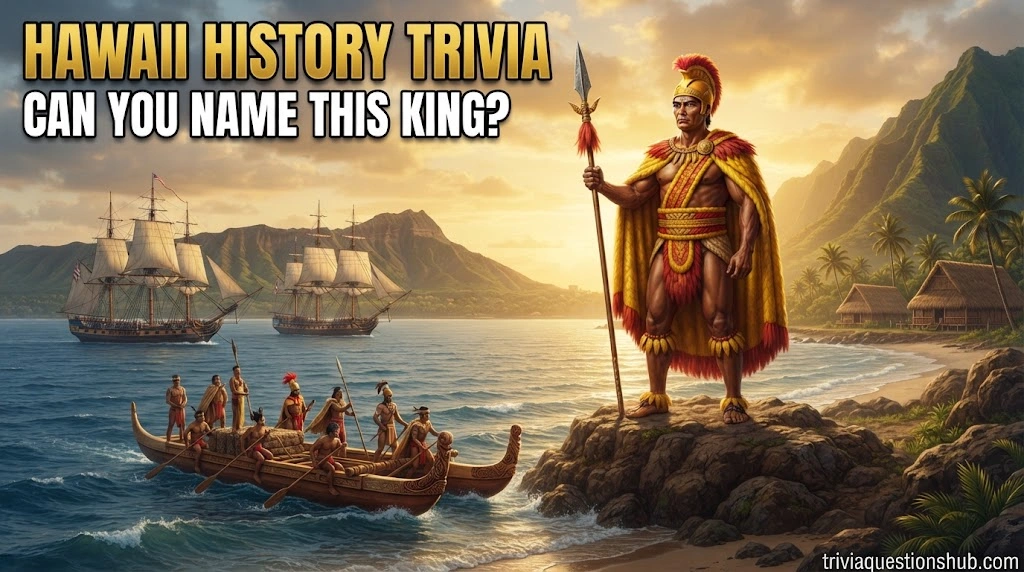
Myth and real history often overlap in Hawaii. These final 25 questions connect Hawaiian mythology trivia to real events, places, and figures.
76. Who was King Kamehameha the Great?
Kamehameha I united the Hawaiian Islands into a single kingdom by 1810 after years of conquest. He remains one of the most significant figures in Hawaiian history and mythology alike, given his ties to the war god Kū.
77. Why did Captain Cook originally name Hawaii the Sandwich Islands?
In 1778, Captain James Cook named the islands after his patron, the Earl of Sandwich. The name was used in Western records for decades before “Hawaiian Islands” became standard.
78. How did Captain Cook die in Hawaii?
Cook was killed in 1779 at Kealakekua Bay on the Big Island following a conflict with Hawaiians after tensions rose over a stolen boat. His death remains a well-documented turning point in early Hawaii-Western contact.
79. What happened to King Kamehameha II?
Kamehameha II died of measles in 1824 while visiting London to negotiate diplomatic relations with King George IV. His wife, Queen Kamāmalu, died of the same illness during the same trip.
80. Why is Kīlauea significant beyond mythology?
Kīlauea is one of the most active volcanoes on Earth and a major site for volcanic research, according to the U.S. Geological Survey. It sits within Hawaii Volcanoes National Park, a UNESCO-recognized site.
81. What island is known as The Gathering Place?
Oʻahu carries the nickname “The Gathering Place,” largely because it’s home to the state capital, Honolulu, and the majority of Hawaii’s population.
82. What island is known as The Garden Isle?
Kauaʻi is nicknamed “The Garden Isle” due to its lush rainforests and status as the oldest and greenest of the main Hawaiian Islands.
83. Why is Mount Waiʻaleʻale on Kauai famous?
Mount Waiʻaleʻale is regularly ranked among the wettest spots on Earth, averaging well over 400 inches of rain annually. This extreme rainfall feeds the island’s dramatic waterfalls and valleys.
84. What is significant about the Nuʻuanu Pali Lookout?
Besides being a common Night Marcher sighting location, Nuʻuanu Pali was the site of a major 1795 battle where Kamehameha I’s forces defeated Oʻahu’s army, pushing many warriors off the cliff. It’s now a scenic lookout with strong historical weight.
85. Why is there a statue of Sun Yat-sen in Honolulu’s Chinatown?
Sun Yat-sen, founder of the Republic of China, lived and studied in Hawaii during his youth. His time in Honolulu is commemorated with a statue in the city’s historic Chinatown district.
86. What is the significance of Pearl Harbor in Hawaiian history?
Pearl Harbor was the site of the December 7, 1941 attack that brought the United States into World War II. The USS Arizona Memorial remains one of the most visited historic sites in Hawaii today.
87. Who were the first people to settle the Hawaiian Islands?
Most historians and archaeologists believe Polynesian voyagers settled Hawaii between roughly 1000 and 1200 CE, navigating vast ocean distances using stars, wave patterns, and bird flight paths. This navigation skill is a major point of pride in Hawaiian cultural history.
88. How did Polynesian voyagers navigate without modern instruments?
Traditional wayfinding relied on reading the stars, ocean swells, cloud formations, and the flight patterns of birds. This method, called wayfinding, has been revived in modern times through voyages of the Hōkūleʻa canoe.
89. What is the Hōkūleʻa?
The Hōkūleʻa is a modern Polynesian voyaging canoe built in 1975 to prove that ancient wayfinding navigation was possible across the Pacific. It has since sailed around the world using traditional, instrument-free methods.
90. Why is Queen Liliʻuokalani an important historical figure?
Queen Liliʻuokalani was the last reigning monarch of the Hawaiian Kingdom before it was overthrown in 1893. She is also remembered for composing the well-known song “Aloha ʻOe.”
91. What happened during the overthrow of the Hawaiian Kingdom?
In 1893, a group of American and European businessmen, backed by U.S. military support, overthrew Queen Liliʻuokalani’s government. Hawaii was later annexed by the United States in 1898 and became the 50th state in 1959.
92. What is the significance of Father Damien in Hawaiian history?
Father Damien was a Catholic priest known for his work caring for patients with leprosy (Hansen’s disease) on the island of Molokai in the 1800s. He was canonized as a saint by the Catholic Church in 2009.
93. Who are the two Hawaiians honored in the U.S. Capitol’s Statuary Hall?
Statues of King Kamehameha I and Father Damien represent Hawaii in the National Statuary Hall Collection in Washington, D.C. Each state is allowed two statues in the collection.
94. What is the historical significance of the Merrie Monarch Festival?
The Merrie Monarch Festival, founded in 1963 on the Big Island, celebrates Hawaiian culture and hula in honor of King Kalākaua, nicknamed the “Merrie Monarch.” It remains the most prestigious hula competition in the world today.
95. Why was King Kalākaua nicknamed the Merrie Monarch?
Kalākaua earned the nickname for reviving Hawaiian traditions, including hula, which had been suppressed under missionary influence. His reign is remembered for restoring pride in native Hawaiian culture.
96. What was the population impact of Western contact on Native Hawaiians?
Native Hawaiian population estimates dropped drastically after Western contact in 1778, from several hundred thousand to around 40,000 by the late 1800s, largely due to introduced diseases. This population decline remains a significant part of Hawaiian historical study.
97. What island is nicknamed The Forbidden Isle, and why?
Niʻihau is known as “The Forbidden Isle” because it’s privately owned and access is restricted to protect its small Native Hawaiian community and preserve traditional Hawaiian language use. It remains one of the last places where Hawaiian is spoken as a first language by most residents.
98. What is the significance of Diamond Head?
Diamond Head, or Lēʻahi, is a volcanic crater on Oʻahu that got its English name from 19th-century sailors who mistook calcite crystals in the rock for diamonds. It remains one of Hawaii’s most recognized landmarks.
99. Why is Hawaii Volcanoes National Park culturally significant?
Beyond its geological importance, Hawaii Volcanoes National Park is considered a sacred landscape tied directly to Pele. The National Park Service works closely with Native Hawaiian cultural practitioners on land management there.
100. What can trivia like this teach us about Hawaiian identity today?
Hawaiian mythology and history are not just historical footnotes—they remain active parts of daily life, language, and land respect across the islands. Understanding this trivia helps visitors and locals alike appreciate Hawaii as a living culture, not just a vacation destination.
FAQs
What is Hawaiian mythology and culture trivia?
It’s a category of trivia covering Hawaiian gods, demigods, legendary creatures, language, and traditions. It blends ancient storytelling with real cultural practices still followed in Hawaii today.
Who are the major gods and goddesses in Hawaiian mythology?
The main deities include Kāne (creation), Kanaloa (the ocean), Lono (agriculture and peace), Kū (war), and Pele (fire and volcanoes). Goddesses like Hina, Haumea, and Laka also play major roles across different stories.
Who is Pele in Hawaiian mythology?
Pele is the goddess of fire and volcanoes, believed to reside in Kīlauea on the Big Island. She’s known for her fierce temper and the belief that removing lava rock from Hawaii brings bad luck.
What is Maui known for in Hawaiian mythology?
Māui is a trickster demigod famous for fishing up the Hawaiian Islands and slowing down the sun using a magic lasso at Haleakalā. He’s one of the most widely known figures across all Polynesian mythology.
Conclusion
Hawaiian mythology and culture go far beyond quiz answers—they’re tied to real volcanoes, real language, and real family traditions still alive today. Whether it’s Pele’s fire, Māui’s tricks, or the Menehune’s craftsmanship, these stories connect directly to the land you can still visit.

Abroy Sohail is the founder and lead content writer at TriviaQuestionsHub.com. Passionate about trivia, general knowledge, and helping readers learn something new every day, Abroy curates and writes engaging quiz content for readers of all ages.