Alaska is the largest, wildest, and most wildlife-rich state in the U.S. — home to more brown bears than the rest of the country combined, over 3 million lakes, and species you simply won’t find anywhere else. Whether you’re planning a trip, hosting trivia night, or just love testing your knowledge, this Alaska wilderness and wildlife trivia quiz is the most complete one on the internet. We didn’t just cover the usual moose-and-bear questions you’ll find on other Alaska trivia quizzes — we dug into Indigenous history, conservation, geography, and lesser-known species most competitor lists skip entirely.
Grab a pen (or just scroll and guess along) — here are 100+ Alaska wilderness and wildlife trivia questions and answers, organized by category so you can jump straight to what interests you most.Alaska Nature Trivia Quiz.
Table of Contents
What Is Alaska Wilderness and Wildlife Trivia?
Alaska wilderness and wildlife trivia covers fun facts, quiz questions, and lesser-known details about the Last Frontier’s animals, national parks, geography, and natural history — everything from how many brown bears live in Katmai National Park to why Denali means “the tall one.” This kind of trivia blends hard facts (state records, animal statistics, park history) with Indigenous cultural context and conservation stories, making it popular for trivia nights, classroom lessons, travel planning, and Alaska-bound cruise passengers who want to arrive already “in the know.”Alaska Nature Trivia Quiz.
Below, we’ve organized the full 100+ question set into eight categories: general geography and wilderness facts, bears, marine mammals, birds, land mammals, salmon and fish, national parks, and fun/little-known facts that most other Alaska trivia articles leave out.
100+ Alaska Wilderness and Wildlife Trivia Questions & Answers
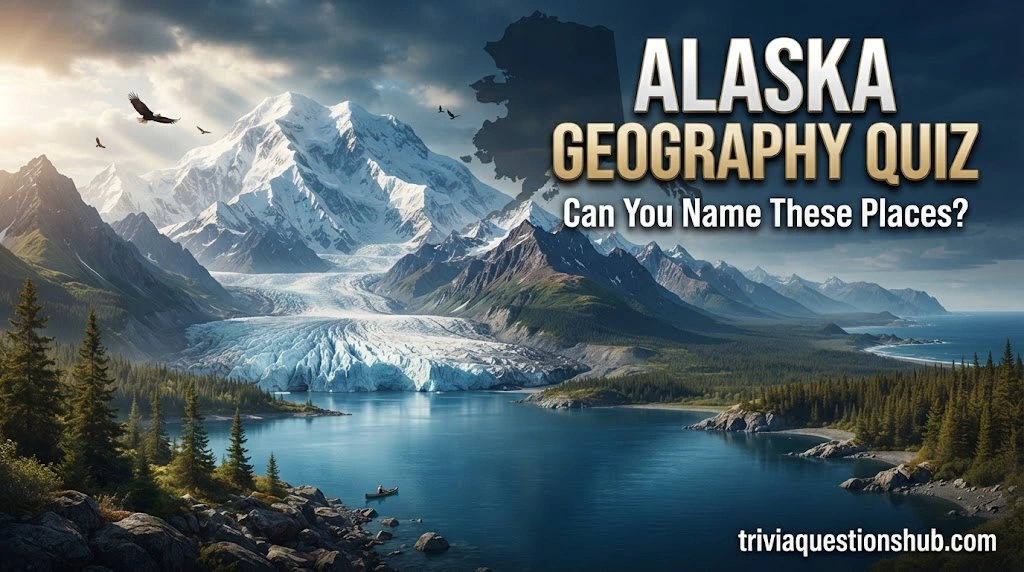
Category 1: Alaska Geography & Wilderness Basics
What is the highest mountain in North America? Answer: Denali, standing at 20,310 feet.
What was Denali formerly known as? Answer: Mount McKinley — it was officially renamed Denali in 2015.
What does the name “Denali” mean? Answer: “The tall one,” from the Koyukon Athabascan word “deenaalee.”
How many of the 20 highest peaks in the United States are located in Alaska? Answer: 17 of the 20 highest U.S. peaks are in Alaska.
How many glaciers does Alaska have? Answer: Roughly 100,000 glaciers, covering about 5% of the state.
How many lakes does Alaska have? Answer: More than 3 million lakes.
How many miles of coastline does Alaska have? Answer: Over 34,000 miles — more than all other U.S. states combined.
How many seas does Alaska touch? Answer: Three — the Arctic Ocean, Pacific Ocean, and Bering Sea.
What does “Alaska” mean, and where does the name come from? Answer: It comes from the Aleut word “Alyeska,” meaning “The Great Land” or “great land whose western side the sea washes against.”
How many national parks does Alaska have? Answer: Eight — Denali, Gates of the Arctic, Glacier Bay, Katmai, Kenai Fjords, Kobuk Valley, Lake Clark, and Wrangell-St. Elias.
What is Alaska’s nickname? Answer: “The Last Frontier.”
How many volcanoes does Alaska have? Answer: More than 100 volcanoes and volcanic fields, making it the most volcanic state in the U.S.
In what year did the U.S. purchase Alaska from Russia, and for how much? Answer: 1867, for $7.2 million — about two cents per acre.
In what year did Alaska become the 49th U.S. state? Answer: 1959.
Which is Alaska’s largest lake? Answer: Lake Iliamna, stretching about 77 miles long.
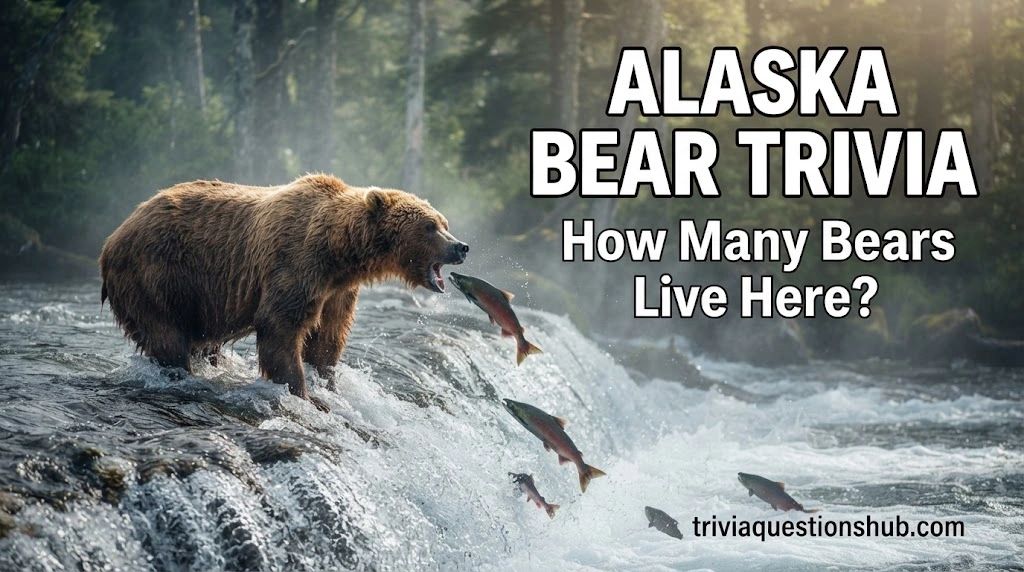
Category 2: Bears of Alaska
How many brown bears live in Alaska? Answer: An estimated 30,000, roughly 98% of the entire U.S. brown bear population.
Which national park is home to the largest protected population of brown bears? Answer: Katmai National Park.
What percentage of a coastal brown bear’s diet can come from salmon? Answer: More than 40%.
What do inland brown bears eat when salmon isn’t available? Answer: Roots, berries, plants, insects, and occasionally caribou calves.
Where is the best-known spot in the world to watch bears catch salmon mid-air? Answer: Brooks Falls in Katmai National Park.
Which Alaska island has the highest concentration of brown bears in North America? Answer: Admiralty Island.
Where can visitors see black bears and brown bears feeding together at the same site? Answer: Anan Creek.
What is the Kodiak bear? Answer: A brown bear subspecies found only on the Kodiak Archipelago, isolated for roughly 10,000 years, and among the largest brown bears in the world.
How many black bears live in Alaska? Answer: Roughly 100,000.
What plant is nicknamed “bear root” because bears were seen eating it after hibernation? Answer: Osha.
Why is the bearberry plant named after bears? Answer: Because of bears’ documented fondness for the fruit; it’s also been used by Alaska Native peoples as food and medicine.
Do Alaska’s polar bears live in the same region as brown bears? Answer: No — polar bears live in the state’s northernmost Arctic reaches, separate from brown bear range.
What is the largest land-based carnivore in the world? Answer: The polar bear.
How do bears typically create visible trails in the Alaska wilderness? Answer: By repeatedly walking the same paths, creating ruts marked by scent along the route.
What is the primary reason coastal brown bears grow larger than inland brown bears? Answer: Access to a salmon-rich diet high in fat and protein.
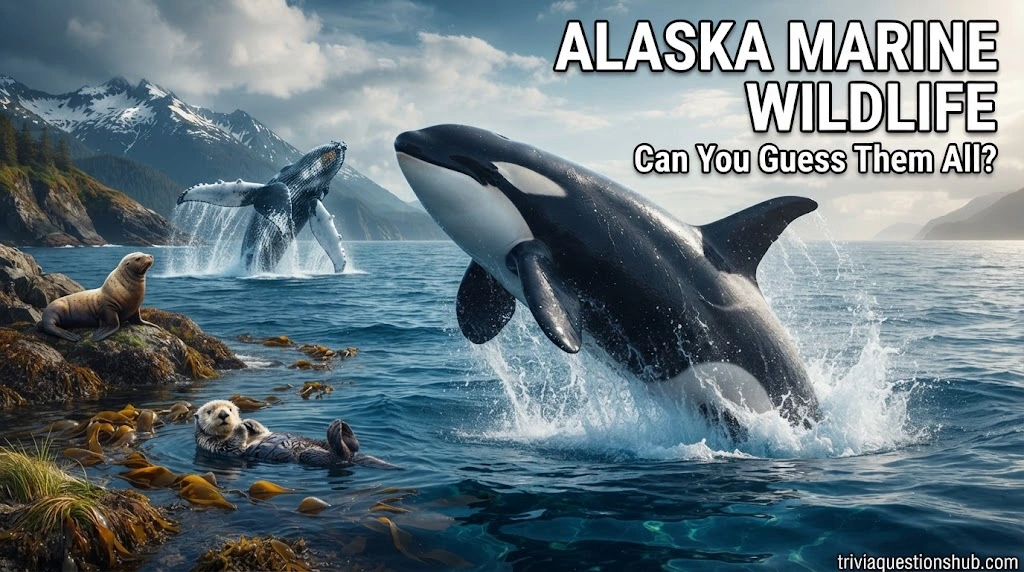
Category 3: Marine Mammals & Ocean Wildlife
What is the Alaska state marine mammal? Answer: The bowhead whale.
Approximately how much do newborn humpback whale calves weigh? Answer: About two tons, and they’re already around 20 feet long at birth.
What is a group of resting sea otters called? Answer: A “raft.”
What makes sea otters unusual among marine mammals? Answer: They’re one of the few animals known to use tools, carrying rocks to crack open shellfish.
Why did sea otter populations nearly disappear in the 1800s? Answer: Extensive fur hunting nearly drove them to extinction before conservation efforts helped them recover.
How deep can harbor seals dive, and how long can they hold their breath? Answer: Over 1,000 feet deep, holding their breath for up to 30 minutes.
What large pinniped is commonly seen lounging on Alaska’s beaches and rocky coastlines? Answer: The Steller sea lion.
Which whale species are commonly spotted from cruise ships in Alaska’s waters? Answer: Humpback, orca (killer whale), minke, gray, fin, and sei whales.
What is the world’s largest salmon fishery, located in Alaska? Answer: Bristol Bay.
Roughly what percentage of the world’s wild sockeye salmon rely on Bristol Bay? Answer: About 46%.
What proposed mine has threatened the Bristol Bay watershed? Answer: The Pebble Mine, a proposed open-pit gold and copper mine.
Which marine mammal is known for its distinctive black-and-white coloring and travels in pods? Answer: The orca, or killer whale.
What is unique about how orcas hunt in some parts of Alaska? Answer: They hunt cooperatively in pods, often targeting salmon, seals, and even other whales.
What is a baleen whale, and name one found in Alaska waters? Answer: A whale that filters food through baleen plates instead of teeth; examples include the humpback whale and bowhead whale.
What sea creature is sometimes rumored to live in Alaska’s largest lake, Lake Iliamna? Answer: A legendary “lake monster,” often compared to a very large, unidentified fish.
Category 4: Birds of Alaska
Roughly how many bird species can be found in Alaska? Answer: More than 500 species.
Where do bald eagles gather in especially large numbers late in the season to feed on salmon? Answer: Near Haines, where thousands congregate.
What is the wingspan of an adult bald eagle in Alaska? Answer: Around 7.5 feet.
What bird is famous for its colorful beak and comical waddling walk? Answer: The puffin.
What is the fastest animal on Earth, and can it be found in Alaska? Answer: The peregrine falcon, which can dive at speeds up to 240 mph and is found in Alaska.
What courtship display do bald eagle pairs perform mid-air? Answer: They lock talons and spiral toward the ground together as a bonding ritual.
What large owl species with piercing yellow eyes is native to Alaska? Answer: The great grey owl.
What is the wingspan of an adult male great grey owl? Answer: Over 5 feet.
Which duck species, known for its striking blue-and-chestnut markings, is common along Alaska’s coasts? Answer: The harlequin duck.
What large white swan species breeds in Alaska’s wetlands? Answer: The trumpeter swan.
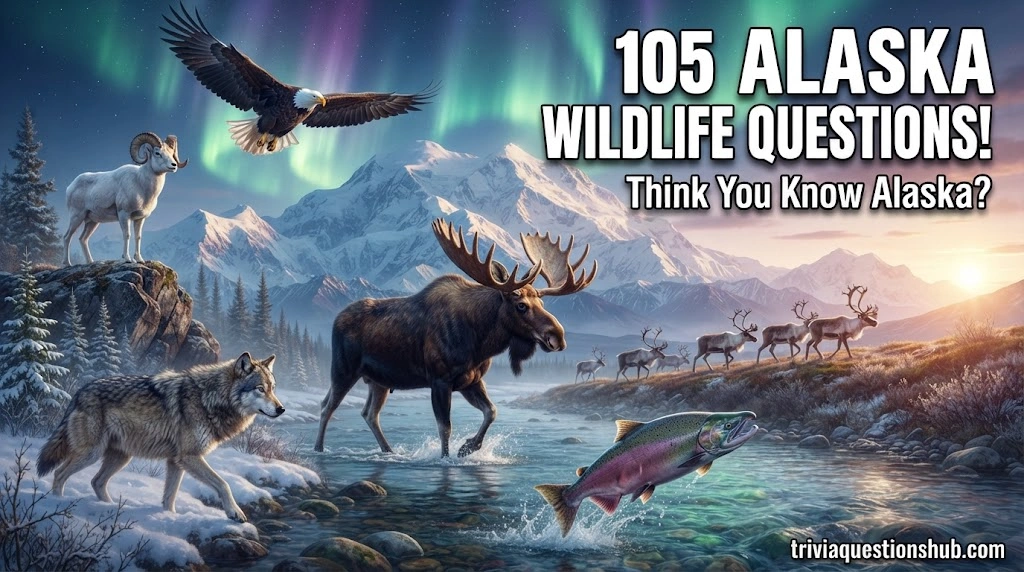
Category 5: Land Mammals (Moose, Caribou, Wolves & More)
Where does the word “moose” come from, and what does it mean? Answer: From the Algonquin word “mooswa,” meaning “twig eater.”
How much can an Alaskan bull moose weigh? Answer: Up to 1,600 pounds — the largest moose subspecies in the world.
When do moose typically give birth, and how many calves at once? Answer: In May, usually one or two calves (not triplets).
What happens to a bull moose’s antlers each year? Answer: They drop in winter and fully regrow each year.
Which animal attacks more people in Alaska each year — moose or bears? Answer: Moose.
What makes caribou the most migratory land animal on the planet? Answer: Some herds travel up to 3,100 miles per year.
What percentage of Alaska’s land do wolves roam across? Answer: More than 85%.
Roughly how many wolves live in Alaska? Answer: Estimates suggest as many as one wolf per 25 square miles in some regions.
What large curved-horned mammal is found on steep, rocky Alaska terrain? Answer: The Dall sheep.
Which animal’s advocacy led to the creation of Denali National Park in 1917? Answer: The Dall’s sheep, thanks to naturalist Charles Sheldon’s lobbying efforts.
What large, shaggy bovine species, once nearly extinct in the state, has been successfully reintroduced to Alaska? Answer: The wood bison.
What non-native ungulate was imported to Alaska from Washington State’s Olympic Peninsula in the 1920s? Answer: Elk.
What elusive, snowshoe-pawed wildcat is listed as threatened under the Endangered Species Act? Answer: The Canada lynx.
What adaptation helps caribou cross Alaska’s rivers? Answer: Their hooves double as paddles, functioning like built-in swim gear.
Which land mammal historically supplied food, shelter, clothing, and tools to the Athabaskan peoples? Answer: The moose.
Category 6: Salmon & Alaska Fish
How many species of Pacific salmon spawn in Alaska? Answer: Five — Chinook, coho, sockeye, chum, and pink.
How many eggs can a female salmon lay, and how many typically survive to spawn as adults? Answer: Between 2,000 and 4,500 eggs, but only about 2 to 3 survive to return to their natal stream.
What is Alaska’s official state fish? Answer: The King salmon (Chinook salmon).
How high can salmon leap to climb waterfalls during their upstream migration? Answer: More than 13 vertical feet.
What percentage of U.S. seafood production comes from Alaska? Answer: About 50%.
Why is salmon considered central to the culture of the Yup’ik, Dena’ina, and Alutiiq peoples? Answer: It’s regarded as a subsistence food and a cultural lifeblood, tied to traditions across 25 tribal councils in the Bristol Bay region alone.
What is unique about a salmon’s life cycle compared to most fish? Answer: Pacific salmon spend most of their lives at sea before returning to the freshwater streams of their birth to spawn and die.
How large can a King salmon caught in Alaska get? Answer: Up to 100 pounds.
What natural event draws large numbers of bears and eagles together each year? Answer: The salmon run, when spawning salmon become widely available as prey.
What is the average length of an Alaska salmon fishing boat? Answer: About 37 feet.
Category 7: National Parks & Wildlife Habitats
Which national park is best known for coastal brown bear viewing and calving glaciers visible from boat tours? Answer: Kenai Fjords National Park.
Which Alaska national park is the largest in the entire U.S. National Park System? Answer: Wrangell-St. Elias National Park and Preserve.
Which park protects North America’s tallest peak? Answer: Denali National Park and Preserve.
What wildlife would you NOT expect to see on a Kenai Fjords cruise? Answer: Manatees, leopard seals, spinner dolphins, and yellow-eyed penguins — none are native to Alaska’s waters.
Which national park is known for dramatic volcanic terrain alongside abundant wildlife? Answer: Katmai National Park.
Which Alaska national park lies almost entirely above the Arctic Circle? Answer: Gates of the Arctic National Park and Preserve.
Which national park is known for tidewater glaciers calving directly into the sea? Answer: Glacier Bay National Park and Preserve.
What is unique about Kobuk Valley National Park’s landscape? Answer: It contains large Arctic sand dunes, an unusual feature for a park located above the Arctic Circle.
Which park protects prime habitat along the Chinitna Bay coastline where brown bears forage? Answer: Lake Clark National Park and Preserve.
What organization partners with Alaska tour operators to help protect wildlife habitats like Bristol Bay? Answer: World Wildlife Fund (WWF).
Category 8: Fun & Little-Known Alaska Wildlife Facts
What Alaska forest recently supplied the U.S. Capitol’s Christmas tree? Answer: The Tongass National Forest, which supplied an 80-foot Sitka spruce.
Which national forest is the largest in Alaska? Answer: The Tongass National Forest.
What is Alaska’s official state tree? Answer: The Sitka spruce.
Does Alaska have poison ivy or poison oak? Answer: No — Alaska is free of both, though hikers should still watch for devil’s club and cow parsnip.
What is Alaska’s official state sport? Answer: Dog mushing.
What famous long-distance sled dog race takes place in Alaska each year? Answer: The Iditarod Trail Sled Dog Race.
How many seismic events does Alaska record annually, making it the most earthquake-prone U.S. state? Answer: Between 40,000 and 50,000 per year.
What natural light phenomenon is Fairbanks especially famous for viewing? Answer: The Aurora Borealis (Northern Lights).
How much of Alaska’s total area is covered by water? Answer: About 14.2%, or nearly 95,000 square miles — larger than the entire United Kingdom.
What tiny mammal, weighing less than a penny, lives in Alaska? Answer: The pygmy shrew.
Which Alaska city is the only U.S. state capital not accessible by road? Answer: Juneau.
What is the northernmost point in the United States, located in Alaska? Answer: Point Barrow (Utqiaġvik area).
How large is Alaska compared to Texas? Answer: More than twice the size of Texas.
If Alaska were an independent country, where would it rank in size globally? Answer: Around the 18th largest country in the world.
What Aleut word inspired Alaska’s name, and what does it literally reference? Answer: “Alyeska,” referencing the land whose western edge the sea washes against — “The Great Land.”
Fascinating Alaska Wildlife Facts You Should Know
Beyond the quiz questions above, a few standout facts capture just how extreme Alaska’s wildlife really is:
The largest land animal in Alaska is the moose — specifically the Alaskan moose subspecies, with bulls weighing up to 1,600 pounds, making it not just Alaska’s largest land mammal but the largest moose subspecies on Earth.
Alaska holds roughly 98% of the entire U.S. brown bear population, an estimated 30,000 bears, concentrated most densely on Admiralty Island and in Katmai National Park.
Salmon connect nearly every part of the ecosystem — bears, eagles, wolves, and Indigenous communities all depend on the same five species of Pacific salmon that return to Alaska’s rivers each year.
Caribou are the most migratory land animals on the planet, with some herds covering over 3,100 miles annually — farther than many bird migrations.
Sea otters, once nearly wiped out by 1800s fur hunting, are now a conservation success story and one of the few tool-using mammals on Earth.
These facts are exactly why Alaska wilderness and wildlife trivia continues to be such a popular topic — the numbers are almost too extreme to believe until you see them firsthand.
FAQs
What is Alaska wilderness and wildlife trivia?
Alaska wilderness and wildlife trivia is a category of fun facts and quiz questions covering the state’s animals, national parks, geography, and natural history — from bear and salmon statistics to Indigenous place names and conservation stories, often used for quizzes, trip planning, and educational content.
What animals are commonly found in the Alaska wilderness?
Alaska is home to brown and black bears, moose, caribou, wolves, Dall sheep, sea otters, humpback whales, orcas, bald eagles, puffins, and five species of Pacific salmon, among hundreds of other species.
What is the largest land animal in Alaska?
The moose is Alaska’s largest land animal, with Alaskan bull moose — the largest moose subspecies in the world — weighing up to 1,600 pounds.
What are some interesting facts about Alaska wildlife?
Alaska holds about 98% of the U.S. brown bear population, caribou are the most migratory land animals on Earth, salmon lay thousands of eggs but only a handful survive to spawn, and sea otters are among the only tool-using mammals in the animal kingdom.
Conclusion
With over 100 questions spanning bears, whales, salmon, national parks, and lesser-known Alaska wilderness facts, this trivia quiz goes well beyond what most competitor articles cover — pulling in conservation angles, Indigenous cultural context, and record-breaking wildlife stats that make Alaska genuinely one of a kind. Whether you scored a perfect 105 or learned something new about the Last Frontier, there’s always more wild Alaska left to discover.
Abroy Sohail is the founder and lead content writer at TriviaQuestionsHub.com. Passionate about trivia, general knowledge, and helping readers learn something new every day, Abroy curates and writes engaging quiz content for readers of all ages.