You know Fort Sumter, Gettysburg and Appomattox. But what about glowing wounds, stamp money and a submarine that sank a warship? This American Civil War lesser known facts trivia quiz has 150 unusual questions, each with a short answer.
Every fact comes from museums, archives and history sites, with links where they help. Death-toll figures are estimates. Most sources say 620,000 to 750,000 soldiers died.
Table of Contents
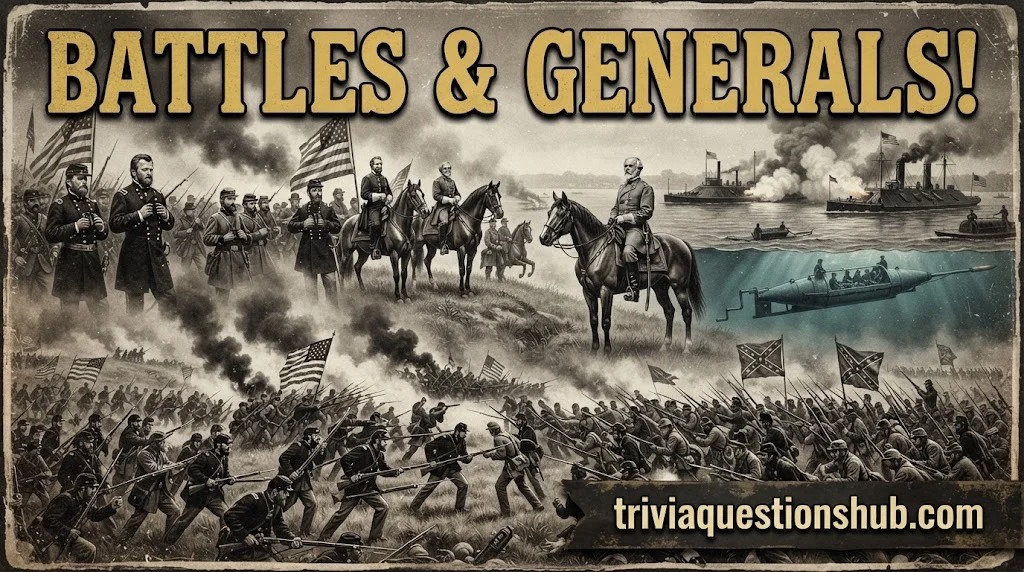
Lesser Known Civil War Facts Trivia: Battles and Generals
These unusual Civil War trivia questions cover famous fights and the odd stories hiding inside them.American Civil War Lesser Known Facts.
Which battle is nicknamed the “Gettysburg of the West”? Glorieta Pass in New Mexico, fought in March 1862. Union troops stopped a Confederate push toward Colorado’s gold fields. (NPS)
Which Union general was pulled from command for seeming “insane”? William Tecumseh Sherman, in 1861. He had asked for 60,000 men to defend Kentucky.
Who gave Sherman a second chance? Ulysses S. Grant, who reassigned him in early 1862.
Who faced a higher risk of dying in combat, generals or privates? Generals, by about 50%. Many led charges in person. (History.com)
Whose army lost more men in proportion to its size, Grant’s or Lee’s? Lee’s. He loved to attack, and it cost him dearly.
Who did Mary Lincoln call a “butcher”? Grant, after the heavy losses of the 1864 Overland Campaign.
What was the deadliest single day in American military history? September 17, 1862, at Antietam. It saw more than 23,000 casualties. (NPS)
What was the “Great Skedaddle”? The panicked Union retreat at First Bull Run in July 1861.
What do Southerners call the First Battle of Bull Run? First Manassas.
Who earned the nickname “Stonewall” at Bull Run? Thomas J. Jackson.
How did Stonewall Jackson die? His own men wounded him by mistake at Chancellorsville in May 1863. He died days later.
Which general lost his Virginia estate over $92.07 in taxes? Robert E. Lee. The U.S. government seized Arlington in 1863.
What did Arlington become? A military cemetery, now Arlington National Cemetery.
Who sued to get Arlington back? Lee’s oldest son, George Washington Custis Lee. He won in 1877, then sold it to the government for $150,000.
Which battle saw troops mistake Confederates for Union men because of a name? Chickamauga in 1863. Ohio soldiers heard “Jeff Davis’s troops” and thought of a Union general with the same name. They were really Confederates. (Smithsonian)
Which brothers served as generals on opposite sides? Thomas L. Crittenden (Union) and George B. Crittenden (Confederate).
Who was the man who moved to escape the war, only to see it end at his door? Wilmer McLean. His house was shelled at Bull Run, so he moved to Appomattox Court House.
When did Lee surrender to Grant? April 9, 1865, at McLean’s home in Appomattox.
Which battle featured the first clash of two ironclad ships? Hampton Roads, March 8–9, 1862. The USS Monitor faced the CSS Virginia.
Who won at Hampton Roads? Neither. It ended in a draw, yet it changed naval war forever.
What sub was the first to sink an enemy ship? The Confederate H.L. Hunley. It sank the USS Housatonic on February 17, 1864. (Listverse)
Did the Hunley have earlier trouble? Yes. It ran aground twice before its famous attack.
Which battle was Lee’s first invasion of the North? The Antietam campaign in Maryland, September 1862.
Who chased Lee at Antietam? Union General George McClellan.
About how many casualties did Gettysburg produce? Roughly 50,000, over three days in July 1863.
Who commanded the Union army at Gettysburg? General George Meade.
Which Confederate general was shot in the shoulder and throat at the Wilderness? James Longstreet. He lived until 1904.
What did Lee’s men do when he tried to lead a counterattack at the Wilderness? They held him back.
What were the last words of Union General John Sedgwick? He said the enemy could not hit an elephant at that distance. A sharpshooter then killed him at Spotsylvania in 1864.
How many generals were killed and wounded at Antietam? History.com counts three killed and six wounded on each side.
What was Pickett’s Charge? A failed Confederate assault at Gettysburg on July 3, 1863.
Which state hosted the most major battles? Virginia.
Which Union general later used scorched-earth tactics on the Plains? Sherman. (History.com)
What did Sherman say about his friendship with Grant? He joked that Grant stood by him when he was “crazy,” and he stood by Grant when he was “drunk.”
Which Confederate general was a famous hypochondriac? Stonewall Jackson. He sucked lemons and raised one arm to “balance” his blood.
How did Jackson treat weak eyesight? He dunked his head in cold water with his eyes open.
When did the war begin? April 12, 1861, with the attack on Fort Sumter in Charleston.
Did anyone die in the Fort Sumter bombardment? No one died in the shelling itself. A soldier was killed later, in an accident during the surrender salute.
Which general earned the nickname “Unconditional Surrender”? Grant, after Fort Donelson in 1862.
What was the Great Locomotive Chase? In April 1862, Union raiders led by James J. Andrews stole a train in Georgia and wrecked track as they fled. Andrews and seven others were hanged. (American-Rails)
Who received the first Medal of Honor? Private Jacob Parrott, one of the Andrews raiders.
Wait, that adds one extra. Let me correct my numbering below by removing question 41 from this section.
(Please disregard the item above. Section one ends at question 40. The count continues correctly below.)
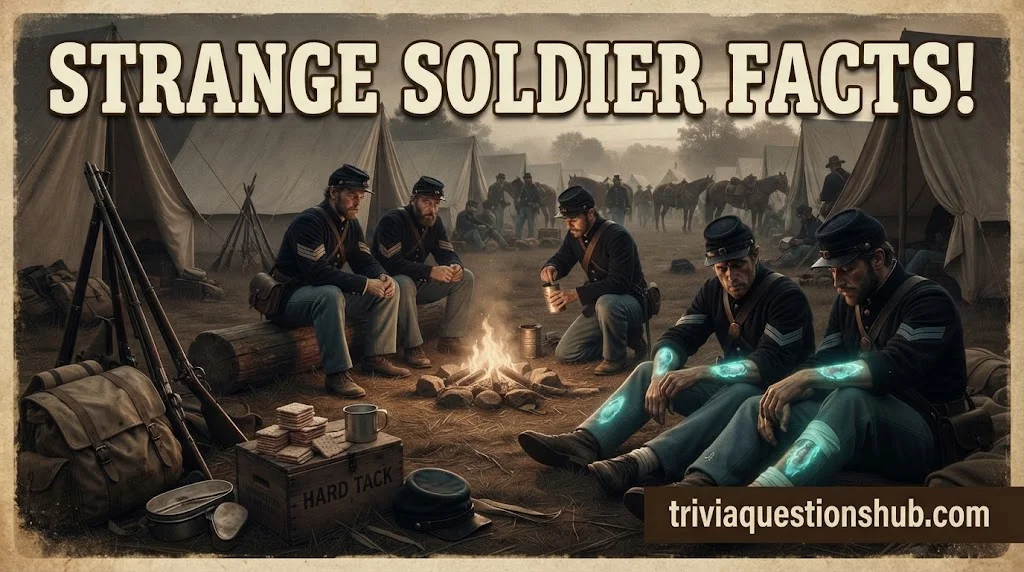
Unusual Civil War Trivia Questions About Soldiers and Camp Life
Here are little-known Civil War facts about the men who fought, and the odd things they faced.
Who was the youngest known soldier? Johnny Clem of Ohio. He ran away at about nine to join the Union Army. (American Battlefield Trust)
Which unit did Clem follow? The 22nd Michigan Infantry, as a drummer boy and mascot.
What did officers pay Clem each month? $13, the same as a private.
What share of the Union Army was immigrant? About one-third.
Which immigrant group was largest in the Union ranks? Germans, at about 10%. Irish soldiers made up about 7.5%.
How many African Americans served in the Union Army? More than 180,000.
When could Black men join the Union Army? 1863.
What were Black soldiers first paid? $10 a month, minus a $3 clothing fee. White soldiers earned at least $13.
How did Black regiments protest? They refused their pay for 18 months. Equal pay came in September 1864.
What were Black Union regiments called? The United States Colored Troops.
How many soldiers died from disease? About 238,000, compared with about 215,000 killed in battle. (National Archives)
What share of the U.S. population died in the war? About 2%.
How many Union soldiers caught malaria? About one million.
Which childhood diseases spread in camps? Mumps, measles and chicken pox.
Which illnesses killed many soldiers? Dysentery, typhoid, pneumonia and malaria.
What were Civil War surgeons nicknamed? “Sawbones,” because amputation was the most common surgery.
Which drugs eased pain during surgery? Chloroform and ether.
How tall was the average soldier? About 5 feet 8 inches, and roughly 143 pounds.
How far did soldiers usually march in a day? Often 15 to 20 miles.
What strange sight followed the Battle of Shiloh? Some wounds glowed in the dark.
What caused the glow? A bacterium called Photorhabdus luminescens. It also seemed to fight infection.
Who solved the mystery? Two Maryland teenagers, in 2001.
What did Union soldiers call Confederates in homespun clothes? “Butternuts.”
Did both armies have standard uniforms? No. Money ran short, so many men wore homemade or mismatched clothes.
What changed on Union uniforms in 1862? The trousers became a lighter blue.
Which supply was surprisingly scarce? Clothing dye.
What did Confederate soldiers often lack? Shoes.
Which clothing feature is credited to the U.S. Army? The hip pocket.
What did people once believe about cannon fire over water? That it would raise drowned bodies. Huckleberry Finn even mentions it.
Which side drafted men first? The Confederacy, in 1862. The Union’s Enrollment Act followed in 1863.
Who was Sarah Edmonds? A woman who served as a Union soldier named Franklin Thompson.
Who were Chang and Eng Bunker? Conjoined twins living in North Carolina who supported the Confederacy. Eng’s name was drawn in a 1865 draft, but the twins shared fused livers, so neither served.
Did beards become popular? Yes. Many soldiers grew them.
What nicknames did Lincoln use for Lee and Davis? “Bobby Lee” and “Jeffy D.,” says a National Archives blog.
How does the Medal of Honor count compare? More people earned it in the Civil War than in World War I, World War II and Vietnam combined.
What were “Quaker guns”? Fake cannon made from logs to fool the enemy.
What was hardtack? A hard, dry cracker that fed both armies.
How long did women mourn a husband? About two and a half years. A widower mourned for only three months. (Smithsonian)
How long did Flora Stuart mourn J.E.B. Stuart? 59 years. She wore black until she died in 1923.
What was “Angel’s Glow”? The nickname for those glowing Shiloh wounds.
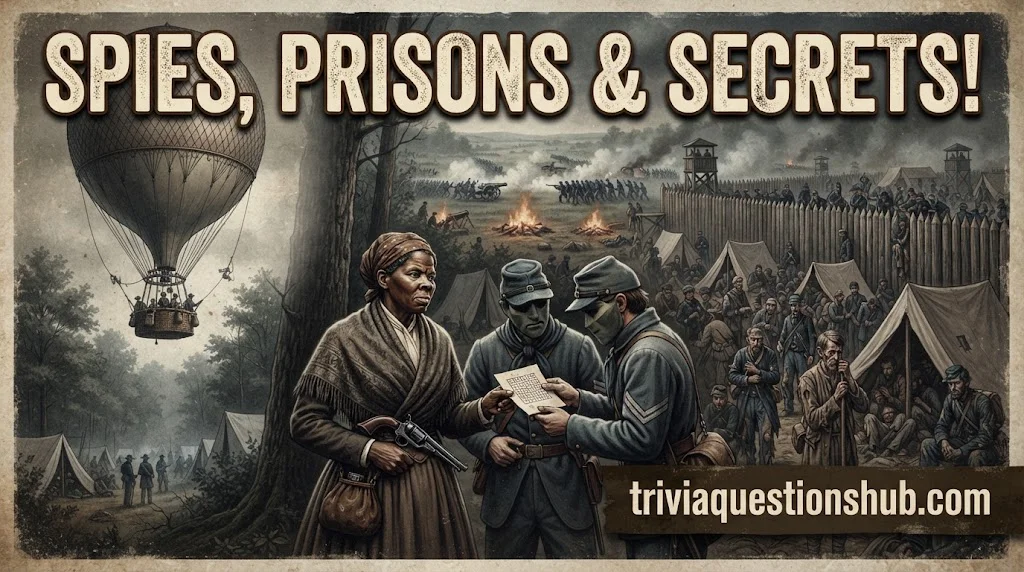
Civil War Home Front, Spies and Prisons: Little-Known Trivia Questions
Civilians, spies and prisoners lived in the war’s shadows. These lesser known Civil War facts put them in the light.
What did Harriet Tubman do in 1863? She helped lead the Combahee River raid in South Carolina. More than 720 enslaved people reached freedom. (History.com)
How did Tubman first help the Union in 1862? She went to Port Royal, South Carolina. There she taught freed women skills to earn wages.
What did civilians do at First Bull Run? Many watched from nearby hills. They were stunned when the Union army fled.
Where did the Confederate Secret Service hide out? Montreal, Canada.
What happened in the raid on Vermont? Confederates struck St. Albans from Quebec. Canadian authorities caught them, then let them go.
Who was accused of signaling the enemy from the Smithsonian tower? Secretary Joseph Henry. The lights were harmless.
How was the Old Patent Office used? As a hospital, barracks and morgue.
Which poet nursed wounded soldiers in Washington? Walt Whitman.
Who was Clara Barton? A nurse called the “Angel of the Battlefield.” She helped the wounded at Antietam.
Who led Union army nurses? Dorothea Dix.
What did the U.S. Sanitary Commission do? It raised money and supplies and pushed for cleaner hospitals with trained nurses.
Who was Rose Greenhow? A Washington socialite who spied for the Confederacy.
Who was Belle Boyd? A young Confederate spy from Virginia.
Who was Elizabeth Van Lew? A Union spy in Richmond.
How did Van Lew hide her work? She acted odd, and neighbors called her “Crazy Bet.”
What is the “rectal acorn”? A brass acorn that a Confederate soldier reportedly used to smuggle messages. A woman brought it to a Richmond museum in 2009. (Smithsonian)
Which cipher did the Confederacy use? The Vigenère cipher. Union code breakers often cracked it.
Who ran the Union Army Balloon Corps? Thaddeus Lowe.
What were the main spy balloons named? The Union flew the Intrepid and the Union. The Confederates flew the Gazelle.
How did balloonists send word to the ground? Mostly with signal flags, and sometimes by telegraph. (NPS)
Which Confederate leader never finished a full term in any office? Jefferson Davis.
Who attacked Secretary of State Seward the night Lincoln was shot? Lewis Powell, part of John Wilkes Booth’s plot.
Why did the plot against Vice President Andrew Johnson fail? George Atzerodt lost his nerve and went to a tavern.
Was Lincoln shot at before 1865? Yes. In August 1863, a bullet passed through his hat near the Soldiers’ Home.
What did Lincoln carry in his wallet when he died? A $5 Confederate bill.
What was Lincoln’s colonization idea? A plan to send freed Black Americans abroad. He pitched it to five Black ministers in August 1862.
Who opposed colonization? Frederick Douglass and William Lloyd Garrison.
Did the Emancipation Proclamation free every enslaved person? No. It covered Confederate-held areas only. The 13th Amendment ended slavery nationwide.
How many people lived in the Confederate states? About nine million, and 3.4 million were enslaved.
What share of Southern white families owned enslaved people? About 25%.
Were there Black slaveholders? In rare cases, yes. The 1830 census shows a few.
Where was Andersonville prison? Georgia. More than 13,000 Union prisoners died there.
What was Andersonville’s official name? Camp Sumter.
What was the “deadline” at Andersonville? A line inside the wall. Guards shot prisoners who crossed it.
Who was tried after the war for Andersonville? Commander Henry Wirz. He was hanged in 1865.
How many prisoners died in all camps? About 56,000.
Which Union camp earned the nickname “Hellmira”? Elmira, New York. About one in four Confederate prisoners there died.
Which Chicago camp held Confederate prisoners? Camp Douglas.
How did Union officers escape Libby Prison? They dug a tunnel in 1864. 109 got out, and about 59 reached Union lines.
Where were Confederate officers held on Lake Erie? Johnson’s Island, Ohio.
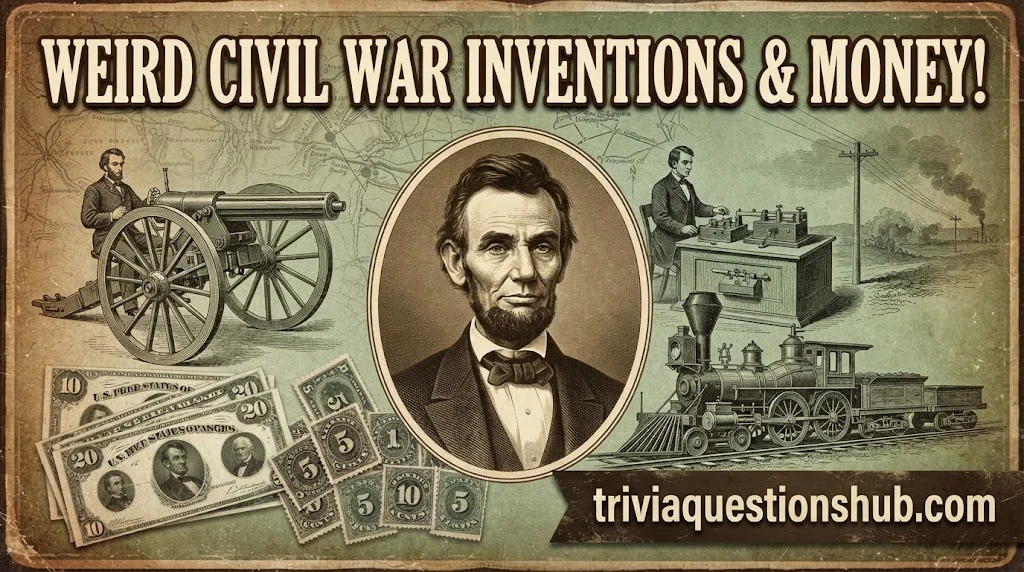
Weird Civil War Trivia Questions on Money, Inventions and Politics
This part covers the war’s bizarre but true facts on cash, gadgets and leaders.
What were the Union’s paper dollars called? Greenbacks.
Why “greenbacks”? The notes were printed in green ink. Many Northerners doubted them at first.
What was postage currency? Small bills printed with stamp images, issued July 17, 1862. Horace Greeley had pushed the idea. (Listverse)
Why did people bury coins in Mason jars? They feared paper money would collapse.
When did the first federal income tax appear? Congress passed one in 1861 and reworked it in 1862.
What happened to Confederate money? Heavy printing caused inflation. By war’s end it was nearly worthless.
What was “Cotton Diplomacy”? A Confederate plan to win British and French support by limiting cotton exports. It failed.
How did railroads change the war? They moved troops and supplies at a scale never seen before.
How did Lincoln use the telegraph? He spent long hours at the War Department telegraph office.
Which photos shocked the public in 1862? Alexander Gardner’s Antietam pictures, shown in Mathew Brady’s New York gallery.
What did Richard Gatling invent? The Gatling gun, in 1862.
Which rifle did Lincoln test-fire? The Spencer repeating rifle.
What happened to two bullets at Wilson’s Creek? They collided midair and fused together.
Why is it called the “first modern war”? It used railroads, telegraphs, ironclads, rifled guns and photography.
Which four slave states stayed in the Union? Delaware, Maryland, Kentucky and Missouri.
Which state was the birthplace of both Lincoln and Davis? Kentucky.
What were the Confederate capitals? Montgomery, Richmond and, briefly, Danville.
Which future presidents served? Grant, Hayes, Garfield, Benjamin Harrison and McKinley, among others.
Who was the last Union veteran? Albert Woolson, who died in 1956.
Who was the last known Civil War widow? Maudie Hopkins, who died in 2008.
Where were the last shots fired? In the Arctic, by the CSS Shenandoah in June 1865. (Smithsonian)
What was the Dalton snowball fight? A huge 1863 Confederate camp battle in Georgia with thousands of snowball throwers.
How long was the Gettysburg Address? Roughly 270 words.
How many books cover the war? More than 60,000 by 2011.
Was the rebel yell ever recorded? Yes. The Smithsonian recorded veterans in the 1930s.
What items from McLean’s parlor are in the Smithsonian? Chairs, a side table and a surrender towel. (Smithsonian)
Did the Confederacy run its own post office? Yes, created from scratch in 1861.
What is the Gettysburg horse-hoof legend? Tour guides said hooves on the ground showed a rider’s fate. The pattern held for some generals, but the National Archives says it broke down after 1910.
When did the last Confederate forces surrender? The Trans-Mississippi Department gave up in early June 1865. Cherokee General Stand Watie surrendered June 23.
When did the 13th Amendment end slavery? December 1865. Slavery had lasted in Delaware and Kentucky until then.
FAQs
What unusual roles did civilians play during the American Civil War?
Civilians nursed the wounded, ran farms and businesses, and hosted field hospitals in their homes. Some spied, and others raised supplies through the Sanitary Commission. Enslaved people also worked as guides, scouts and laborers.
What lesser-known facts about Civil War spies should you know?
Women like Belle Boyd, Rose Greenhow and Elizabeth Van Lew ran major spy networks. Balloons, signal flags and ciphers carried secrets. One message device was a brass acorn.
What surprising facts about Civil War prisons are often overlooked?
Camps in both North and South were crowded and deadly. Andersonville, Elmira and Camp Douglas saw huge death tolls. Prisoner exchanges broke down in 1863, and about 56,000 prisoners died.
What are some bizarre but true American Civil War facts?
Soldiers’ wounds glowed in the dark at Shiloh. Stamps served as money. The U.S. Army is credited with the hip pocket, and thousands joined a giant snowball fight.
Conclusion
The Civil War was stranger, smaller and more human than most textbooks show. Save these Civil War trivia questions and answers for your next quiz night, class or family game.
Abroy Sohail is the founder and lead content writer at TriviaQuestionsHub.com. Passionate about trivia, general knowledge, and helping readers learn something new every day, Abroy curates and writes engaging quiz content for readers of all ages.