Apollo Missions Trivia: 150+ Amazing NASA Questions
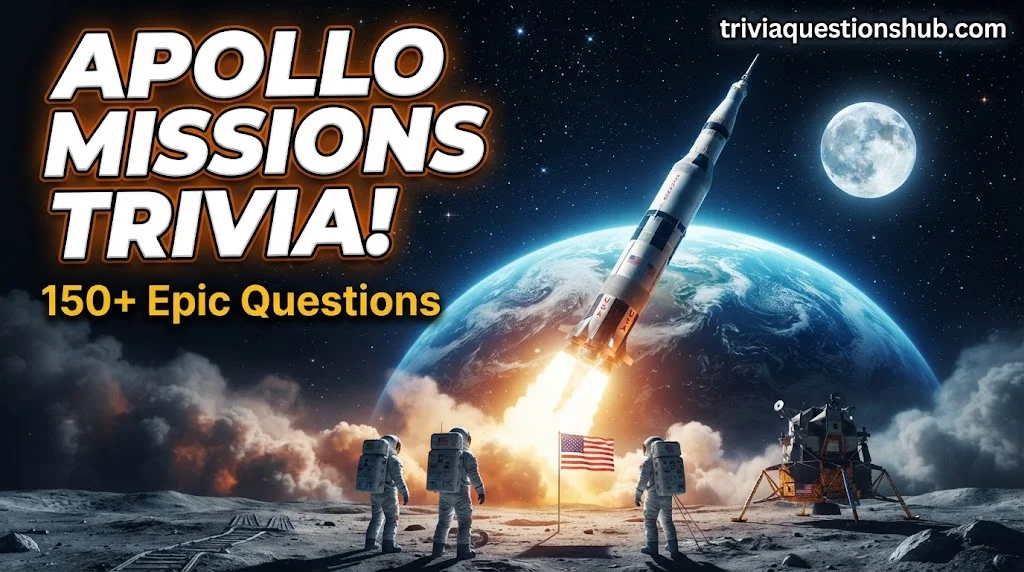
How well do you know the Apollo program? This Apollo missions trivia quiz has 150 numbered questions with short answers, from the space race to Apollo 17 and the Artemis return to the Moon.
The facts come from sources like NASA’s Apollo program page. It suits students, teachers, and space fans across the USA. Score yourself as you go: 0–50 is a Rookie, 51–100 is a Flight Controller, and 101–150 is a Mission Commander.
Table of Contents
Apollo Missions Trivia Questions: Space Race to Apollo 10

These first questions cover why Apollo began, the hardware, and the test flights before the landing.
Must visite:First Ladies Historical Trivia Questions: 150+ Challenging Questions for History Fans
- What does NASA stand for?
Answer: National Aeronautics and Space Administration. It was founded in 1958. - Which country launched the first satellite?
Answer: The Soviet Union. Sputnik 1 went up on October 4, 1957 and kicked off the space race. - Who was the first human in space?
Answer: Soviet cosmonaut Yuri Gagarin, on April 12, 1961. - Who was the first American in space?
Answer: Alan Shepard, on May 5, 1961, aboard Freedom 7. - Which US president set the goal of landing on the Moon?
Answer: John F. Kennedy. He announced it to Congress on May 25, 1961. - What was Kennedy’s goal for the Moon?
Answer: Land a man on the Moon and return him safely to Earth before the decade ended. - Which two programs came before Apollo?
Answer: Project Mercury and Project Gemini. - How many crewed flights did Project Gemini have?
Answer: Ten. Crews practiced docking, spacewalks, and long stays in orbit. - Why is the program called Apollo?
Answer: It’s named after the Greek god Apollo. NASA’s Abe Silverstein suggested the name. - How many crewed Apollo missions were there?
Answer: Eleven, from Apollo 7 to Apollo 17, according to NASA. - How many Apollo missions landed on the Moon?
Answer: Six: Apollo 11, 12, 14, 15, 16, and 17. - Which rocket carried Apollo astronauts to the Moon?
Answer: The Saturn V. It stood about 363 feet tall and made roughly 7.5 million pounds of thrust. - Who led the Saturn V design team?
Answer: Wernher von Braun, at NASA’s Marshall Space Flight Center in Huntsville, Alabama. - How many stages did the Saturn V have?
Answer: Three. Each one burned its fuel and dropped away. - Where did Apollo missions launch from?
Answer: Kennedy Space Center, Florida, from Launch Complex 39. - Where was Apollo mission control?
Answer: Houston, Texas, at the Manned Spacecraft Center. Today it’s called Johnson Space Center. - What is lunar orbit rendezvous?
Answer: One ship stays in lunar orbit while a small lander goes down and comes back. NASA chose this plan in 1962. - What were the three parts of the Apollo spacecraft?
Answer: The command module (CM), the service module (SM), and the lunar module (LM). - How many astronauts rode the lunar module to the surface?
Answer: Two. The third stayed in the command module. - Which company built the lunar module?
Answer: Grumman. - Who led the software team for the Apollo Guidance Computer?
Answer: Margaret Hamilton, at MIT’s Instrumentation Laboratory. - What happened to Apollo 1?
Answer: A cabin fire during a launch pad test on January 27, 1967 killed the crew. The mission was also called AS-204. - Who were the Apollo 1 astronauts?
Answer: Gus Grissom, Ed White, and Roger Chaffee. - What changed after the Apollo 1 fire?
Answer: NASA redesigned the hatch to open outward and used fire-resistant materials. It also stopped using pure oxygen on the pad. - What was Apollo 4?
Answer: The first all-up test of the Saturn V, uncrewed, in November 1967. - What was the goal of Apollo 5?
Answer: The first test flight of the lunar module, uncrewed, in January 1968. - What was Apollo 6?
Answer: The last uncrewed Saturn V test, in April 1968. It had engine trouble, and engineers fixed the issues. - Which Apollo mission was the first crewed flight?
Answer: Apollo 7, launched October 11, 1968, for a 10-day Earth-orbit test. - Who was the only astronaut to fly Mercury, Gemini, and Apollo?
Answer: Wally Schirra, who commanded Apollo 7. - Which Apollo mission first carried astronauts around the Moon?
Answer: Apollo 8, in December 1968. It was the first crewed trip to lunar orbit. - Who were the Apollo 8 astronauts?
Answer: Frank Borman, Jim Lovell, and William Anders. - How many times did Apollo 8 orbit the Moon?
Answer: Ten times, before returning to Earth on December 27, 1968. - Who took the famous Earthrise photo?
Answer: William Anders, from lunar orbit on Apollo 8. - What did the Apollo 8 crew read on Christmas Eve?
Answer: Verses from the Book of Genesis. Atheist activist Madalyn Murray O’Hair sued NASA over it, and the case was dismissed. - What did Apollo 9 test?
Answer: The full spacecraft in Earth orbit in March 1969. The lander was called Spider and the command ship Gumdrop. - Which Apollo 9 astronaut tested the moonwalk backpack in space?
Answer: Russell “Rusty” Schweickart. - Why was Apollo 10 called a dress rehearsal?
Answer: It tested every step of a landing except touching down, in May 1969. - Who flew on Apollo 10?
Answer: Thomas Stafford, John Young, and Eugene Cernan. - What were the Apollo 10 spacecraft nicknamed?
Answer: Snoopy for the lunar module and Charlie Brown for the command module. - How close did Apollo 10 come to the lunar surface?
Answer: About 9 miles (15 km).
Apollo 11 Moon Landing Trivia Questions and Answers

Apollo 11 is the most famous flight in NASA history. These questions cover the crew, the landing, and the surprises. Read more on NASA’s Apollo 11 page.
- Which Apollo mission successfully landed the first humans on the Moon?
Answer: Apollo 11. - Who were the astronauts on the Apollo 11 mission?
Answer: Neil Armstrong (commander), Buzz Aldrin (lunar module pilot), and Michael Collins (command module pilot). - When did Apollo 11 launch?
Answer: July 16, 1969, from Kennedy Space Center Pad 39A. - When did Apollo 11 land on the Moon?
Answer: July 20, 1969. - Where did Apollo 11 land?
Answer: The Sea of Tranquility on the Moon’s near side. - What was the Apollo 11 lunar module called?
Answer: Eagle. - What was the Apollo 11 command module called?
Answer: Columbia. - What did Armstrong say when Eagle landed?
Answer: “Houston, Tranquility Base here. The Eagle has landed.” - Who took the first step on the Moon?
Answer: Neil Armstrong, on the night of July 20 in US Eastern time. - What were Armstrong’s famous first words?
Answer: “That’s one small step for (a) man, one giant leap for mankind.” He meant to say “a man.” - Who stepped out second?
Answer: Buzz Aldrin, about 19 minutes after Armstrong. - Who stayed in lunar orbit?
Answer: Michael Collins, alone in Columbia. - Why are there so few photos of Armstrong on the Moon?
Answer: He carried the main camera. Most surface photos show Aldrin. - How long was the first moonwalk?
Answer: About 2 hours and 31 minutes. The crew spent nearly 22 hours on the surface in all. - How many moon rocks did Apollo 11 bring back?
Answer: About 47.5 pounds (21.5 kg) of lunar samples. - What does the Apollo 11 plaque say?
Answer: “We came in peace for all mankind.” It was left on the lander’s leg. - Did the crew plant a flag?
Answer: Yes. Aldrin later said the exhaust from Eagle’s liftoff knocked it over. - What experiments did Apollo 11 leave behind?
Answer: A seismometer and a laser retroreflector mirror. - Who was flight director during the landing?
Answer: Gene Kranz, in Houston mission control. - What was the 1202 alarm?
Answer: A computer overload warning during descent. Controllers judged it safe, and the landing went ahead. - Why did Armstrong fly Eagle by hand?
Answer: The autopilot was heading toward a boulder-filled crater. He steered past it. - How long did the whole Apollo 11 mission last?
Answer: About eight days. - How did the crew return to Earth?
Answer: They splashed down in the Pacific on July 24, 1969. The USS Hornet picked them up. - How long were the astronauts kept in quarantine?
Answer: 21 days, to guard against unknown Moon germs. - Who was US president during Apollo 11?
Answer: Richard Nixon. He spoke with the crew by radio-telephone while they stood on the Moon. - How many people watched the landing?
Answer: An estimated 600 million watched on TV around the world. - What was William Safire’s “In Event of Moon Disaster” speech?
Answer: A backup speech for Nixon in case the astronauts died. It was never needed. - What was Armstrong’s job before NASA?
Answer: He was a Navy pilot and a test pilot who flew the X-15 rocket plane. - Which Apollo 11 astronaut was nicknamed “Dr. Rendezvous”?
Answer: Buzz Aldrin. His MIT doctorate was about orbital rendezvous. - Did Michael Collins ever walk on the Moon?
Answer: No. He flew Apollo 11 and never left the command module. - What did Armstrong and Aldrin leave for lost space heroes?
Answer: A patch from Apollo 1 and medals honoring Yuri Gagarin and Vladimir Komarov. - Which Saturn V carried Apollo 11?
Answer: The one numbered AS-506. - What private ceremony did Aldrin hold on the Moon?
Answer: He quietly took communion inside Eagle. - What did Armstrong carry from the Wright brothers?
Answer: A small piece of wood and fabric from the 1903 Wright Flyer. - What was on the small silicon disc left on the Moon?
Answer: Goodwill messages from leaders of 73 countries. - What did Aldrin call the Moon’s landscape?
Answer: “Magnificent desolation.” - How far is the Moon from Earth?
Answer: About 238,900 miles (384,400 km) on average. - What happened to Eagle’s upper half?
Answer: The crew left the ascent stage in lunar orbit. Its final location is unknown. - Can scientists still bounce lasers off Apollo mirrors?
Answer: Yes. Researchers use the reflectors to measure the Moon’s distance. - How did Apollo 11 get off the Moon?
Answer: Eagle’s ascent engine fired and rejoined Columbia. Its descent stage stayed on the surface.
Apollo 12–17 NASA Trivia Questions: Missions and Astronauts

After Apollo 11, NASA got bolder. These questions cover the later landings, the rover, and the near-disaster of Apollo 13. For deeper reading, try the Apollo Lunar Surface Journal.
- Who flew on Apollo 12?
Answer: Pete Conrad, Alan Bean, and Richard Gordon, in November 1969. - What struck Apollo 12 at launch?
Answer: Lightning, twice. The crew and controllers recovered and kept going. - Where did Apollo 12 land?
Answer: The Ocean of Storms, close to the old Surveyor 3 probe. - What were the Apollo 12 spacecraft called?
Answer: Intrepid (lander) and Yankee Clipper (command ship). - What did Apollo 12 bring home from Surveyor 3?
Answer: Parts of the probe, including its camera, for study. - How did Alan Bean ruin the TV camera?
Answer: He pointed it at the Sun, and the tube burned out. - Who flew on Apollo 13?
Answer: Jim Lovell, Jack Swigert, and Fred Haise, launched April 11, 1970. - Who was replaced on Apollo 13?
Answer: Ken Mattingly. He was exposed to measles, so Swigert took his seat. - What went wrong on Apollo 13?
Answer: An oxygen tank exploded in the service module about 56 hours into the flight. - What was the famous line from Apollo 13?
Answer: “Houston, we’ve had a problem.” - How did the crew survive?
Answer: They used the lunar module Aquarius as a lifeboat. The command module was Odyssey. - Did Apollo 13 land on the Moon?
Answer: No. The crew looped around the Moon and splashed down safely on April 17, 1970. - What record did Apollo 13 set?
Answer: It carried humans farther from Earth than ever before, about 248,000 miles. - How did the crew fix the carbon dioxide problem?
Answer: They built an adapter from spare parts, tape, and cardboard, guided by Houston. - Did Gene Kranz say “failure is not an option”?
Answer: No. A screenwriter wrote it for the 1995 film Apollo 13. Kranz later used it as his book title. - Which book inspired the Apollo 13 movie?
Answer: Lost Moon by Jim Lovell and Jeffrey Kluger. Tom Hanks starred in the film. - Who flew on Apollo 14?
Answer: Alan Shepard, Edgar Mitchell, and Stuart Roosa, in early 1971. - Where did Apollo 14 land?
Answer: The Fra Mauro highlands. The lander was Antares and the command ship Kitty Hawk. - What sport did Shepard play on the Moon?
Answer: Golf. He swung a makeshift club and hit two balls. - What were “Moon trees”?
Answer: Trees grown from seeds Roosa carried around the Moon in orbit. - How old was Shepard on the Moon?
Answer: 47, making him the oldest person to walk on it. - Who flew on Apollo 15?
Answer: David Scott, Alfred Worden, and James Irwin, in July 1971. - What was new on Apollo 15?
Answer: The first Lunar Roving Vehicle, an electric moon buggy. - Where did Apollo 15 land?
Answer: Near Hadley Rille, a long winding valley. - What is the Genesis Rock?
Answer: A moon rock about four billion years old, found on Apollo 15. - What did Scott drop on live TV?
Answer: A hammer and a feather. Both fell at the same speed, proving Galileo right. - What is the Fallen Astronaut figurine?
Answer: A small aluminum statue left on the Moon. It honors 14 astronauts and cosmonauts who died in spaceflight. - What did Worden do on the way home?
Answer: He made the first deep-space spacewalk to retrieve film. - Who flew on Apollo 16?
Answer: John Young, Ken Mattingly, and Charles Duke, in April 1972. - Where did Apollo 16 land?
Answer: The Descartes Highlands, the first landing in the lunar highlands. - Who is the youngest person to walk on the Moon?
Answer: Charles Duke, at age 36. - What did Mattingly finally do on Apollo 16?
Answer: He flew to the Moon, two years after missing Apollo 13. - What did Duke leave on the surface?
Answer: A photo of his family. - What were the Apollo 16 spacecraft called?
Answer: Orion (lander) and Casper (command ship). - Who flew on Apollo 17?
Answer: Eugene Cernan, Ronald Evans, and Harrison Schmitt, in December 1972. - Who was the last person to walk on the Moon?
Answer: Eugene Cernan, on December 14, 1972. - Who was the only scientist to walk on the Moon?
Answer: Harrison Schmitt, a geologist. - What was special about the Apollo 17 launch?
Answer: It was the only night launch of a Saturn V. - Where did Apollo 17 land?
Answer: The Taurus-Littrow valley. - What surprising soil did Schmitt find?
Answer: Orange volcanic glass near a crater named Shorty. - What is the “Blue Marble” photo?
Answer: A picture of the whole Earth taken by the Apollo 17 crew on the way to the Moon. - What records did Apollo 17 set?
Answer: The longest Moon stay (about 75 hours) and the biggest sample haul, roughly 243 pounds. - What were the Apollo 17 spacecraft called?
Answer: Challenger (lander) and America (command ship). - Which Apollo missions were cancelled?
Answer: Apollo 18, 19, and 20, dropped in 1970 to save money. - How many people have walked on the Moon?
Answer: Twelve, all Americans. See the full list on NASA’s moonwalkers page.
Apollo Program Legacy and Artemis Trivia Questions
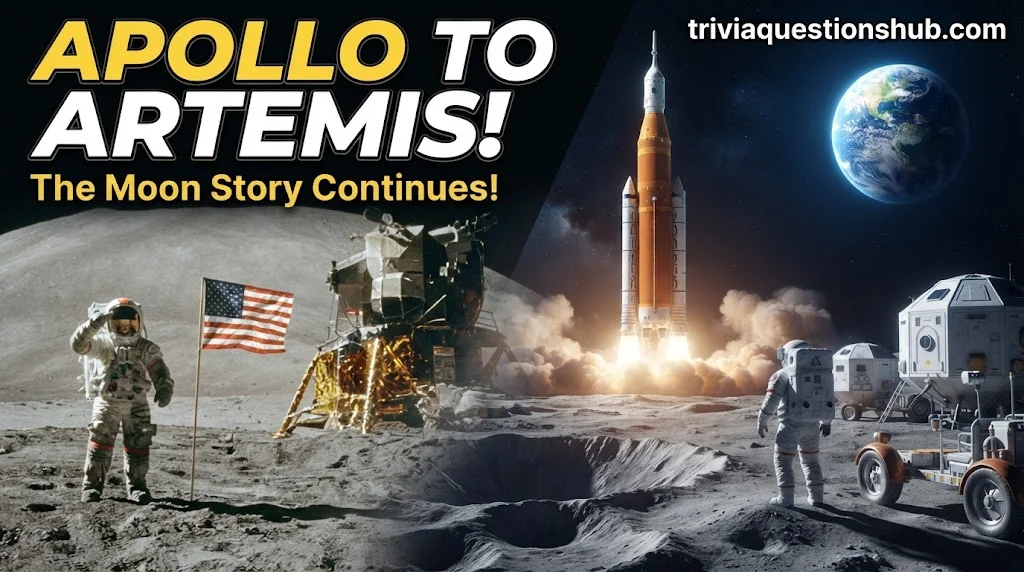
The last group covers what Apollo cost, what it left behind, and how NASA is heading back to the Moon.
- How much did the Apollo program cost?
Answer: About $25.4 billion at the time. That is well over $150 billion in today’s money. - How many people worked on Apollo?
Answer: About 400,000 engineers, technicians, and scientists. - How much moon rock did Apollo bring back?
Answer: About 842 pounds (382 kg) across six missions. - Where are most Apollo samples kept?
Answer: The Lunar Sample Laboratory at Johnson Space Center in Houston. - How fast is the Moon drifting away?
Answer: About 1.5 inches (3.8 cm) a year, measured with Apollo mirrors. - What was the Apollo-Soyuz Test Project?
Answer: A 1975 US-Soviet docking in orbit. Stafford and cosmonaut Alexei Leonov shook hands in space. - What was Skylab?
Answer: America’s first space station, launched in 1973 on a Saturn V. - What was the last Saturn V launch?
Answer: Skylab, on May 14, 1973. - How did Katherine Johnson help?
Answer: The NASA mathematician calculated flight paths for early missions and helped with Apollo work. - Who was Deke Slayton?
Answer: The astronaut who chose Apollo crews. He finally flew in space on Apollo-Soyuz in 1975. - How much memory did the Apollo Guidance Computer have?
Answer: Roughly 4 KB of working memory. Your phone has millions of times more. - What everyday tech did Apollo help push?
Answer: Cordless power tools and integrated circuits, among many other NASA spinoffs. - What did astronauts leave on the Moon?
Answer: Flags, rovers, lander bases, cameras, golf balls, and bags of waste. Some call it the astronaut junkyard. - How many US flags stand on the Moon?
Answer: Six, one per landing, planted from 1969 to 1972. - Was the Moon landing faked?
Answer: No. Independent labs studied the rocks, and the retroreflectors still work. - What photographed the landing sites from orbit?
Answer: NASA’s Lunar Reconnaissance Orbiter, launched in 2009. It shows tracks and hardware. - How many people have flown to the Moon?
Answer: 24, on Apollo 8 and Apollos 10 through 17. - Who flew to the Moon twice?
Answer: Jim Lovell, John Young, and Eugene Cernan. - Why is the new program called Artemis?
Answer: In Greek myth, Artemis is Apollo’s twin sister. - What was Artemis II?
Answer: A 2026 crewed flight around the Moon. The crew was Reid Wiseman, Victor Glover, Christina Koch, and Jeremy Hansen of Canada. - What is a key Artemis goal?
Answer: Landing the first woman and first person of color on the Moon. - What rocket and capsule does Artemis use?
Answer: The Space Launch System (SLS) rocket and the Orion spacecraft. - Where does NASA plan to land Artemis crews?
Answer: Near the Moon’s south pole, where ice may be hidden. - Why does Apollo still matter?
Answer: It proved humans can travel to another world. It also drove advances in computers, materials, and engineering. - How long since a human last stood on the Moon?
Answer: More than 53 years, since December 1972.
FAQs
Which Apollo mission first carried astronauts around the Moon?
Apollo 8 did, in December 1968. Frank Borman, Jim Lovell, and William Anders orbited the Moon ten times and returned safely.
Which Apollo mission successfully landed the first humans on the Moon?
Apollo 11 did, on July 20, 1969. The lander Eagle touched down in the Sea of Tranquility.
Who were the astronauts on the Apollo 11 mission?
Neil Armstrong, Buzz Aldrin, and Michael Collins. Armstrong and Aldrin walked on the Moon while Collins stayed in orbit.
What was the main goal of the American Apollo space program?
The main goal was to land a man on the Moon and return him safely to Earth, as John F. Kennedy set out in 1961. NASA also aimed to lead in space, explore the Moon scientifically, and learn to work there.
Conclusion
Apollo took just over a decade, and 12 people walked on the Moon. Now Artemis is picking up the story.Want more trivia? Try the quizzes at Space.com, FunTrivia, and ProProfs, or read History Hit’s Apollo facts.

Abroy Sohail is the founder and lead content writer at TriviaQuestionsHub.com. Passionate about trivia, general knowledge, and helping readers learn something new every day, Abroy curates and writes engaging quiz content for readers of all ages.